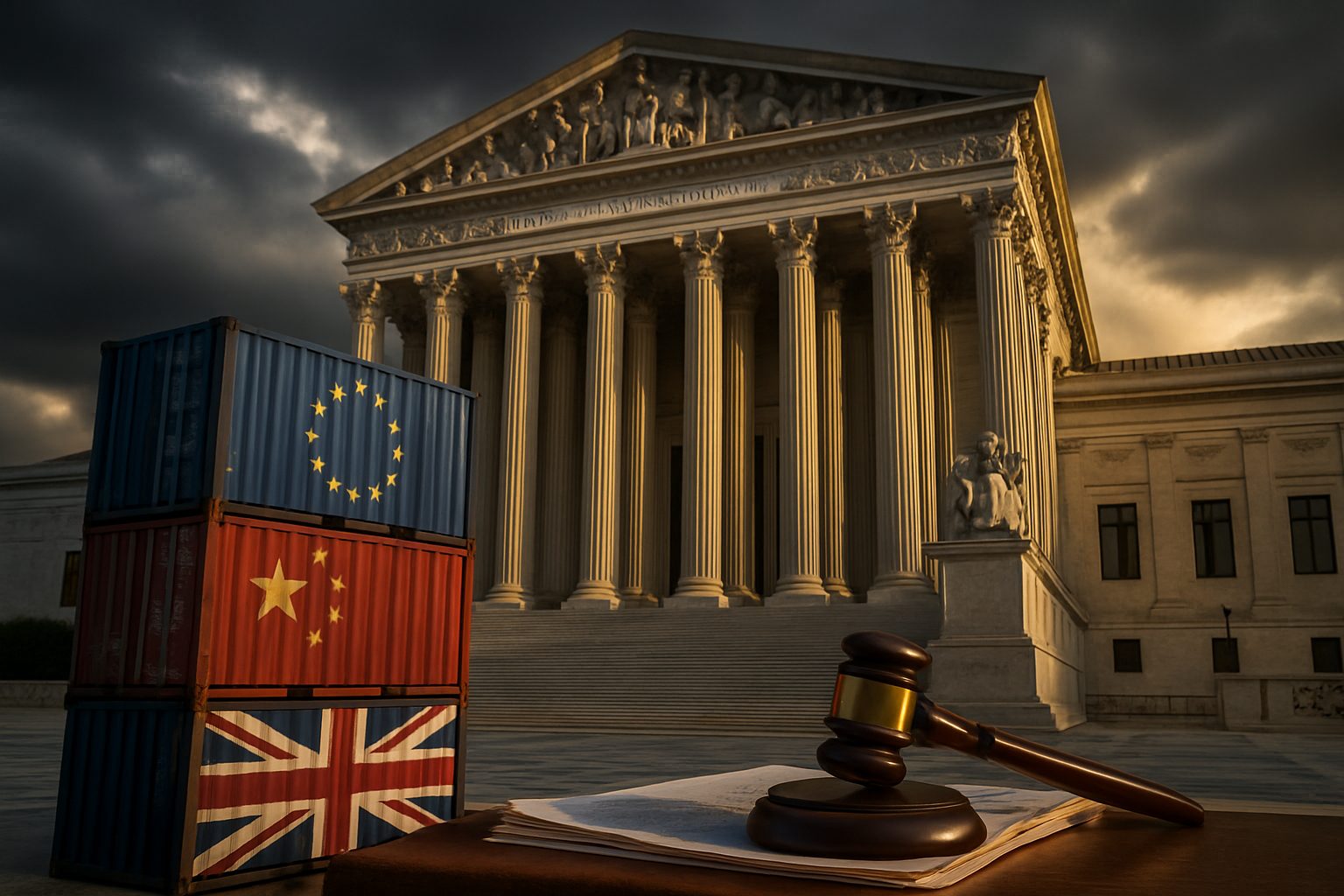
The United States Supreme Court delivered a devastating 6-3 ruling Friday that struck down President Trump's comprehensive global tariff program, triggering the most serious constitutional crisis since Watergate and prompting unprecedented international reactions as the European Union prepares to suspend its trade agreement with Washington.
Chief Justice John Roberts authored the historic majority opinion, applying the "major questions doctrine" to declare that the International Emergency Economic Powers Act (IEEPA) "does not authorize president to impose tariffs" without explicit congressional authorization for actions of "vast economic and political significance." The ruling represents the first major defeat of Trump's economic agenda in his second term and establishes crucial precedent limiting presidential emergency powers for trade policy.
Trump's Unprecedented Constitutional Defiance
Within hours of the ruling, President Trump launched the most severe attack on the federal judiciary by a sitting president in modern American history, calling the justices "absolutely ashamed," "a disgrace to our nation," and "disloyal to the Constitution." Trump immediately escalated to 15% global tariffs using Section 122 of the Trade Act of 1974—the maximum legal level allowed for 150 days—in direct defiance of the Court's constitutional directive.
This immediate alternative tariff implementation represents the most serious executive-judicial confrontation since the Watergate crisis, testing the fundamental separation of powers that underpins American democracy. Legal scholars note that while previous presidents have criticized Supreme Court decisions, Trump's contemptuous tone and immediate defiance through alternative legal authorities is unprecedented in scope and constitutional implications.
"The Court decision made presidential trade powers more powerful and crystal clear"
— President Donald Trump, responding to the ruling
European Union's Historic Response
The European Parliament is preparing to "freeze" implementation of the EU-US trade agreement today following an emergency meeting to address the constitutional crisis. Bernd Lange, chairman of the European Parliament's International Trade Committee and a German Social Democrat, announced Sunday that he would call for suspending the agreement during the extraordinary session.
Representatives from major parliamentary groups confirmed their support for this unprecedented step to AFP on Monday. The European Commission had previously demanded that the United States honor commitments made in the 2025 joint declaration on trade relations, with officials declaring "an agreement is an agreement" after weekend talks between EU Trade Commissioner Valdis Dombrovskis, US Trade Representative Katherine Tai, and Commerce Secretary Howard Lutnick.
This marks the first time the European Union has considered suspending a major trade agreement with the United States due to concerns about American institutional stability and policy predictability.
Global Market Disruption and Economic Fallout
Financial markets initially surged on hopes of reduced trade uncertainty—the Nasdaq gained 0.90% to 22,886.07 and the S&P 500 rose 0.69% to 6,090 points—but gains moderated significantly when Trump announced the replacement 15% tariffs. Oil prices jumped over $1 per barrel as energy markets reflected the renewed trade tensions.
The ruling creates massive administrative challenges as potentially billions of dollars in tariff refunds may be owed to US importers who have paid approximately $200 billion since Trump's return to office. German businesses are already calculating massive refund claims, while Trump predicted the refunds would be "tied up in court for years."
The US Customs and Border Protection agency announced it would halt collection of IEEPA-based tariffs starting Tuesday at 12:01 AM Eastern Time, more than three days after the Supreme Court ruling, with no explanation provided for the delay or information about refund procedures.
International Diplomatic Fallout
China welcomed the Supreme Court ruling as vindication of its position, strengthening Beijing's negotiating stance ahead of Trump's scheduled March 31-April 2 visit to Beijing. Chinese officials noted the decision validates their long-standing argument that unilateral tariff measures violate international trade law principles.
Taiwan moved swiftly to seek clarification from Washington, as the legal reset raised questions about whether tariff exemptions negotiated under the existing Taiwan-US trade framework would remain valid. The ruling prompted concerns across Asia about the stability of bilateral trade arrangements with the United States.
Canada's Trade Minister welcomed the tariff reduction but warned of "considerable uncertainty" ahead, reflecting broader allied concerns about American policy predictability. This comes after the House of Representatives passed legislation 219-211 to end Canada tariffs, with six Republican defections representing the first significant bipartisan rebuke of Trump's trade authority in his second term.
Constitutional and Legal Implications
The Supreme Court's application of the "major questions doctrine" creates a higher bar for executive branch economic policy implementation without explicit congressional authorization. The ruling strengthens institutional checks and balances during an era of expanded executive power, demonstrating that constitutional limits remain enforceable through judicial review even with politically aligned appointees.
Trump's new 15% tariff framework under Section 122 of the Trade Act of 1974 affects all countries except USMCA partners, with exemptions for minerals, fertilizers, metals, energy equipment, agricultural products, pharmaceuticals, and medical materials. However, constitutional experts predict immediate legal challenges to this alternative authority, questioning whether the statutory framework can support such broad trade restrictions.
The 150-day limitation on Section 122 tariffs creates urgent pressure for congressional approval or alternative policy approaches, setting up a constitutional showdown between executive authority and congressional trade oversight.
Congressional Resistance Vindicated
The Supreme Court ruling vindicated congressional opposition to Trump's expansive use of emergency powers for economic objectives. House Speaker Mike Johnson was unable to prevent the floor vote on Canada tariffs despite intense White House pressure, highlighting growing Republican anxiety about the administration's unpredictable trade approach.
The six Republican defections on the Canada tariff vote—the first major bipartisan rebuke of Trump's trade policies in his second term—demonstrated that institutional opposition to expanded presidential trade authority extends beyond party lines. Several additional Republicans reportedly considered joining the opposition but ultimately remained loyal to the administration.
Trade Effectiveness Called Into Question
Despite extensive tariff policies implemented since Trump's return to office, the US trade deficit reached $901.5 billion annually as of December 2025, essentially unchanged from pre-tariff levels. This demonstrates the structural nature of trade imbalances that extend beyond what tariff adjustments alone can address.
The persistence of the trade deficit despite comprehensive tariff measures raises fundamental questions about the effectiveness of unilateral trade tools in addressing complex global economic relationships. January 2026 employment data showed strength with 130,000 jobs added versus 55,000 forecast and unemployment declining to 4.3%, suggesting economic performance independent of trade interventions.
Global Governance at a Crossroads
The crisis occurs within a broader context of global governance challenges, including the recent expiration of the New START treaty—marking the first time in over 50 years that the United States and Russia operate without nuclear arms control constraints—and ongoing tensions with China over trade and territorial disputes.
European officials are privately concerned about the precedent this constitutional crisis sets for American moral authority and institutional reliability in international relationships. The coordinated European response suggests allies are prepared to take concrete diplomatic action to preserve sovereignty principles within the NATO framework.
Success or failure in resolving this constitutional crisis will influence international approaches to economic policy coordination, democratic institution effectiveness, and multilateral cooperation frameworks essential for addressing transnational challenges in the 21st century.
Looking Ahead: Critical 150-Day Window
The coming 150 days represent a critical period for American constitutional governance and international relations. Trump must either secure congressional approval for his tariff policies or find alternative approaches that respect both constitutional limitations and international law obligations.
The stakes extend far beyond trade policy to encompass fundamental questions about democratic institutional resilience, rule of law enforcement, and the credibility of international cooperation mechanisms. The resolution of this crisis will establish precedents for presidential power limitations that will affect future administrations for generations.
As international observers monitor American institutional resilience as a crucial factor for global cooperation, the world watches to see whether the United States can navigate this constitutional crisis while maintaining the policy predictability essential for stable international relationships. The template established by this confrontation between executive power and judicial oversight will likely influence democratic governance approaches worldwide in an era of increasing authoritarian challenges to institutional norms.