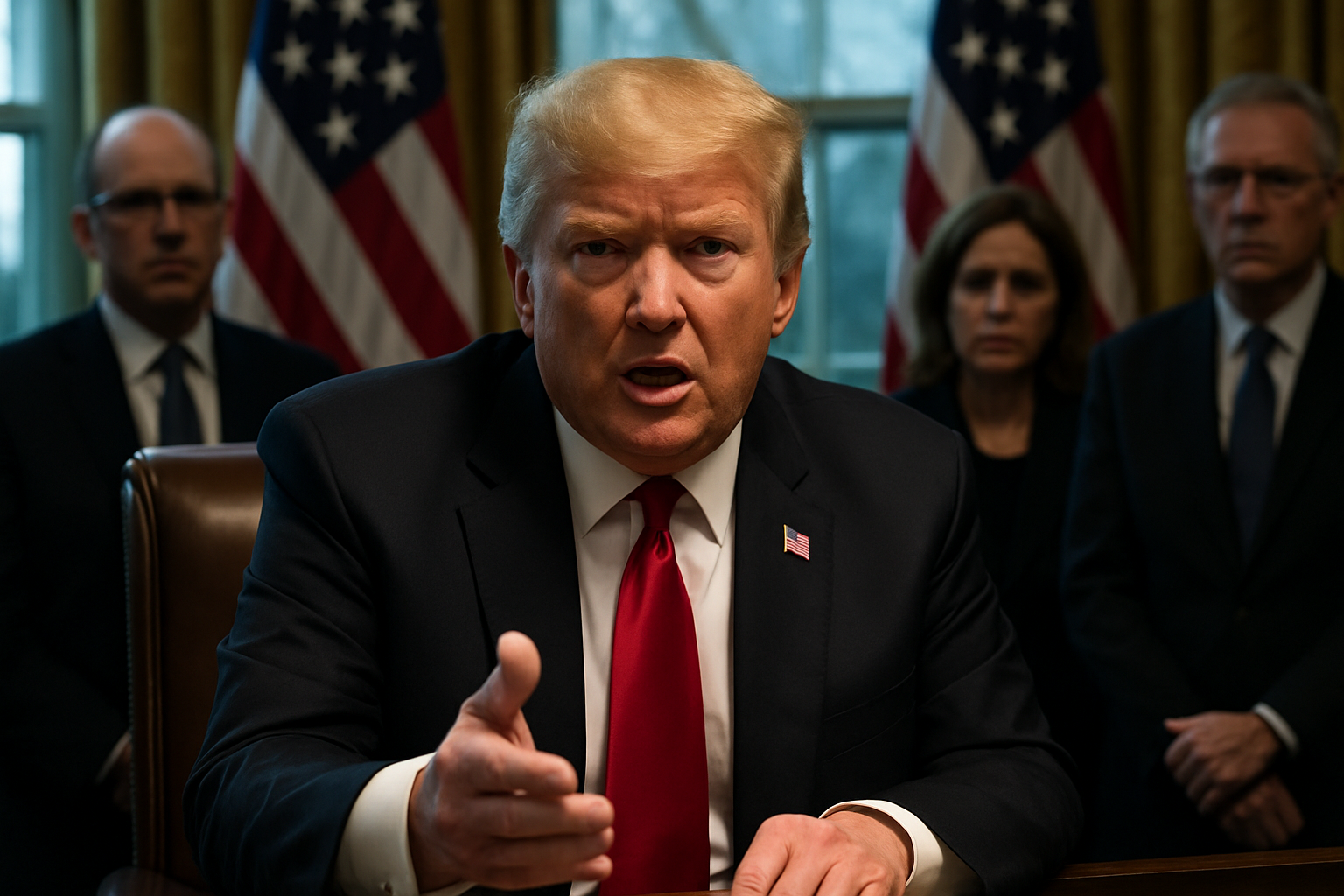
President Donald Trump has escalated threats against Iran, warning he "expects to be bombing" the country if ongoing ceasefire talks fail, while confirming that Vice President JD Vance is preparing to travel to Pakistan for what could be the final round of diplomatic negotiations.
The stark warning comes as the historic two-week ceasefire, brokered by Pakistan just 88 minutes before Trump's "whole civilization will die tonight" deadline on April 8, approaches its Wednesday expiration amid growing uncertainty about Iran's willingness to participate in continued talks.
"I don't want to do that. We don't have that much time," Trump told CNBC when asked about extending the truce. "I expect to be bombing because I think that's a better attitude to go in with. But we're ready to go. I mean, the military is raring to go."
Pakistan's Historic Mediation Under Threat
The current diplomatic crisis threatens to unravel what has been described as the most significant middle-power mediation success in decades. Pakistani Prime Minister Shehbaz Sharif and Field Marshal Asim Munir achieved the breakthrough through an innovative "message relay system" when direct US-Iran communication proved impossible.
Their "Islamabad Accord" framework triggered an immediate 20% crash in oil prices from $119.50 to below $100 per barrel and ended an aviation crisis that had cancelled 18,000+ flights globally. The ceasefire also led to the partial reopening of the Strait of Hormuz, which handles 40% of global oil transit.
"I think we're going to end up with a great deal. I think we're in a very strong negotiating position."
— Donald Trump, U.S. President
However, reports suggest uncertainty about whether Iran will actually participate in the proposed second round of talks. Iranian state television has denied that any official delegation is en route to Pakistan, while Foreign Ministry spokesperson Esmaeil Baghaei stated Iran has "no plans for further negotiations with the US" citing a lack of trust.
Nuclear Sticking Points Remain Unresolved
The core disagreement that led to the collapse of previous 21-hour marathon negotiations in Islamabad remains unchanged. The United States demands that Iran commit to not seeking nuclear weapons development and suspend its 60% uranium enrichment program, while Iran maintains its position that it will "never abandon enrichment even if war is imposed," according to Foreign Minister Abbas Araghchi.
Iran currently possesses over 400kg of weapons-grade uranium material, sufficient for multiple nuclear weapons if weaponized, according to expert assessments. This crisis unfolds against the backdrop of the New START treaty's expiration in February 2026, marking the first time in over 50 years that the world lacks US-Russia nuclear constraints.
The Lebanon Loophole
Adding complexity to the diplomatic landscape is what analysts term the "Lebanon loophole." Israeli Prime Minister Benjamin Netanyahu explicitly excluded Lebanon from the Pakistan-mediated ceasefire, creating what Iranian officials describe as an "unbridgeable gap." Israeli strikes killed 254+ people in a single day during previous talks, with 1.2 million Lebanese displaced.
Iran has consistently threatened to withdraw from broader regional talks unless there is comprehensive ceasefire enforcement on all fronts. Vice President Vance previously acknowledged this as a "legitimate misunderstanding" by Iran, though the US never agreed to include Israeli-Lebanon operations in the ceasefire scope.
Global Economic Stakes
The failure of diplomatic efforts threatens to reverse the massive economic relief that followed the initial ceasefire breakthrough. Major shipping companies including Maersk and MSC have suspended Persian Gulf operations, leaving over 150 tankers stranded with billions of dollars worth of cargo.
Iran continues to implement a cryptocurrency payment system requiring $1 per barrel for oil tankers transiting the Strait of Hormuz, representing a dramatic shift in maritime commerce protocols. While the first ships successfully navigated during the ceasefire, vessel owners remain reluctant to send additional tankers for fear of stranding if the framework collapses.
Consumer impacts are already being felt globally, with Bangladesh maintaining fuel rationing for 170 million people, Pakistan continuing wartime austerity measures, and European households facing potential heating cost increases if the crisis escalates.
Regional Coalition Under Maximum Strain
The unprecedented regional coalition of Saudi Arabia, UAE, Qatar, and Egypt that has supported diplomatic solutions faces its greatest test. During the height of the crisis, Iran's "Operation True Promise 4" caused casualties across the region: one killed in Abu Dhabi, 32 injured at Kuwaiti airports, and eight wounded in Qatar despite Patriot missile interceptions.
Egyptian President Abdel Fattah el-Sisi's previous warnings about "comprehensive chaos among sisterly countries" appear increasingly prophetic as diplomatic failures mount. The coalition's preservation depends on successful conflict resolution, making the coming negotiations critical not just for US-Iran relations but for regional stability.
Congressional Opposition Mounts
Trump faces unprecedented domestic opposition to military action, with only 25% of Americans supporting Operation Epic Fury according to recent polls—a historically low level of support for military operations. The operation has already cost $11.3 billion in its first week, with Pentagon projections extending through September far beyond initial 4-6 week estimates.
"I'm more concerned than ever about the deployment of ground troops."
— Senator Richard Blumenthal
International allies have also largely rejected military escalation. UK Prime Minister Keir Starmer has declared Britain "will not be dragged into Iran war," while France and Germany emphasize diplomatic approaches. Only Israel has offered full support for US military operations, with Netanyahu providing "close coordination."
Template-Setting Moment for 21st Century Diplomacy
UN Secretary-General António Guterres has described the current crisis as the "greatest test of multilateral cooperation in the modern era." The stakes extend far beyond bilateral US-Iran relations, affecting global energy security, nuclear governance credibility, and international law enforcement mechanisms for decades to come.
Pakistan's emergence as a crucial mediator demonstrates that middle-power diplomacy can bridge major adversaries when traditional mechanisms fail. The success or failure of this mediation will establish precedents for whether diplomatic innovation or military confrontation becomes the preferred approach to 21st-century international crises.
The Naval Blockade Factor
Complicating diplomatic efforts is the ongoing US naval blockade of Iranian ports, which Iran considers an act of war under international law. The Islamic Revolutionary Guard Corps maintains "complete control" of the Strait of Hormuz and has threatened a "deadly whirlpool" for any military vessels challenging Iranian sovereignty.
Recent naval incidents, including the US seizure of Iranian cargo vessel M/V Touska in the Gulf of Oman, have added further tensions to diplomatic efforts. Iran has threatened "swift retaliation against armed piracy," highlighting how military actions continue to complicate peace efforts.
Critical 48-Hour Window
As the ceasefire deadline approaches, the coming 48 hours represent a critical juncture for global stability. The failure of Pakistan's historic mediation could return the world to what many analysts consider the most dangerous crisis since the end of the Cold War.
The humanitarian toll has already been severe, with Iranian Red Crescent reporting 787+ civilian casualties, including a Pentagon-confirmed elementary school strike that killed 165-185 students due to "outdated targeting data." International evacuations have reached Arab Spring scales, with Australia evacuating 115,000 people and Germany 30,000.
With nuclear risks at their highest level in decades and energy markets volatility threatening global economic stability, the success or failure of diplomatic innovation in the coming hours will determine whether the international community can bridge fundamental disagreements through negotiation or whether military confrontation becomes the dominant paradigm for resolving territorial and nuclear disputes in the 21st century.
The template-setting significance of these negotiations extends far beyond the immediate crisis, potentially affecting energy architecture evolution, nuclear proliferation mechanisms, and international stability frameworks for generations to come.