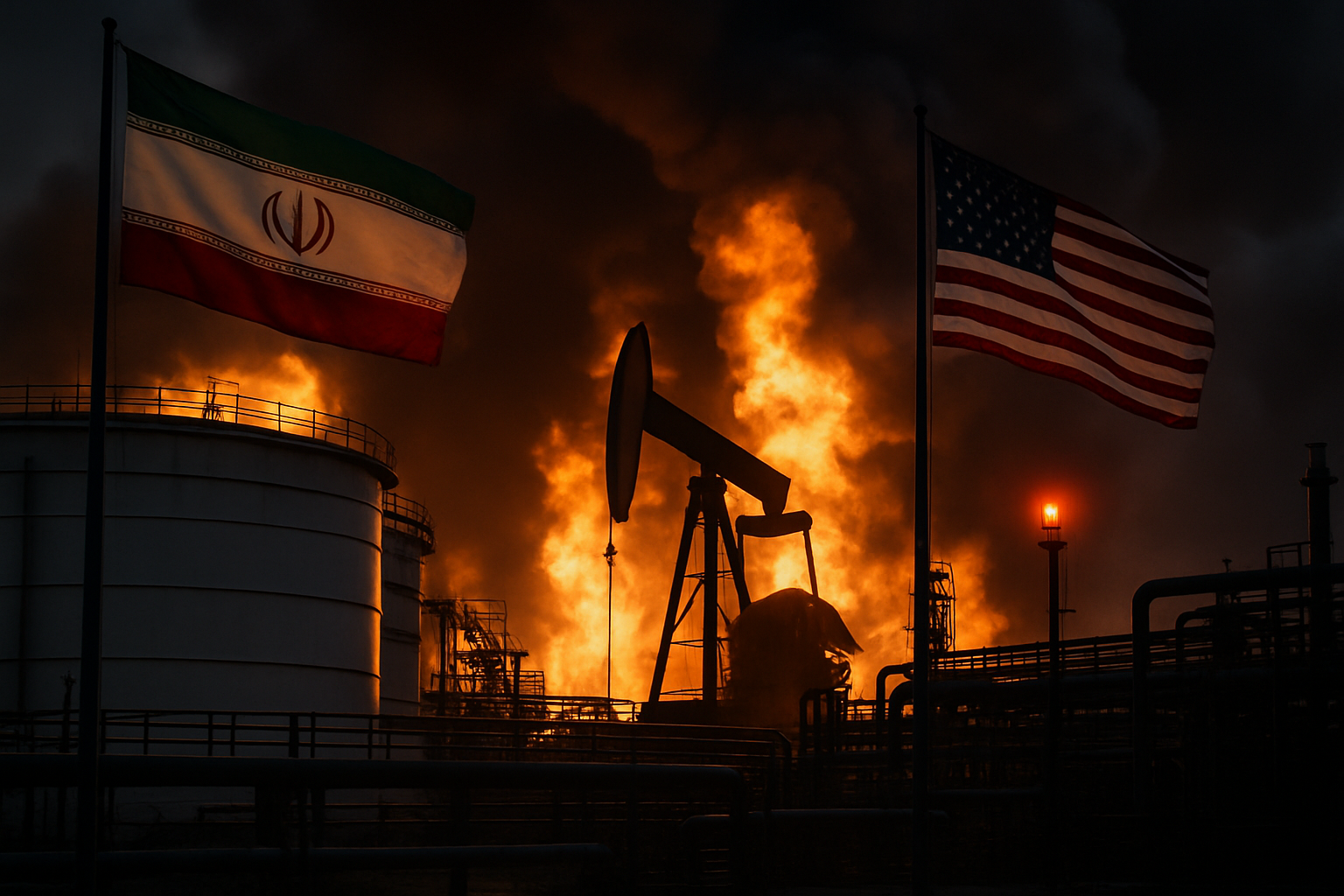
President Donald Trump issued an unprecedented threat to "massively blow up" Iran's South Pars gas field—the world's largest natural gas reserve—if Tehran continues its attacks on energy infrastructure in neighboring Gulf states, marking the most dangerous escalation in the three-week-old Iran-Middle East war.
The stark warning comes after Iran launched retaliatory missile strikes against Qatar's Ras Laffan LNG complex on March 19, responding to Israeli attacks on the same South Pars field shared between Iran and Qatar. The escalating energy war has sent oil prices soaring past $110 per barrel and threatens to fundamentally reshape global energy security.
Energy Infrastructure Becomes Primary Battlefield
Trump's threat, delivered via Truth Social, represented the most direct U.S. warning yet regarding Iran's energy assets. "ISRAEL WILL NOT CONDUCT FURTHER ATTACKS relative to the South Pars Gas Field unless Iran decides to strike a totally innocent party, in this case Qatar," Trump wrote, before adding his devastating ultimatum: "In which instance the United States of America, with or without the help or consent of Israel, will massively blow up the entirety of the South Pars Gas Field at an amount of strength and power that Iran has never seen or witnessed before."
The South Pars/North Dome field, straddling the Iran-Qatar maritime border, contains approximately 14 trillion cubic meters of natural gas and supplies roughly 70% of Iran's domestic gas needs while also serving Qatar's massive LNG export industry. The field produces approximately 20% of global LNG exports, making it critical to European and Asian energy supplies.
"This is a historic moment for energy warfare in the 21st century. We're witnessing the weaponization of critical infrastructure on an unprecedented scale."
— Energy Security Expert at the International Energy Agency
Iran's Regional Energy Campaign
Iranian forces dramatically expanded their targeting beyond traditional military sites, launching coordinated attacks across the Gulf region's energy infrastructure. Revolutionary Guard forces struck Qatar's Ras Laffan Industrial City—processing approximately one-fifth of global gas supply—causing "extensive damage and sizeable fires," according to QatarEnergy officials.
The attacks extended to multiple countries: Saudi Arabia intercepted four ballistic missiles targeting Riyadh and repelled drone attacks on gas facilities; the UAE suspended operations at its Habshan gas facility after debris from intercepted missiles fell in the area; and Kuwait's National Guard destroyed several drones and UAVs targeting energy installations.
Iran's Islamic Revolutionary Guard Corps declared "no red lines remain," with military officials warning that all economic centers cooperating with the United States would become "legitimate targets" under their expanded "Operation True Promise 4."
Trump Distances U.S. from Israeli Strike
In an apparent attempt to limit American culpability for the escalation, Trump claimed the United States "had no prior knowledge" of Israel's strike on the South Pars field, describing it as Israel having "violently lashed out" in anger. The statement contradicted earlier reports from Axios and the Wall Street Journal, citing U.S. and Israeli officials, that suggested the attack was coordinated between the Israeli Prime Minister's office and the White House.
Trump also categorically exonerated Qatar, stating the nation "was not involved in any way, shape or form, nor did it have any idea it was going to happen." This diplomatic positioning appears designed to justify potential U.S. retaliation while maintaining regional coalition support.
Global Energy Crisis Deepens
The energy war has triggered the most severe global crisis since the COVID-19 pandemic. Oil prices have surged to $110+ per barrel, with Brent crude reaching $119.50 and WTI at $108.15. The International Energy Agency announced the largest strategic petroleum reserve release in its 50-year history—400 million barrels from 32 countries—double the amount released during the 2022 Ukraine crisis.
Natural gas prices exploded 24% in Europe and 78% in the United States, while Iran's mining of the Strait of Hormuz with an estimated 2,000-6,000 naval mines has effectively closed the waterway that handles 40% of global seaborne oil transit. Over 150 oil and LNG tankers worth billions in cargo remain stranded in the Persian Gulf.

Regional Coalition Under Severe Strain
The unprecedented attacks on energy infrastructure have severely tested the Saudi-UAE-Qatar-Egypt coalition that initially supported diplomatic solutions to the Iran nuclear crisis. Egyptian President Abdel Fattah el-Sisi condemned Iranian attacks on "sisterly Arab countries," warning of "comprehensive chaos" spreading across the region.
Qatar took the dramatic step of expelling Iranian military and security attachés from its embassy in Doha, ordering them to leave within 24 hours. The Foreign Ministry cited "repeated Iranian targeting and brutal aggression" against Qatar's sovereignty as a "flagrant violation of international law."
Kuwait has arrested 10 Hezbollah operatives allegedly plotting attacks on "vital installations," marking the second such operation this week. The Gulf state has also activated a new mobile alert system to warn residents of potential attacks on energy infrastructure.
Aviation Industry in Crisis
The conflict has created the most severe aviation disruption since COVID-19, with over 18,000 flights cancelled worldwide. Eight Middle Eastern countries have simultaneously closed their airspace, severing crucial Europe-Asia flight corridors. Dubai International Airport—the world's busiest with 86 million passengers annually—remains shut down from missile damage.
Major carriers including Emirates, Air France-KLM, and Wizz Air have suspended operations indefinitely, while airlines worldwide have implemented emergency fuel surcharges as jet fuel costs jumped from $85-90 per barrel to $150-200.
Intelligence Contradictions and Diplomatic Breakdown
The energy war escalation comes amid contradictory U.S. intelligence assessments about the original justifications for military action. Director of National Intelligence Tulsi Gabbard told the Senate Intelligence Committee that Iran was not attempting to rebuild nuclear enrichment facilities destroyed in previous strikes, contradicting Trump's claims that sparked the current conflict.
The crisis emerged from the complete collapse of Geneva nuclear negotiations in February 2026, despite achieving what diplomats called "broad agreement on guiding principles"—the most progress since the JCPOA's collapse in 2018. The fundamental scope disagreement proved insurmountable, with Iran demanding nuclear-only talks while the U.S. insisted on comprehensive agreements covering ballistic missiles, regional proxies, and human rights.
International Response and Coalition Fractures
Foreign ministers from 13 countries, meeting in an emergency session in Riyadh, strongly condemned Iranian attacks and called for an immediate halt to hostilities. However, traditional U.S. allies have shown reluctance to join military operations, with Japan and Australia rejecting American requests to send warships to help secure the Strait of Hormuz.
European nations have deployed naval assets to protect Cyprus after Iranian drones struck RAF Akrotiri—the first attack on European territory since World War II. HMS Dragon leads a coalition including Spanish, Italian, French, Dutch, and Greek vessels in an unprecedented European naval response.
The Ayatollah's Death and Succession Crisis
The current escalation stems from the March 1 death of Iran's Supreme Leader Ali Khamenei in U.S.-Israeli strikes, ending his 37-year rule. His son, Mojtaba Khamenei, has emerged as the successor in the first hereditary transition in the Islamic Republic's history, with the Revolutionary Guards consolidating unprecedented military control over governance.
Intelligence officials report that Ali Larijani, Iran's top security chief and considered the "de facto leader" during the succession crisis, was killed along with his son and aide in targeted Israeli airstrikes on March 18, further destabilizing Iran's leadership structure.
Economic Warfare and Supply Chain Disruption
The targeting of energy infrastructure has exposed the vulnerability of global supply chains dependent on Gulf logistics networks. Manufacturing in automotive, electronics, and textiles sectors faces severe disruption, while Pakistan's stock exchange recorded its largest single-day decline in history at -8.97%.
The Persian Gulf, serving as a critical Asia-Europe trade hub, has become completely compromised, forcing a fundamental reconsideration of global supply chain resilience and reducing over-dependence on strategic chokepoints like the 21-mile-wide Strait of Hormuz.
"We're witnessing the collapse of the post-World War II energy architecture. This crisis will reshape global energy security for decades to come."
— UN Secretary-General António Guterres
Congressional Opposition Mounts
The conflict faces mounting bipartisan opposition in Congress, with only 25% of Americans supporting the military operations according to recent polling. Senator Richard Blumenthal expressed being "more concerned than ever" about potential ground troop deployments, while financial markets are emerging as what analysts call the "ultimate constraint" on further escalation.
Operation Epic Fury has cost $11.3 billion in its first week alone, with the Pentagon planning operations through September—far beyond the Trump administration's initial 4-6 week timeline. The conflict has resulted in 150 U.S. troops wounded and 3 confirmed deaths.
Humanitarian Crisis and War Crimes Allegations
The Iran Red Crescent reports over 787 civilian casualties from U.S.-Israeli strikes, while the Pentagon has confirmed responsibility for an elementary school attack that killed 165-185 students using what officials called "outdated targeting data." International human rights organizations are demanding Geneva Conventions investigations into potential war crimes.
Lebanon has recorded 968 fatalities from Israeli attacks as Hezbollah joined the conflict, while approximately 832,000 people have been displaced. The systematic targeting of medical personnel has resulted in 26 paramedics killed and 51 wounded.
Nuclear Governance in Crisis
The conflict occurs amid a broader nuclear governance crisis, with the New START treaty expiring in February 2026—the first time in over 50 years without U.S.-Russia nuclear constraints. Combined with China's nuclear expansion, UN officials warn that nuclear risks are at their "highest in decades."
Iran continues enriching uranium at 60% purity with over 400 kilograms of weapons-grade material—sufficient for multiple nuclear weapons if weaponized. The breakdown of diplomatic engagement after the Geneva framework's collapse has eliminated near-term prospects for negotiated solutions.
Template-Setting Crisis for 21st Century
UN Secretary-General António Guterres has called the March 2026 crisis "the greatest test of multilateral cooperation and crisis management in the modern era." The rapid transition from diplomatic breakthrough to military escalation demonstrates what experts describe as the fragility of crisis management in the multipolar era.
The stakes extend far beyond the Middle East, affecting regional war prevention, global energy security, nuclear governance credibility, and international law enforcement mechanisms. Success in containing the crisis could provide a diplomatic template for future nuclear disputes, while failure may accelerate military solutions globally, encouraging proliferation and undermining diplomatic credibility worldwide.
Looking Ahead: Energy Security's New Reality
The Iran-Middle East energy war represents a watershed moment for international relations, with implications extending decades beyond the current conflict. The targeting of critical energy infrastructure has fundamentally altered calculations about economic warfare, forcing nations to reconsider energy security architecture and supply chain resilience.
As Trump's ultimatum hangs over the world's most important gas field, the international community faces its most dangerous crisis since the Cold War's end. The decisions made in the coming days and weeks will determine whether diplomatic or military solutions become the preferred approach for resolving 21st-century territorial and nuclear disputes, reshaping the post-World War II international order's sustainability.
With oil prices continuing to surge, global aviation networks paralyzed, and energy infrastructure under direct attack, the world watches as the Middle East's energy war threatens to fundamentally transform the global economy and international security architecture for generations to come.