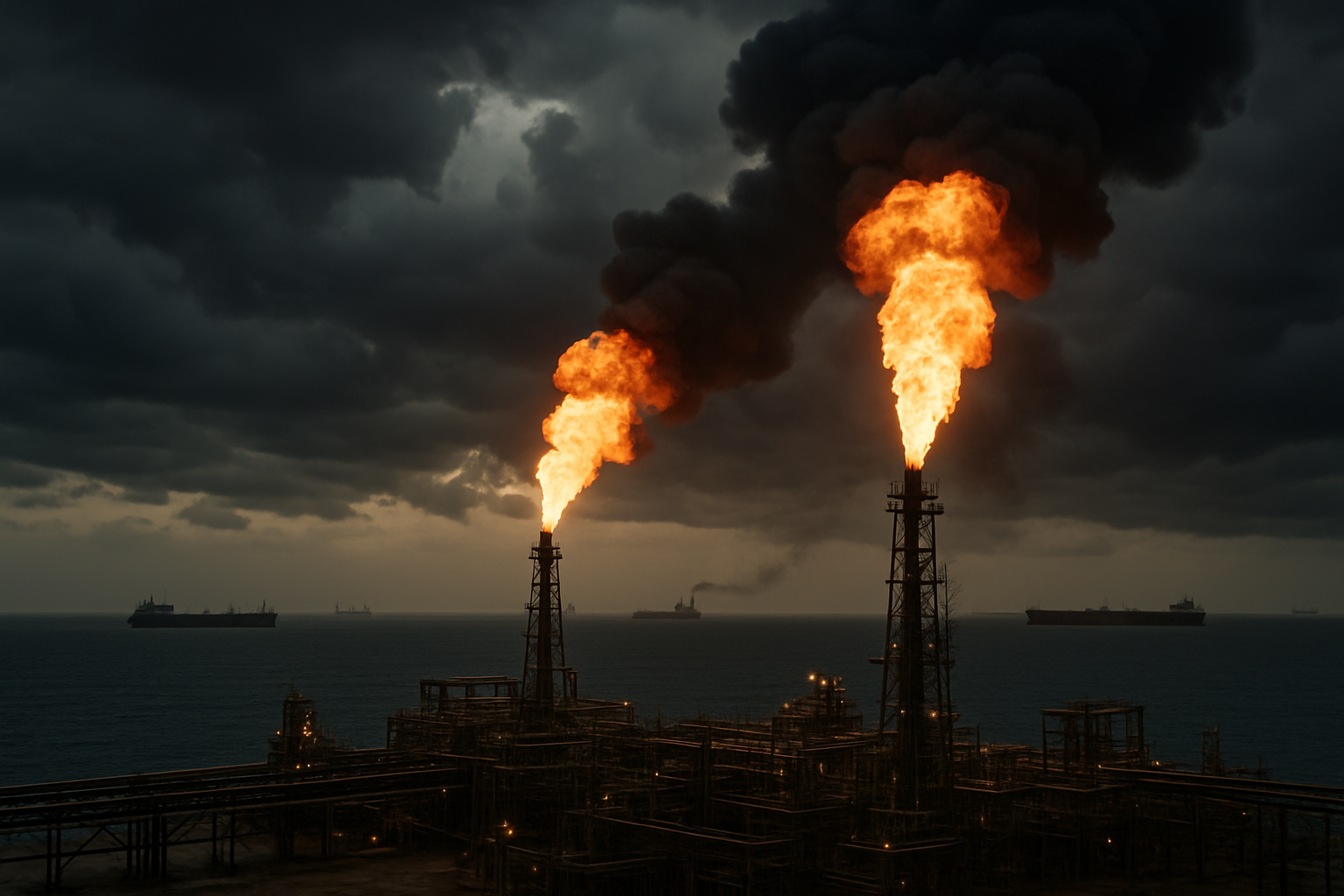
President Donald Trump issued his most explicit threat yet against Iran's energy infrastructure, pledging to "massively blow up the entirety" of the world's largest natural gas field if Tehran continues attacks against Qatar, as Pentagon officials seek an unprecedented $200 billion emergency war budget from Congress.
The stark warning, delivered via social media Wednesday night, marked a dramatic escalation in the three-week conflict that has already emerged as the most dangerous international crisis since the Cold War ended. Trump's threat targets Iran's South Pars gas field, which supplies approximately 70% of Iran's natural gas production and represents 20% of global LNG exports.
Unprecedented Military Funding Request
According to Romanian sources citing senior administration officials, the Pentagon has formally requested approval from the White House for a Congressional funding package exceeding $200 billion to support ongoing operations against Iran. The request represents the largest emergency military appropriation in recent history and faces certain resistance from lawmakers opposed to the expanding conflict.
Operation Epic Fury has already consumed $11.3 billion in its first week alone, making it the most expensive military operation since the 2003 Iraq invasion. Pentagon officials are now planning operations through September 2026, far beyond the initial four-to-six week timeline suggested by the White House.
Cycle of Retaliation Intensifies
The latest threats emerged following Iran's devastating retaliation against Gulf energy infrastructure under "Operation True Promise 4." Iranian Revolutionary Guard forces struck Qatar's Ras Laffan LNG complex, causing extensive damage to facilities handling 20% of global LNG exports. The attacks came in direct response to Israeli strikes that "completely destroyed" Iran's South Pars gas field earlier Wednesday.
Qatar responded by expelling Iran's military and security attachés within 24 hours, marking a complete diplomatic rupture between the Gulf state and Tehran. The escalation has transformed what began as a bilateral Iran-Israel conflict into a regional war threatening global energy security.
"Will massively blow up entirety of South Pars Gas Field at amount of strength and power Iran has never seen if Qatar attacked again."
— Donald Trump, President
The South Pars field, shared between Iran and Qatar, contains the world's largest natural gas reserves. Any successful attack on the facility would cripple Iran's energy sector while potentially affecting Qatar's own production capabilities.
Global Energy Crisis Reaches Critical Phase
Oil prices have surged past $110 per barrel for the first time since 2022, with Brent crude reaching $119.50 and West Texas Intermediate hitting $108.15 in an unprecedented 18.98% single-day jump. The International Energy Agency announced its largest strategic petroleum reserve release in 50 years, mobilizing 400 million barrels from 32 countries.
Iran's deployment of an estimated 2,000-6,000 naval mines throughout the Strait of Hormuz has effectively closed the critical waterway that handles 40% of global seaborne oil transit. Over 150 oil tankers remain stranded in the Persian Gulf, carrying billions of dollars in cargo.
The aviation industry faces its worst crisis since COVID-19, with more than 18,000 flights cancelled worldwide as eight Middle Eastern countries maintain simultaneous airspace closures. Dubai International Airport, the world's busiest with 86 million annual passengers, remains shuttered following missile damage.
Congressional Opposition Mounts
The massive funding request faces significant hurdles in Congress, where bipartisan lawmakers are demanding comprehensive answers about strategy, costs, and the potential deployment of ground troops. Senator Richard Blumenthal expressed being "more concerned than ever" about the possibility of boots on the ground.
Public support for the conflict remains historically low at just 25%, creating political constraints for continued escalation. Financial markets have emerged as what analysts describe as the "ultimate constraint" on prolonged military action, with global stock exchanges experiencing severe volatility.
Regional Coalition Under Extreme Strain
The unprecedented diplomatic consensus among Saudi Arabia, UAE, Qatar, and Egypt that initially supported diplomatic solutions has crumbled under Iranian retaliation targeting member territories. Egypt's President Abdel Fattah el-Sisi condemned attacks on "sisterly Arab countries," warning of "comprehensive chaos" spreading across the region.
The UAE confirmed one civilian death from Iranian attacks on Abu Dhabi, while Kuwait reported 32 injuries from drone strikes on its international airport. Qatar intercepted 65 missiles and 12 drones using Patriot systems but still suffered eight injuries from falling debris.
Nuclear Diplomacy Collapse Context
The current crisis stems from the complete breakdown of US-Iran nuclear negotiations, despite achieving "broad agreement on guiding principles" in Geneva talks - the most diplomatic progress since the 2018 JCPOA collapse. The talks foundered on fundamental scope disagreements, with Iran excluding ballistic missiles and regional proxies as "red lines" while the US demanded comprehensive agreements covering missiles, armed groups, and human rights.
Iran continues uranium enrichment at 60% purity with over 400 kilograms of weapons-grade material - sufficient for multiple nuclear weapons if weaponized. The nuclear governance crisis has been compounded by the February expiration of the New START treaty, marking the first time in over 50 years without US-Russia nuclear constraints.
European Territory Attacked
In an unprecedented escalation, Iranian drones struck RAF Akrotiri in Cyprus - the first attack on European territory since World War II. The assault prompted an emergency naval coalition response featuring HMS Dragon, Spanish frigates, and vessels from Italy, France, Netherlands, and Greece protecting the Eastern Mediterranean.
The European Union activated its ESTIA crisis mechanism for Cyprus for the first time in the bloc's history, reflecting the conflict's expansion beyond traditional Middle Eastern boundaries.
Humanitarian Crisis Mounts
The Iran Red Crescent reports over 787 civilian casualties from US-Israeli strikes, including a Pentagon-confirmed attack on an elementary school that killed 165-185 students using "outdated targeting data." The incident has drawn international condemnation and demands for Geneva Conventions investigations.
International evacuations have reached levels not seen since the 2011 Arab Spring, with Australia reporting 115,000 nationals trapped in the region and Germany evacuating 30,000 citizens. Multiple European countries have ordered immediate evacuations from Iran citing "extremely uncertain" security conditions.
Iranian Leadership Transition
Following the confirmed death of Supreme Leader Ali Khamenei on March 1, Iran faces its first hereditary succession in Islamic Republic history. Mojtaba Khamenei, the former leader's son, has been appointed as the new Supreme Leader, with CIA assessments suggesting unprecedented Revolutionary Guard control over military governance.
The transition from clerical to military leadership during active warfare represents a fundamental shift in Iranian governance structure, with defense officials claiming the new leader has been "wounded and likely disfigured" from ongoing strikes.
Template-Setting Crisis for 21st Century
UN Secretary-General António Guterres has called the crisis "the greatest test of multilateral cooperation in the modern era." The rapid transition from diplomatic breakthrough to military confrontation demonstrates the fragility of crisis management in the multipolar era.
The stakes extend far beyond the Middle East, affecting global energy security architecture, nuclear governance credibility, international law enforcement mechanisms, and setting precedents for diplomatic versus military solutions to 21st-century conflicts.
"This is the most dangerous international crisis since the Cold War ended, with implications extending decades beyond current events."
— Senior International Relations Expert
Energy Architecture Transformation Required
The crisis has exposed dangerous over-dependence on strategic chokepoints, requiring fundamental restructuring to reduce geopolitical volatility. The 21-mile Strait of Hormuz represents a single-point failure for modern logistics with no viable alternatives, demonstrating the vulnerability of global systems to geopolitical shocks.
Supply chains for automotive, electronics, and textile manufacturing face severe disruption due to dependence on Gulf logistics networks. The Persian Gulf's role as a critical Asia-Europe trade hub has been completely compromised, affecting worldwide economic stability.
As the conflict enters its third week, Trump's threat against Iran's largest gas field represents a potential point of no return in what has already become the most consequential international crisis in decades. The Pentagon's historic funding request underscores the administration's commitment to prolonged military action, while Congressional opposition and international reluctance suggest significant challenges ahead.
The coming days will likely determine whether this crisis can be contained as a regional confrontation or will escalate into a broader Middle Eastern war with global implications extending far beyond current events, fundamentally altering international approaches to conflict resolution and energy security for the 21st century.