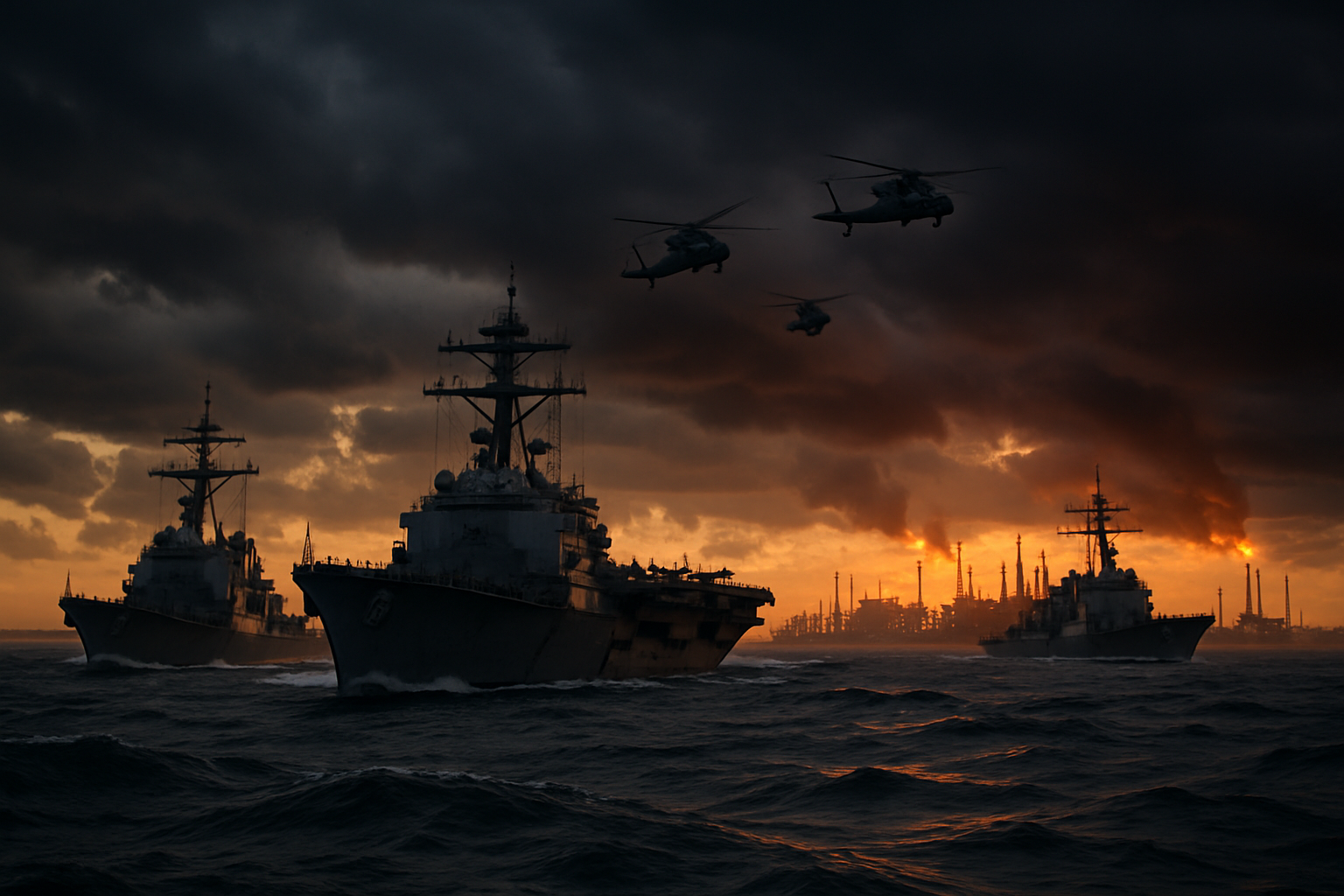
President Donald Trump has escalated tensions with Iran to unprecedented levels, threatening to "completely obliterate" Iran's critical Kharg Island oil facility while Iran implements new tariffs and shipping restrictions in the Strait of Hormuz, creating what UN Secretary-General António Guterres calls "the greatest test of multilateral cooperation in the modern era."
The latest developments mark a dangerous new phase in the month-long conflict between the US-Israeli coalition and Iran, with global implications extending far beyond the Middle East. Trump's threats against Kharg Island, which processes approximately 90% of Iran's crude oil exports worth 1.6 million barrels per day, represent the most direct assault on Iran's economic lifeline since the crisis began.
Trump's Most Explicit Infrastructure Threats
In a series of statements that have shocked international observers, President Trump declared his intention to "completely obliterate all of their Electric Generating Plants, Oil Wells and Kharg Island (and possibly all desalinization plants!)" if Iran fails to reopen the Strait of Hormuz. The threats mark a significant escalation from previous military-focused targets to civilian infrastructure that would constitute potential war crimes under international law.
"I don't think they want the consequences of not making a deal. We could take it very easily if we wanted to take the oil in Iran."
— Donald Trump, President of the United States
Secretary of State Marco Rubio reinforced the administration's position, telling Al Jazeera that the Strait of Hormuz "will reopen one way or another," while maintaining that Trump still prefers diplomatic solutions despite the military escalation. However, sources indicate that the President has been actively considering ground operations to seize control of Iranian oil facilities, comparing the potential action to US operations in Venezuela.
Iran's Economic Warfare Response
Iran has responded to US threats by implementing unprecedented economic measures, including the introduction of tariffs on vessels transiting the Strait of Hormuz. Iran's Parliamentary Security Committee approved legislation establishing "sovereignty" over the strategic waterway, including provisions for collecting transit fees and imposing restrictions on American and Israeli vessels.
The Iranian Revolutionary Guard has deployed an estimated 2,000-6,000 naval mines throughout the 21-mile strait, effectively closing a chokepoint that handles 40% of global seaborne oil transit. This action has stranded over 150 oil tankers worth billions in cargo, while major shipping companies Maersk and MSC have suspended operations indefinitely.
Iran's Operation True Promise 4 has maintained its "no red lines remain" policy, with systematic attacks across the region resulting in casualties in the UAE (1 killed), Kuwait (32 injured), and Qatar (8 injured). The death of Iranian Navy Commander Rear Admiral Alireza Tangsiri, described by Israel as "directly responsible for blocking the Strait of Hormuz," has further escalated tensions.
Global Economic Devastation
The crisis has triggered the most severe global energy emergency since the 1970s oil shocks. Oil prices have surged past $100 per barrel for the first time since 2022, with Brent crude reaching a peak of $119.50 and analysts warning prices could hit $200 if the crisis continues.
The International Energy Agency (IEA) has implemented its largest strategic petroleum reserve release in 50 years, coordinating the release of 400 million barrels from 32 countries - double the amount released during the 2022 Ukraine crisis. Japan has contributed 80 million barrels, marking its first such release since the 2011 Fukushima disaster.
The aviation industry faces unprecedented disruption, with over 18,000 flights cancelled worldwide - the most severe crisis since COVID-19. Dubai International Airport, the world's busiest with 86 million annual passengers, remains shuttered due to missile damage, while eight Middle Eastern countries have simultaneously closed their airspace, severing crucial Asia-Europe flight corridors.
Diplomatic Initiatives and Pakistani Mediation
Amid the escalating crisis, Pakistan has emerged as a crucial mediator, with Foreign Minister Ishaq Dar confirming that his country is facilitating "indirect talks" between the US and Iran through a "message relay system." The US has shared a 15-point peace proposal that Iran is currently deliberating, though Iranian officials have set five stringent counter-conditions.
"The United States has shared 15 points, being deliberated upon by Iran. We are ready to host meaningful talks between the two sides for comprehensive and lasting settlement."
— Ishaq Dar, Pakistani Foreign Minister
Iran's conditions include complete cessation of military aggression, concrete guarantees against future attacks, full war damage reparations, and recognition of Iranian sovereignty over the Strait of Hormuz. However, Iranian President Masoud Pezeshkian has rejected Trump's demands for "unconditional surrender" as "dreams they should take to their grave."
Regional Coalition Under Strain
The unprecedented regional coalition of Saudi Arabia, UAE, Qatar, and Egypt that initially supported diplomatic solutions is now severely strained by Iranian retaliation targeting their territories. Egyptian President Abdel Fattah el-Sisi has condemned attacks on "sisterly countries" and warned of "comprehensive chaos" if the conflict expands further.
European allies have largely rejected Trump's demands for naval coalition support in the Strait of Hormuz, with German Defense Minister Boris Pistorius asking, "What does Donald Trump expect a handful of European frigates to do that the powerful US Navy cannot?" However, the first Iranian attack on European territory since World War II - drone strikes on RAF Akrotiri in Cyprus - prompted an unprecedented European naval response.
Operation Epic Fury: Historic Military Costs
The US-Israeli Operation Epic Fury has become the largest coordinated military campaign since the 2003 Iraq invasion, with costs reaching $11.3 billion in the first week alone. The deployment of dual aircraft carriers USS Gerald R. Ford and USS Abraham Lincoln represents approximately one-third of the active US Navy fleet concentrated in the region.
American casualties have reached historic levels for a Middle East operation, with 150 troops wounded (8 critically) and 3 confirmed deaths. The USS Charlotte submarine achieved a historic milestone by sinking the Iranian frigate IRIS Dena - the first enemy vessel destroyed by a US submarine since World War II.
Nuclear Implications and Succession Crisis
The crisis occurs amid a broader nuclear governance breakdown, with the New START treaty having expired in February 2026 - the first time in over 50 years without US-Russia nuclear constraints. Iran continues uranium enrichment at 60% purity with over 400kg of weapons-grade material, sufficient for multiple nuclear weapons if weaponized.
Adding to the complexity is Iran's constitutional crisis following Supreme Leader Ali Khamenei's death on March 1. His son, Mojtaba Khamenei, has emerged as the favored successor in what would be the Islamic Republic's first hereditary succession, with the Revolutionary Guard consolidating unprecedented military control over governance during the active warfare.
Congressional Opposition Mounts
Domestic opposition to the conflict has reached historically unprecedented levels, with only 25% of Americans supporting the military action. Senator Richard Blumenthal expressed being "more concerned than ever" about potential ground troop deployment, while the Pentagon has extended operations through September, far beyond the initially planned 4-6 week timeline.
The financial markets have become what analysts describe as the "ultimate constraint" on prolonged conflict, with Pakistan's KSE-100 suffering its largest single-day decline in history at -8.97%, and South Korea's KOSPI falling 12% before circuit breakers halted trading.
Humanitarian Crisis and International Evacuations
The humanitarian toll continues to mount, with Iran's Red Crescent reporting over 787 civilian casualties from US-Israeli strikes. The Pentagon has confirmed responsibility for an elementary school strike that killed between 165-185 students due to "outdated targeting data," prompting war crimes investigations and calls from 46 Democratic senators for a full inquiry.
International evacuations have reached a scale not seen since the Arab Spring of 2011, with Australia reporting 115,000 citizens trapped and Germany evacuating 30,000 nationals. The EU has activated its ESTIA crisis mechanism for the first time in the bloc's history following the Cyprus attack.
Energy Architecture Transformation Imperative
The crisis has exposed fundamental vulnerabilities in global energy architecture, with the 21-mile Strait of Hormuz representing a single point of failure for modern logistics systems. Energy experts warn that the over-dependence on strategic chokepoints requires fundamental restructuring to reduce geopolitical volatility.
Consumer impacts are being felt worldwide, with Bangladesh implementing fuel rationing for 170 million people, Pakistan enforcing wartime austerity measures including four-day work weeks, and European nations implementing emergency price controls to prevent profiteering as gasoline approaches €2 per liter in some regions.
Template-Setting Crisis for the 21st Century
UN Secretary-General António Guterres has characterized the situation as "the greatest test of multilateral cooperation in crisis management in the modern era." The rapid transition from diplomatic breakthrough to military confrontation demonstrates the fragility of crisis management in the multipolar era.
The stakes extend far beyond the immediate regional conflict, affecting global energy security, nuclear governance credibility, and international law enforcement mechanisms. Success in containing the crisis could provide a framework for future nuclear dispute resolution, while failure may accelerate military solutions over diplomatic ones for decades to come.
"This is a watershed moment for international relations, determining whether diplomatic or military solutions become the precedent for 21st-century conflict resolution."
— António Guterres, UN Secretary-General
As March 30, 2026 marks Day 31 of this historic crisis, the world watches to see whether Pakistani mediation can bridge the fundamental disagreements between Washington's comprehensive demands and Tehran's red lines, or whether the most dangerous international crisis since the Cold War will continue to escalate with global implications extending decades beyond current events.
The coming days will determine not only the immediate fate of Middle Eastern stability but also establish precedents for energy security architecture, nuclear proliferation responses, and the effectiveness of multilateral cooperation in managing 21st-century geopolitical crises.