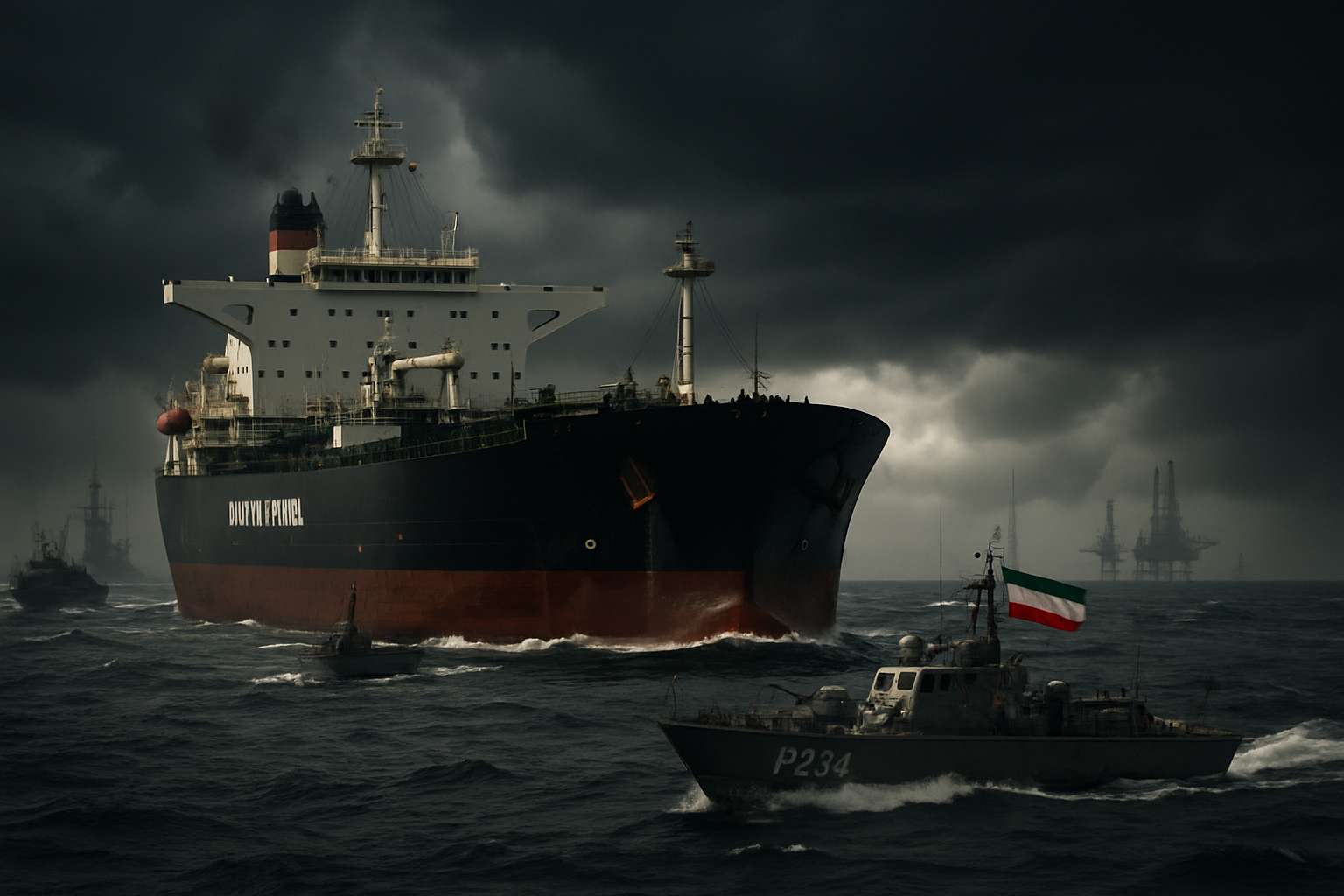
President Donald Trump issued his most explicit threat yet against Iran's vital energy infrastructure on Monday, warning he will "completely obliterate" the country's main oil export hub at Kharg Island if diplomatic negotiations don't progress rapidly.
Trump's escalatory rhetoric, delivered via Truth Social, marks a dangerous new phase in the ongoing Middle East conflict that has already lasted over a month and triggered the most severe global crisis since the Cold War. The President threatened to destroy "all of their Electric Generating Plants, Oil Wells and Kharg Island (and possibly all desalinization plants!)" if Iran fails to reopen the strategically vital Strait of Hormuz.
Kharg Island: Iran's Economic Lifeline
Kharg Island represents Iran's most critical economic asset, processing approximately 90% of the country's crude oil exports - roughly 1.6 million barrels per day. Located just 21 miles off Iran's coast in the Persian Gulf, the island serves as Iran's primary oil terminal and a strategic chokepoint for global energy markets.
According to intelligence assessments, a US ground operation to seize control of the energy hub would put American troops within range of Iranian missiles and drones, significantly escalating military risks. The facility's destruction would devastate Iran's ability to export oil and generate revenue for its war effort.
"Great progress is being made, but if for any reason a deal is not reached shortly, which it probably will be, and if the Hormuz Strait is not immediately 'open for business,' we will conclude our lovely 'stay' in Iran by blowing up and completely obliterating all of their electric generating plants, oil wells and Kharg Island."
— Donald Trump, Truth Social
Month of Unprecedented Global Disruption
The conflict, which began with strikes on Iranian territory in early March, has created cascading global crises across multiple sectors. Over 18,000 flights have been cancelled worldwide - the most severe aviation disruption since COVID-19 - as eight Middle Eastern countries maintain simultaneous airspace closures.
Dubai International Airport, the world's busiest with 86 million passengers annually, remains shuttered due to missile damage. Major carriers including Emirates, Air France-KLM, and Wizz Air have suspended operations indefinitely, stranding hundreds of thousands of travelers globally.
Energy Markets in Crisis
Oil prices have surged past $100 per barrel for the first time since 2014, with warnings they could reach $200 if the crisis continues. Iran's mining of the Strait of Hormuz with an estimated 2,000-6,000 naval mines has effectively closed the waterway that carries 40% of global seaborne oil transit.
The International Energy Agency has authorized the largest strategic petroleum reserve release in its 50-year history - 400 million barrels from 32 countries - in an attempt to stabilize markets. Natural gas prices have spiked 24% in Europe and 78% in the United States, while Qatar has halted LNG production that represents 20% of global exports.
Over 150 oil and LNG tankers worth billions of dollars remain stranded in the Persian Gulf, with major shipping companies Maersk and MSC suspending operations in the region.
Military Escalation Reaches Historic Scale
Operation Epic Fury, the coordinated US-Israeli military campaign, has become the largest Middle East operation since the 2003 Iraq invasion. Costs have reached $11.3 billion in the first week alone, with Pentagon operations now planned through September - far beyond the initial 4-6 week timeline.
The US has deployed dual aircraft carrier groups - the USS Gerald R. Ford and USS Abraham Lincoln - representing approximately one-third of the active US Navy fleet. This marks the first confirmed American casualties in the conflict, with 3 service members killed and 150 wounded, including 8 in critical condition.
In a historic naval engagement, the USS Charlotte submarine sank the Iranian frigate IRIS Dena near Sri Lanka, killing over 80 crew members - the first enemy vessel destroyed by a US submarine since World War II.
Iranian Retaliation Targets Regional Allies
Iran's Revolutionary Guard has launched "Operation True Promise 4" with their declared policy of "no red lines remain," systematically targeting US allies across the region. The retaliation campaign has resulted in civilian casualties in multiple countries:
- UAE: 1 civilian killed in Abu Dhabi, with Dubai operations suspended
- Kuwait: 32 foreign nationals injured in airport drone strikes
- Qatar: 8 injured while intercepting 65 missiles and 12 drones using Patriot systems
- Cyprus: Iranian drones struck RAF Akrotiri - the first attack on European territory since World War II
European Security Implications
The attack on RAF Akrotiri in Cyprus has prompted an unprecedented European naval coalition response. HMS Dragon leads British forces alongside Spanish frigates and vessels from Italy, France, the Netherlands, and Greece in protecting European territory. The EU has activated its ESTIA crisis mechanism for the first time in the bloc's history.
However, European allies have shown resistance to Trump's demands for a broader naval coalition in the Strait of Hormuz. German Defense Minister Boris Pistorius questioned what "a handful of European frigates" could accomplish that "the powerful US Navy cannot."
Diplomatic Collapse and Succession Crisis
The current crisis emerged from the complete breakdown of nuclear negotiations in Geneva, despite achieving what diplomats called "broad agreement on guiding principles" - the most progress since the 2018 JCPOA collapse. The talks foundered on Iran's exclusion of ballistic missiles and regional proxies as "red lines," while the US demanded comprehensive agreements covering missiles, armed groups, and human rights.
The conflict has been complicated by Iran's succession crisis following the death of Supreme Leader Ali Khamenei on March 1. His son, Mojtaba Khamenei, has emerged as the favored successor in what would be the first hereditary succession in the Islamic Republic's 47-year history, representing a shift from clerical to military governance.
Trump has explicitly rejected this succession, claiming the right to personally choose Iran's next leader and demanding Iran's "unconditional surrender" - the most direct assertion of American control over Iranian affairs since the 1979 revolution.
Congressional Opposition Mounts
Bipartisan opposition to the conflict is growing in Congress, with Senator Richard Blumenthal expressing being "more concerned than ever" about potential ground troop deployment. The conflict maintains only 25% public support - described as "almost unprecedented" unpopularity for early-stage military operations.
Pentagon requests for funding could reach $200 billion, representing one of the largest emergency military appropriations in recent history. Financial markets have served as what experts call the "ultimate constraint" on escalation, with Pakistan's stock exchange suffering its largest single-day decline in history.
Humanitarian Crisis Expands
The Iran Red Crescent reports over 787 civilian casualties from US-Israeli strikes, including a Pentagon-confirmed elementary school attack that killed 165-185 students due to "outdated targeting data." Forty-six Democratic senators have demanded a swift investigation into potential Geneva Conventions violations.
International evacuations have reached the scale of the 2011 Arab Spring, with Australia reporting 115,000 nationals trapped in the region and Germany evacuating 30,000 stranded tourists. Multiple countries have ordered immediate evacuations citing "extremely uncertain" security conditions.
Nuclear Dimensions and Global Governance
Iran continues uranium enrichment at 60% purity - approaching the 90% weapons-grade threshold - with over 400kg of enriched material sufficient for multiple nuclear weapons if weaponized. The crisis unfolds against the backdrop of the New START treaty's expiration in February 2026, leaving the world without US-Russia nuclear constraints for the first time in over 50 years.
UN Secretary-General António Guterres has called the situation "the greatest test of multilateral cooperation and crisis management in the modern era," warning that nuclear risks are at their "highest level in decades."
Pakistan's Mediation Efforts
Pakistan has emerged as a potential mediator, with Foreign Minister Ishaq Dar confirming "indirect talks" between the US and Iran through a "message relay system." The US has reportedly shared a "15-point peace proposal" that Iran is currently deliberating, with China expressing "full support" for Pakistan's mediation initiative.
However, Iran has categorically rejected Trump's framework, maintaining that ballistic missiles and regional proxies remain "red lines" excluded from negotiations.
Global Economic Implications
The conflict has exposed fundamental vulnerabilities in global supply chains dependent on Persian Gulf logistics networks. Industries from automotive to electronics to textiles face severe disruption, while the strategic chokepoint of the Strait of Hormuz demonstrates the fragility of modern energy architecture.
Bangladesh has implemented fuel rationing for 170 million people, while UK households face potential £160 energy cost increases. The crisis has highlighted the need for fundamental restructuring of global energy systems to reduce geopolitical volatility.
Template-Setting Moment for 21st Century
Analysts describe the March 2026 crisis as a watershed moment for international relations, determining whether diplomatic or military solutions will serve as the template for 21st-century conflict resolution. The rapid transition from diplomatic breakthrough to military escalation demonstrates the fragility of crisis management in the multipolar era.
Stakes include regional war prevention, global energy security, nuclear governance credibility, and the enforcement of international law within the post-WWII order. Success in containing the crisis could provide a framework for resolving future nuclear disputes, while failure may accelerate military solutions and encourage proliferation globally.
As Trump's threats against Kharg Island represent a potential point of no return, the international community faces its most dangerous moment since the end of the Cold War, with implications extending decades beyond current events and fundamentally altering approaches to conflict resolution and energy security worldwide.