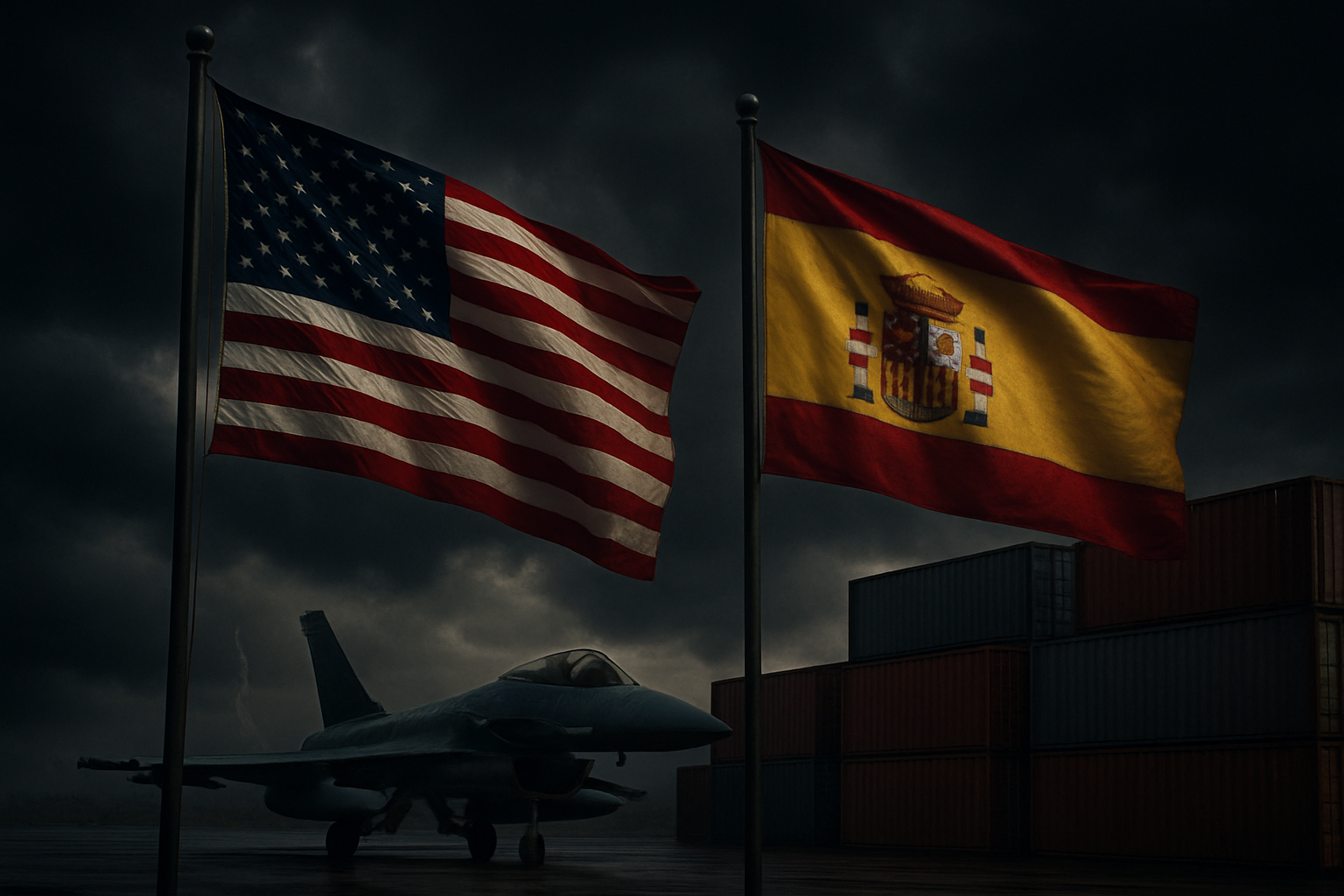
President Donald Trump declared Tuesday that the United States would "cut off all trade with Spain" after the European nation refused to allow U.S. military forces to use Spanish bases for operations against Iran, marking a dramatic escalation in tensions between NATO allies.
Speaking during a meeting with German Chancellor Friedrich Merz at the White House, Trump called Spain a "terrible" ally and ordered Treasury Secretary Scott Bessent to "cut off all dealings" with Madrid. The announcement came as the U.S. relocated 15 aircraft, including refueling tankers, from the Rota and Morón military bases in southern Spain following the Spanish government's refusal to permit their use in strikes against Iran.
Spanish Government's Principled Stand
Spain's Socialist government, led by Prime Minister Pedro Sánchez, has maintained that U.S. forces can only use Spanish bases for activities consistent with the United Nations Charter and international law. The decision reflects Madrid's opposition to what it views as Trump's "unjustified and dangerous" military intervention in Iran.
"Spain has been terrible," Trump told reporters. "They told us we can't use their bases. Well, we don't need them. But if we want to, we'll just fly over and use them. Nobody's going to tell us we can't do that."
The Spanish government responded swiftly to Trump's threats, stating that any changes to trade relations must respect "private company autonomy, international law, and bilateral agreements between the European Union and the United States." Madrid emphasized that Spain remains a "key NATO member" and called on the U.S. to honor existing bilateral agreements with the EU.
Historical Context of Military Cooperation
The U.S. has maintained military presence at Spanish bases since bilateral defense agreements dating back to the 1950s. The Naval Station Rota in Andalusia serves as a strategic logistical hub for U.S. operations in the Mediterranean and Middle East, while Morón Air Base has been crucial for refueling and transport operations.
This marks the first time since the bases were established that Spain has explicitly denied their use for a major U.S. military operation, highlighting the deepening rift over Iran policy between the Trump administration and European allies.
Iran Crisis Background
Trump's threat against Spain comes amid an unprecedented military buildup in the Middle East, with dual-carrier deployment of the USS Gerald R. Ford and USS Abraham Lincoln representing the largest U.S. naval presence in the region since the 2003 Iraq invasion. The military escalation follows the collapse of nuclear negotiations with Iran, despite what had been described as "broad agreement on guiding principles" achieved in Geneva talks.
Iran has maintained uranium enrichment at 60% purity, approaching weapons-grade levels, while excluding ballistic missiles and regional proxy activities from nuclear discussions. The fundamental scope disagreement between Iran's nuclear-only approach and U.S. demands for comprehensive agreements including missiles and human rights ultimately proved insurmountable.
NATO Alliance Strain
The Spanish stance reflects broader European opposition to Trump's Iran strategy. While regional coalition partners including Saudi Arabia, UAE, Qatar, and Egypt had supported diplomatic efforts, European allies have expressed concerns about military escalation and adherence to international law.
Trump also criticized British Prime Minister Keir Starmer for not backing U.S.-Israeli strikes on Iran, declaring "This is not Winston Churchill" in reference to the wartime British leader's alliance with America.
Economic and Legal Implications
Trump's threat to terminate all trade with Spain raises significant questions about implementation and legality. Spain is a major trading partner with the U.S., and any unilateral trade embargo would likely face challenges under World Trade Organization rules and existing EU-U.S. trade agreements.
The Spanish government indicated it has "necessary resources to contain possible impacts, help sectors that could be affected, and diversify supply chains," suggesting Madrid is prepared for potential economic consequences while defending the principles of international law and European sovereignty.
Trump's Broader Pressure Campaign
The Spanish dispute fits into Trump's broader pattern of pressuring allies to support his Middle East policies. He has also criticized Spain for failing to meet his demand that NATO members spend 5% of GDP on defense, calling it the only NATO country that refused to increase defense spending to his required levels.
"Spain has absolutely nothing that we need—except fantastic people," Trump declared, drawing a distinction between his criticism of the government and the Spanish population.
Regional and Global Ramifications
The U.S.-Spain diplomatic crisis occurs as the Middle East situation deteriorates rapidly. Iran has warned that all U.S. military bases in the region would become "legitimate targets" if attacked, raising the stakes for regional allies hosting American forces.
Multiple countries have issued travel warnings and begun evacuating personnel from the region as tensions escalate. The Strait of Hormuz, through which 40% of global oil transit passes, remains a critical flashpoint that could affect worldwide energy markets.
European Unity Response
Spain's position has received implicit support from other European nations, with several countries expressing concerns about the precedent of pressuring allies to support military operations they view as violating international law. The crisis may strengthen European calls for strategic autonomy from American military decisions.
The Spanish Foreign Minister José Manuel Albares emphasized that his government would not permit the use of Naval Station Rota or Morón Air Base for operations that Madrid deems inconsistent with international legal frameworks.
Future of Transatlantic Relations
The dispute between Washington and Madrid represents one of the most serious rifts between NATO allies in recent years, potentially setting a precedent for how European nations respond to American military operations they oppose. Spain's stance may encourage other European allies to assert greater independence in foreign policy decisions.
As Trump announced that Spanish Prime Minister Sánchez would make a statement Wednesday morning from La Moncloa Palace, the international community watches to see whether this crisis can be contained or will spread to affect broader transatlantic relationships.
The Spanish crisis underscores the challenges facing traditional alliances when fundamental disagreements arise over military intervention and international law, particularly as the world grapples with nuclear proliferation concerns and the breakdown of diplomatic solutions in the Middle East.