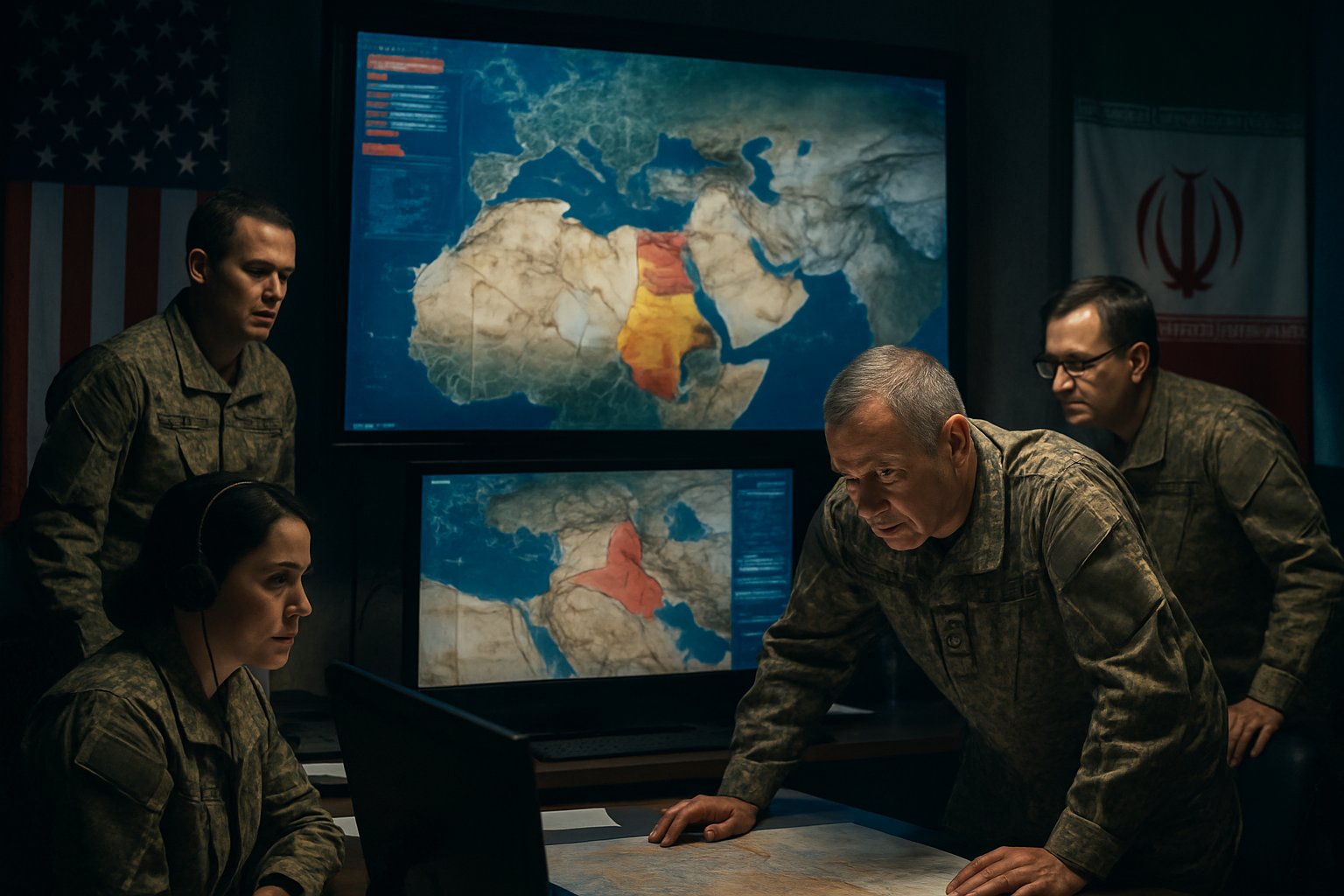
President Donald Trump has issued his strongest warning yet against Iran, threatening to target critical infrastructure including bridges and power plants if Tehran continues its military escalation, as the Middle East conflict enters a dangerous new phase following systematic Iranian attacks on US and allied targets across the region.
In a social media post Friday morning, Trump declared that the United States "hasn't even started" its main military campaign and warned that "much stronger action could follow" if Iran maintains its aggressive posture. The threats represent the most explicit targeting of civilian infrastructure since the crisis began, marking a significant escalation in rhetoric that has global implications.
Iranian Attacks Across Multiple Fronts
The escalation follows a series of devastating Iranian strikes that have sent shockwaves across the region. Kuwait's Mina al-Ahmadi oil refinery was struck by drones early Friday morning, igniting fires across multiple operational units, according to Kuwait Petroleum Corporation. The company confirmed no injuries were reported, but emergency teams are working to contain the blazes and prevent their spread to other refinery facilities.
The Kuwaiti military had earlier announced that air defenses were actively confronting "hostile missile and drone attacks," highlighting the sustained nature of Iran's Operation True Promise 4 campaign. Kuwait Petroleum Corporation stated they are "monitoring and tracking air quality in the areas surrounding the refinery, and no negative environmental impacts have been recorded so far as a result of the attack."
Simultaneously, Iranian forces launched systematic strikes across the region. In a particularly concerning development, reports from multiple Arab media sources indicate that Iranian Revolutionary Guard forces have targeted what they describe as "strategic US positions," with one Iranian military commander warning of attacks on "all economic centers" in the Middle East.
Infrastructure Under Threat
The scope of potential targets has dramatically expanded beyond traditional military installations. Reports from German media indicate that a major bridge in Karaj, west of Tehran, was struck in coordinated US-Israeli operations - described as potentially the "tallest bridge in the Middle East." However, Iranian strategic experts suggest the bridge was still under construction, limiting the immediate impact on Tehran's infrastructure network.
Egyptian sources report that Iran's Revolutionary Guard announced the first phase of what they termed "Wave 92" of their military operations, targeting US strategic positions. Meanwhile, Iranian missiles have struck areas in northern Israel, including Haifa, causing casualties and escalating tensions with additional volleys from Lebanese territory.
Regional Coalition Under Strain
The expanding conflict has placed enormous pressure on regional allies who have been caught between Iranian retaliation and US military operations. Kuwait has been particularly affected, with multiple facilities targeted including power and water desalination plants. The Ministry of Electricity, Water & Renewable Energy confirmed that one facility was attacked at dawn Friday, causing material damage to some components.
Qatar, despite its sophisticated air defense systems, intercepted 65 missiles and 12 drones but still sustained 8 injuries from falling debris. The UAE reported one civilian death in Abu Dhabi, while Dubai International Airport - the world's busiest - remains completely shut down due to missile damage, affecting hundreds of thousands of passengers globally.
"The systematic targeting of civilian infrastructure represents a dangerous escalation that threatens the entire regional security architecture," said Egyptian President Abdel Fattah al-Sisi, warning of "comprehensive chaos" spreading across the Middle East.
— Egyptian Presidency Statement
Global Economic Implications
The conflict has triggered the most severe aviation crisis since COVID-19, with over 18,000 flights cancelled worldwide as eight Middle Eastern countries maintain simultaneous airspace closures. Major carriers including Emirates, Air France-KLM, and Wizz Air have suspended operations indefinitely, severing critical Asia-Europe air corridors.
Energy markets have responded with dramatic price surges. Oil prices have risen past $80 per barrel, with Iran's effective closure of the Strait of Hormuz - which handles 40% of global oil transit - stranding over 150 tankers worth billions in cargo. Natural gas prices have surged 24% in Europe and 78% in the United States, as Qatar has halted LNG production at facilities affected by Iranian strikes.
The International Energy Agency has responded with the largest strategic petroleum reserve release in its 50-year history, releasing 400 million barrels from 32 countries - double the response during the 2022 Ukraine crisis. However, analysts warn that if the conflict continues, oil prices could reach $200 per barrel, potentially triggering a global recession.
Nuclear Diplomacy Collapsed
The current military confrontation emerged from the complete breakdown of nuclear negotiations despite what had appeared to be significant diplomatic progress. Geneva talks in February achieved what Iranian Foreign Minister Abbas Araghchi called "broad agreement on guiding principles" - the most significant progress since the 2018 JCPOA collapse.
However, fundamental disagreements proved insurmountable. Iran maintained that ballistic missiles and regional proxy relationships were "red lines" that must be excluded from nuclear-only talks, while US Secretary of State Marco Rubio insisted on a comprehensive agreement addressing missiles, armed groups, and human rights.
Iran continues enriching uranium at 60% purity - approaching the 90% weapons-grade threshold - with intelligence estimates suggesting the country possesses over 400kg of enriched material, sufficient for multiple weapons if weaponized. The collapse of diplomacy has occurred against the backdrop of the New START treaty's expiration in February 2026, leaving the world without US-Russia nuclear constraints for the first time in over 50 years.
Leadership Transition in Iran
Adding complexity to the crisis, Iran is undergoing its most significant leadership transition since the 1979 revolution. Following the confirmed death of Supreme Leader Ali Khamenei in US-Israeli strikes, his son Mojtaba Khamenei has emerged as the favored successor - marking the first hereditary succession in the Islamic Republic's 47-year history.
CIA assessments suggest that a Revolutionary Guards member is likely to assume ultimate control, representing a historic shift from clerical to military governance during active warfare conditions. This transition has consolidated hardline military influence precisely when diplomatic solutions are most needed.
Congressional and International Pressure
The military campaign faces unprecedented domestic opposition, with only 25% of Americans supporting the operations according to recent polling - representing "almost unprecedented" unpopularity for early-stage military action. Senator Richard Blumenthal expressed being "more concerned than ever" about potential ground troop deployment, while Pentagon sources indicate operations are planned through September, far beyond the initial 4-6 week timeline.
Internationally, the crisis has prompted emergency UN Security Council sessions, with Secretary-General António Guterres calling it "the greatest test of multilateral cooperation in the modern era." Russia has condemned what it terms "reckless actions by Washington and West Jerusalem," while China has issued its strongest condemnation in years of what it calls "sovereignty violations."
Template-Setting Moment for 21st Century
The rapid transition from diplomatic breakthrough to military confrontation demonstrates what analysts describe as the fragility of crisis management in the multipolar era. The stakes extend far beyond the immediate region, affecting global energy security, nuclear governance credibility, and international law enforcement mechanisms.
Success in containing the crisis could provide a framework for future nuclear dispute resolution, while failure may accelerate military approaches to international conflicts for decades to come, potentially encouraging nuclear proliferation globally and undermining diplomatic credibility worldwide.
As Trump's 48-hour ultimatum regarding infrastructure targets approaches its deadline, the world watches what may prove to be the most consequential international crisis since the Cold War ended - one whose resolution will establish precedents for conflict resolution, energy security, and nuclear governance that will reverberate for decades beyond the current events unfolding across the Middle East.