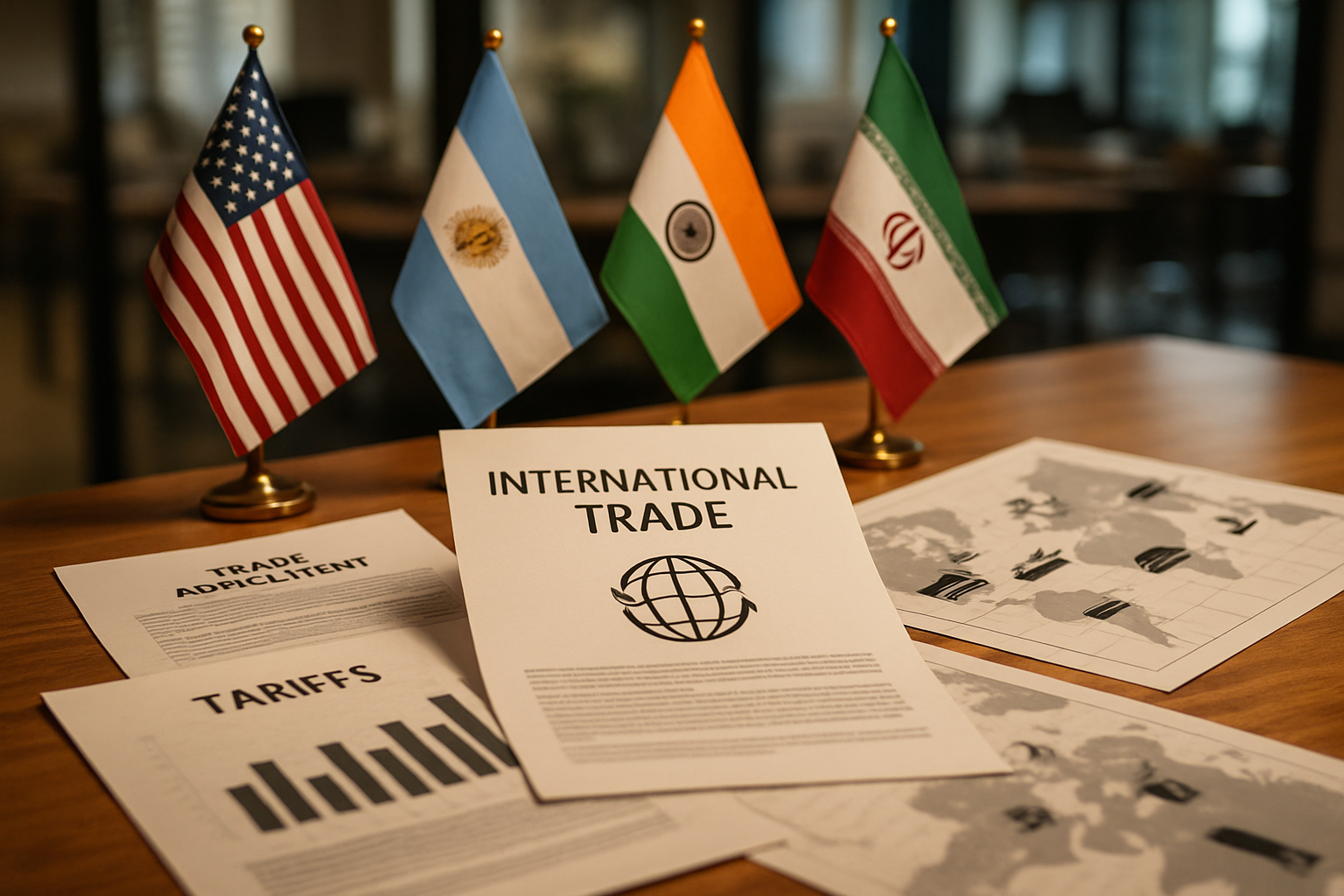
President Donald Trump executed a sophisticated three-pronged trade strategy this week, announcing expanded beef imports from Argentina, lifting penalty tariffs on India, while simultaneously threatening new sanctions on countries conducting business with Iran, demonstrating his administration's nuanced approach to international commerce and diplomacy.
The coordinated announcements, spanning multiple executive orders and trade agreements, reflect the Trump administration's evolving strategy of bilateral engagement backed by strategic pressure, as the United States seeks to strengthen partnerships while maintaining leverage against adversaries.
Argentina Beef Trade Expansion
Trump signed an executive order dramatically expanding US beef imports from Argentina from 20,000 to 100,000 tons annually—a 500% increase that positions Argentina as a key agricultural partner. The directive finalizes terms of the comprehensive trade deal signed Thursday between the US and Argentina, which eliminates hundreds of tariffs and trade barriers on goods exchanged between the two nations.
Argentine Foreign Minister Pablo Quirno hailed the agreement as providing "unprecedented" agricultural market access, estimating the beef quota expansion will generate approximately $800 million in additional external sales for Argentina. The deal represents the culmination of negotiations under President Javier Milei's free-trade reform agenda, which has prioritized closer economic ties with the United States.
"This agreement provides unprecedented agricultural access and positions Argentina as a key Trump administration South American partner."
— Pablo Quirno, Argentine Foreign Minister
However, the expansion triggered fierce opposition from American cattle ranchers, who characterized the decision as "a slap in the face" during an ongoing industry crisis marked by drought, rising feed costs, and market volatility. US ranchers argued for protection rather than increased foreign competition at a time when domestic cattle inventories are already under pressure.
The broader Argentina-US trade framework extends beyond agriculture to include lithium cooperation, leveraging Argentina's substantial mineral reserves, Port of Rosario expansion projects, and intellectual property protections. The agreement covers six key sectors: automobiles, technology, and pharmaceuticals flowing from the US to Argentina, while critical minerals and agricultural products move in the opposite direction.
India Sanctions Relief and Strategic Partnership
In a parallel diplomatic move, Trump officially ended 25% penalty tariffs imposed on Indian goods over New Delhi's continued purchases of Russian oil. The executive order, signed Friday, removes trade barriers that had created significant friction in the US-India strategic partnership.
According to the order, "India committed to stop directly or indirectly importing" Russian oil, though Indian officials have avoided explicit confirmations about ending the approximately 1.5 million barrels per day of Russian energy imports. The agreement includes provisions for monitoring compliance, with potential tariff reinstatement if the Commerce Department determines India has resumed Russian oil exports.
India's Commerce Minister Piyush Goyal announced that agricultural sectors including cereals, maize, soybeans, and genetically modified foods will remain protected under the bilateral framework, preserving domestic food security priorities while pursuing broader economic cooperation. The US reduced import duties on Indian goods to 18%, with aircraft and components tariffs eliminated entirely.
The India agreement establishes enhanced cooperation on standards assessment, investment partnerships focusing on innovation sectors, and critical minerals collaboration aimed at diversifying supply chains away from Chinese dominance. Both nations committed to broader bilateral trade agreement negotiations building on this interim framework foundation.
Iran Trade Sanctions Escalation
Even as Trump extended trade benefits to Argentina and India, his administration escalated economic pressure on Iran through a comprehensive executive order threatening 25% tariffs on countries conducting business with Tehran. The regulation, signed Friday, establishes a framework for imposing duties on goods imported from any nation "directly or indirectly purchasing, importing, or otherwise acquiring goods or services from Iran."
While the order does not specify fixed tariff rates, it uses 25% as an example for potential broad import applications, creating what analysts describe as a "sword of Damocles" over international trade relationships with Iran. The timing proved particularly significant, coming hours after Trump declared Iran nuclear negotiations "very good" with Iran "very eager to make a deal."
The Iran sanctions framework represents an evolution of the "maximum pressure" campaign, extending beyond traditional sanctions to target third-country trade relationships. However, the broad "direct or indirect" language creates enforcement challenges given global supply chain complexity and could strain relationships with allies conducting legitimate business under existing international agreements.
"The regulation establishes tariff framework for goods imported from any country directly or indirectly purchasing, importing, or otherwise acquiring goods or services from Iran."
— Executive Order Text
Strategic Context and Implementation Challenges
The simultaneous trade initiatives reflect Trump's preference for bilateral arrangements over multilateral frameworks, continuing patterns established with previous agreements including the historic India deal that reduced tariffs from 50% to 18%. This approach allows for tailored arrangements addressing specific strategic objectives while maintaining leverage over different partners and adversaries.
The Argentina partnership serves multiple strategic purposes: countering Chinese influence in Latin America, securing critical materials supply chains, and establishing a template for hemispheric bilateral arrangements. Argentina's substantial lithium reserves prove particularly valuable as the United States seeks to diversify supply chains for renewable energy and electric vehicle manufacturing.
Implementation challenges vary across the three initiatives. The Argentina beef expansion faces opposition from domestic ranchers and requires Argentine producers to meet rigorous US quality standards. Congressional approval is needed for broader framework aspects, though the executive order beef imports proceed immediately.
The India agreement requires massive supply chain restructuring and energy infrastructure modifications, with success depending on sustained political will across electoral cycles. Technical implementation complexity far exceeds previous agreements given the advanced scope of the trade relationship and geopolitical dimensions.
The Iran sanctions framework faces legal challenges under World Trade Organization rules limiting unilateral tariff actions. European Union officials have expressed concerns about the extraterritorial nature of sanctions affecting sovereign trade relationships, potentially complicating allied cooperation.
Market and International Reactions
Financial markets responded cautiously to the announcements, with oil prices rising over $1 per barrel following the Iran sanctions threat. Energy analysts warned of potential supply chain disruption and international commodity market uncertainty, though the selective nature of the trade actions provided some stability.
Argentina's financial markets responded positively to the trade agreement, with bonds and stocks rebounding as country risk indicators stabilized around 520 points. The agreement provides Argentina breathing room during President Milei's comprehensive economic reforms, including labor market changes and statistical agency restructuring.
Regional powers including Saudi Arabia, UAE, Qatar, and Egypt have expressed support for diplomatic engagement with Iran despite the economic pressure, reflecting unprecedented Middle Eastern consensus for preventing military confrontation. The Gulf states emphasize energy market and maritime security concerns over potential conflict escalation.
Congressional and Political Implications
The trade initiatives face varied congressional reception, with Republicans generally supporting pressure on Iran while expressing mixed reactions to expanded foreign agricultural competition. Democrats have raised concerns about the diplomatic impact of economic pressure during ongoing nuclear negotiations and potential strain on allied relationships.
House Democrats may review legal authority for broad tariff measures affecting allied nations, though executive authority provides significant latitude for national security-related trade actions. The Argentina agreement requires congressional ratification for broader aspects, while the India framework may need legislative approval for comprehensive implementation.
The timing of the announcements, coinciding with Iran nuclear talks and ongoing Ukraine conflict resolution efforts, demonstrates the administration's confidence in managing multiple diplomatic tracks simultaneously while maintaining economic leverage.
Looking Forward
The success of Trump's multi-front trade strategy depends on effective coordination between diplomatic engagement and economic pressure. The approach tests whether selective incentives combined with targeted sanctions can achieve strategic objectives without undermining broader international cooperation.
Argentina's role as a key US partner in South America could influence other regional governments considering similar bilateral arrangements, potentially reshaping Latin American trade patterns. India's energy transition timeline remains crucial for maintaining the partnership momentum, while Iran's response to economic pressure will determine whether diplomatic tracks can produce meaningful progress.
The initiatives represent a fundamental test of economic coercion balanced with partnership incentives in an increasingly complex global trade environment. Success requires sustained implementation across multiple government agencies while maintaining political support for potentially controversial trade-offs between domestic and international interests.