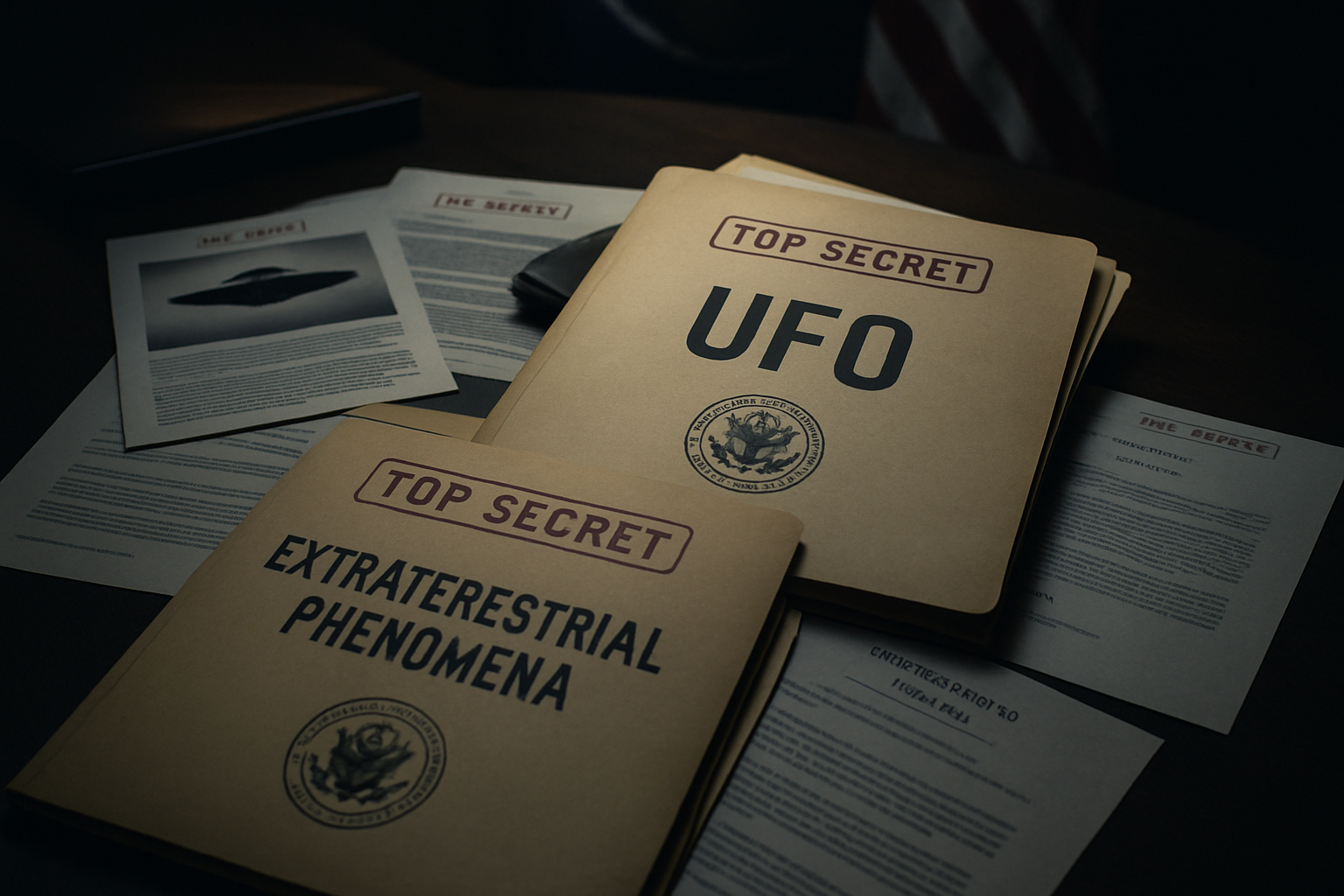
President Donald Trump announced Thursday he will order Defense Secretary Pete Hegseth and other federal agencies to begin releasing classified government files related to UFOs and extraterrestrial life, citing "tremendous interest" from the public in what could represent the most significant disclosure of government UFO records in decades.
The announcement, made via Truth Social, comes just hours after Trump criticized former President Barack Obama for allegedly disclosing classified information during a recent podcast interview where Obama suggested aliens were real. Trump's directive represents a dramatic escalation in government UFO transparency efforts that could surpass previous disclosure initiatives.
Presidential Directive on Extraterrestrial Files
According to multiple international sources, Trump has instructed the Pentagon and other federal departments to start "identifying and releasing" government records linked to unidentified flying objects, unidentified aerial phenomena (UAP), and extraterrestrial intelligence. The order specifically targets files containing "any and all other information connected to these highly complex, but extremely interesting and important, matters."
Defense Secretary Pete Hegseth, recently appointed amid controversy over his previous statements regarding military readiness, will oversee the implementation of the disclosure directive. The scope of the release could potentially include decades of classified military encounters, intelligence assessments, and scientific analyses of unexplained aerial phenomena.
"There is tremendous interest in this subject, and the American people deserve to know what their government knows about these phenomena."
— President Donald Trump, Truth Social
Obama Controversy Sparks Political Dimension
The timing of Trump's announcement appears directly connected to his criticism of Obama's recent statements about extraterrestrial life. Speaking to reporters aboard Air Force One, Trump accused the former president of improperly disclosing classified information, stating: "I don't know if they're real or not, but Obama shouldn't have said that."
Obama's podcast comments, where he suggested that aliens were "real," have created what Trump characterizes as an unauthorized revelation of sensitive government information. This controversy has transformed what is traditionally a scientific and national security matter into a political issue, with Trump positioning himself as more transparent than his predecessor.
The political dimension represents a significant departure from previous UFO disclosure efforts, which have generally maintained bipartisan support and focused on scientific inquiry rather than partisan criticism. Trump's approach connects UFO transparency directly to broader political narratives about government accountability and transparency.
International Media Coverage and Global Interest
The announcement has generated substantial international media coverage across multiple continents. News outlets in Afghanistan's Khaama Press, Brazil's Rio Times, France 24, RT, Czech Republic's Aktuálně.cz, Albania's Vizion Plus, and Venezuela's Efecto Cocuyo have all reported on the development, indicating significant global interest in American UFO disclosure policies.
International coverage has particularly focused on the unprecedented nature of a sitting U.S. president directly ordering the release of classified extraterrestrial files while simultaneously criticizing a predecessor for allegedly revealing similar information. European outlets have noted the unusual political context surrounding what has historically been treated as a matter of scientific and national security concern.
Implementation Challenges and Bureaucratic Hurdles
Despite the presidential directive, implementation faces substantial bureaucratic and security challenges that could significantly delay or limit the scope of document releases. The process requires extensive classification reviews, national security assessments, and coordination between multiple government agencies including the Pentagon, CIA, NASA, and other intelligence services.
Previous UFO disclosure efforts have encountered similar challenges, with agencies often citing national security concerns, ongoing investigations, and the need to protect sources and methods as reasons for continued classification. The Pentagon's own 2024 report found no evidence of extraterrestrial technology in government possession, though it acknowledged numerous unexplained encounters.
Military and intelligence officials will need to balance presidential directives with existing classification protocols, potentially creating conflicts between transparency goals and security considerations. The review process alone could take months or years, depending on the volume of relevant documents and the level of classification involved.
Historical Context of UFO Disclosure
Trump's directive represents a potential expansion of previous government UFO disclosure initiatives, including the Pentagon's establishment of the All-domain Anomaly Resolution Office (AARO) and previous releases of military encounter videos. However, the explicitly political context and direct presidential involvement mark a significant departure from previous approaches.
The order comes amid ongoing congressional interest in UFO phenomena, with lawmakers from both parties having called for greater transparency regarding government knowledge of unexplained aerial encounters. Recent military acknowledgments of unidentified aerial phenomena have increased public and political pressure for more comprehensive disclosure.
Scientific and Defense Community Response
The scientific community has long advocated for transparent investigation of unexplained aerial phenomena, arguing that rigorous analysis requires access to comprehensive data currently held by military and intelligence agencies. However, some experts have expressed concerns about politicizing what should remain a scientific and national security matter.
Defense officials have emphasized the importance of distinguishing between legitimate security concerns and public curiosity, noting that many classified encounters involve sensitive military capabilities or intelligence gathering methods that must be protected regardless of their relation to extraterrestrial phenomena.
Looking Forward: Transparency vs. Security
The success of Trump's disclosure directive will largely depend on how federal agencies balance presidential orders with existing classification protocols and national security considerations. Previous attempts at comprehensive UFO disclosure have often resulted in heavily redacted documents that provide limited new information while protecting sensitive details.
The international attention generated by the announcement creates additional pressure for substantive releases rather than symbolic gestures. However, the political controversy surrounding Obama's statements may complicate efforts to maintain the scientific credibility and bipartisan support that have characterized recent UFO transparency initiatives.
As federal agencies begin the complex process of document review and classification assessment, the American public and international observers will be watching to see whether this directive produces meaningful transparency or becomes another chapter in the ongoing political tensions between current and former administrations.
The ultimate impact of Trump's UFO disclosure order may depend not only on what files are eventually released, but on whether the process can maintain focus on scientific inquiry and public transparency while navigating the increasingly politicized environment surrounding discussions of extraterrestrial phenomena and government accountability.