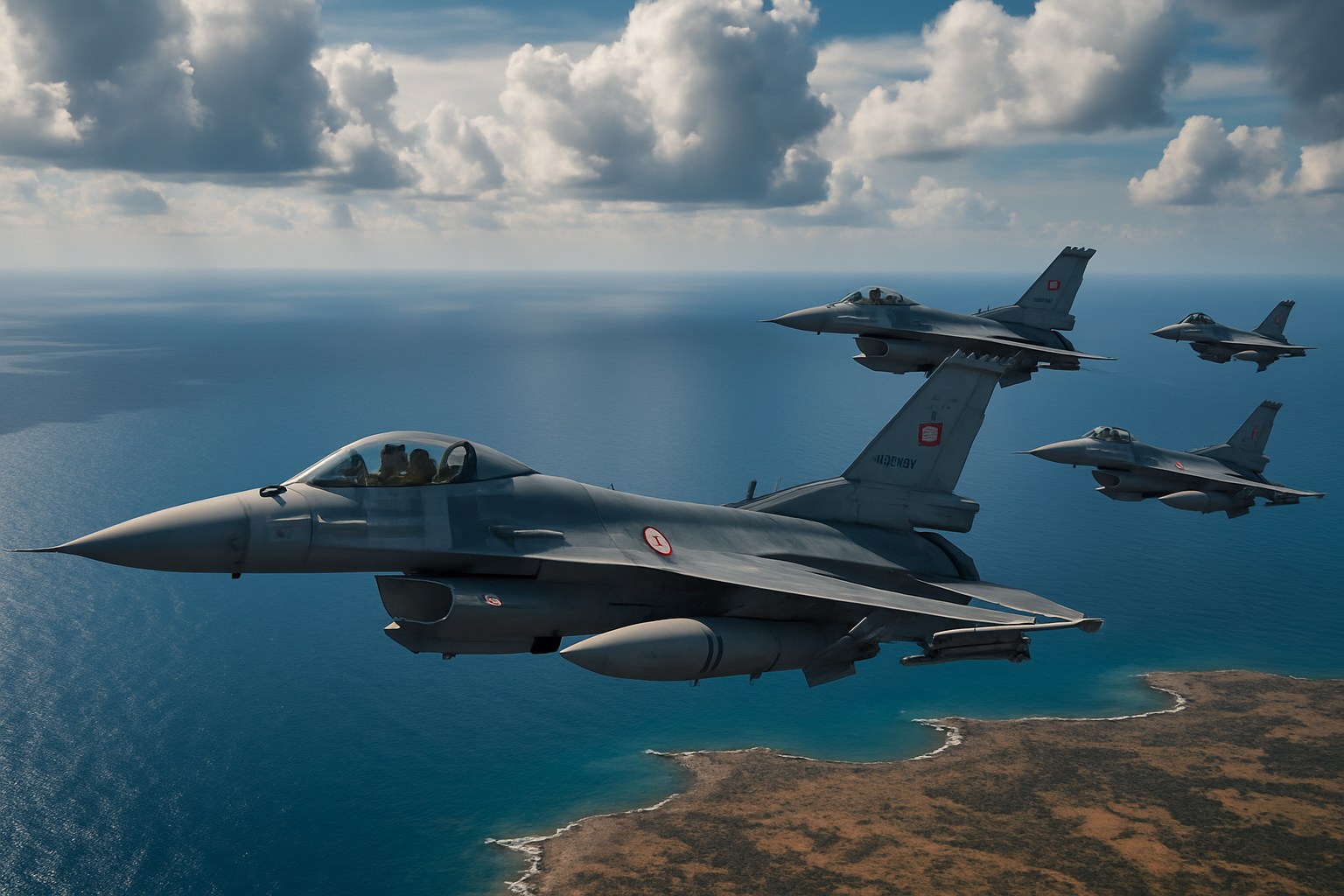
Turkey's Ministry of National Defense announced Monday the deployment of six F-16 fighter jets and advanced air defense systems to Northern Cyprus, marking a significant escalation in regional military positioning amid the most dangerous international crisis since the Cold War.
The Turkish deployment comes as the Middle East conflict has expanded beyond traditional geographic boundaries, with Iranian drone attacks on British sovereign bases in Cyprus representing the first targeting of European territory since World War II. Turkey's decision to strengthen its military presence in Northern Cyprus reflects the unprecedented nature of the current regional crisis.
Strategic Response to Regional Deterioration
According to Turkey's Defense Ministry, the F-16 deployment represents "phased planning" to bolster security as regional tensions continue to escalate. The ministry warned that "additional measures will continue to be taken based on further developments, if deemed necessary," indicating Turkey's readiness to further expand its military presence if the security situation deteriorates.
The deployment was originally planned for four aircraft but was expanded to six F-16s in response to the rapidly evolving security environment. This expansion underscores the gravity of the regional crisis that has already prompted unprecedented European military coordination in the Eastern Mediterranean.
Unprecedented European Military Mobilization
Turkey's F-16 deployment occurs within the context of the most significant European military mobilization in the Eastern Mediterranean since the 1974 Turkish invasion of Cyprus. Following Iranian drone attacks on RAF Akrotiri British sovereign base on March 2-6, European nations launched coordinated defensive measures unprecedented in scope and scale.
France deployed the aircraft carrier Charles de Gaulle from the Baltic Sea to the Mediterranean, along with the frigate Languedoc and advanced anti-missile and anti-drone systems. Greece committed four F-16 fighter jets and two naval frigates, including the advanced Kimon, representing the most significant Greek military support to Cyprus since 1974. Britain deployed HMS Dragon Type 45 destroyer equipped with Sea Viper missile systems and AW159 Wildcat helicopters with counter-drone capabilities.
"This represents the most concrete expression of European strategic autonomy in decades - rapid military coordination independent of traditional NATO/US frameworks."
— European Defense Analysis, March 2026
Cyprus at the Center of Global Crisis
Cyprus has found itself at the epicenter of a crisis that has fundamentally altered post-WWII European security assumptions. The island nation activated its ESTIA evacuation plan for the first time in history, evacuating the Akrotiri village and closing schools in affected areas including Asomatos, Episcopi, and Trachoni.
Government spokesman Konstantinos Letymbiotis coordinated the European response through emergency EU Foreign Affairs Council sessions, while the crisis exposed significant gaps in Cyprus's civil defense capabilities - only 2,200 shelters provide protection for approximately 30% of the population.
The strategic vulnerability of Cyprus, located just 100 miles from Lebanon and 200 miles from Syria, has been starkly highlighted by recent events. The island's position as an EU member state hosting Western military assets while attempting to maintain diplomatic independence has proven challenging in the current crisis.
Context of Operation True Promise 4
Turkey's military deployment must be understood within the broader context of Iran's "Operation True Promise 4," launched following the death of Supreme Leader Ali Khamenei on March 1, 2026. The Iranian Revolutionary Guard declared "no red lines remain," systematically targeting US and allied assets across the region.
This Iranian retaliation campaign has resulted in casualties across multiple countries: one civilian killed in Abu Dhabi with Dubai International Airport shut down, 32 injured in Kuwait airport strikes, eight injured in Qatar while intercepting 65 missiles and 12 drones, and nine killed with 28 wounded in Beit Shemesh, Israel. The attack on Cyprus RAF Akrotiri marked the first European sovereign territory to be targeted since WWII.
Template-Setting European Coordination
The current crisis has established new templates for European security cooperation in the 21st century. The rapid mobilization of multiple European navies and air forces demonstrates the continent's capacity for independent defense responses when territorial integrity is threatened.
Italy deployed the missile frigate Federico Martinengo with over 160 naval personnel, while Spain sent the Cristóbal Colón air defense frigate. The Netherlands coordinated additional maritime assets, creating the most comprehensive Eastern Mediterranean coalition since 1974.
This European response operates largely independent of traditional NATO frameworks, representing what analysts describe as the acceleration of European strategic autonomy amid questions about US reliability and commitment to continental defense.
Nuclear Diplomacy Collapse
The current military escalation follows the complete collapse of US-Iran nuclear diplomacy, despite achieving a "broad agreement on guiding principles" during Geneva talks - the most progress since the JCPOA collapse in 2018. Iran's exclusion of ballistic missiles and regional proxies as "red lines" proved insurmountable against US demands for comprehensive agreements addressing missiles, armed groups, and human rights.
With Iran continuing uranium enrichment at 60% purity (approaching the 90% weapons-grade threshold) and possessing over 400 kilograms of enriched uranium, the nuclear crisis has contributed to the broader regional instability now affecting European territory.
Global Aviation and Energy Crisis
The regional crisis has triggered unprecedented global disruptions. Over 18,000 flights have been cancelled worldwide, with eight Middle Eastern countries simultaneously closing their airspace. Dubai International Airport, the world's busiest with 86 million passengers annually, remains completely shut down due to missile damage.
Oil prices have surged over 10% past $80 per barrel as Iran declared the Strait of Hormuz "unsafe," affecting 40% of global oil transit. Natural gas prices have increased 24% in Europe and 78% in the United States, while over 150 tankers worth billions in cargo remain stranded in the Persian Gulf.
Historical Significance
The deployment of Turkish F-16s to Northern Cyprus, while significant in its own right, represents part of a broader watershed moment in post-WWII European security. For the first time since 1945, geographic boundaries have failed to contain a Middle Eastern conflict, with European sovereign territory directly targeted.
This crisis tests European strategic autonomy through coordinated defense responses, potentially defining the next phase of European integration in security matters. The success or failure of these coordinated measures will provide templates for future extra-regional threats and influence defense architecture for decades to come.
Looking Ahead
Turkey's commitment to deploy additional forces "if deemed necessary" suggests the potential for further military escalation in the region. With the New START nuclear treaty having expired on February 5, 2026 - the first time in over 50 years without US-Russia nuclear constraints - and China expanding its nuclear capabilities, the current crisis unfolds against a backdrop of broader nuclear governance breakdown.
As the largest international evacuation since the Arab Spring continues, with Australia reporting 115,000 citizens trapped and Germany evacuating 30,000, the stakes of this crisis extend far beyond the Eastern Mediterranean. The template being set for 21st-century crisis management will influence international approaches to territorial sovereignty enforcement and conflict resolution for generations.
The success of European coordination in containing this unprecedented threat demonstrates global security relevance, while failure could marginalize European influence in Middle Eastern developments and encourage further territorial violations. Turkey's F-16 deployment to Northern Cyprus thus represents not just a regional military adjustment, but a component of the most significant test of multilateral cooperation and crisis management in the modern era.