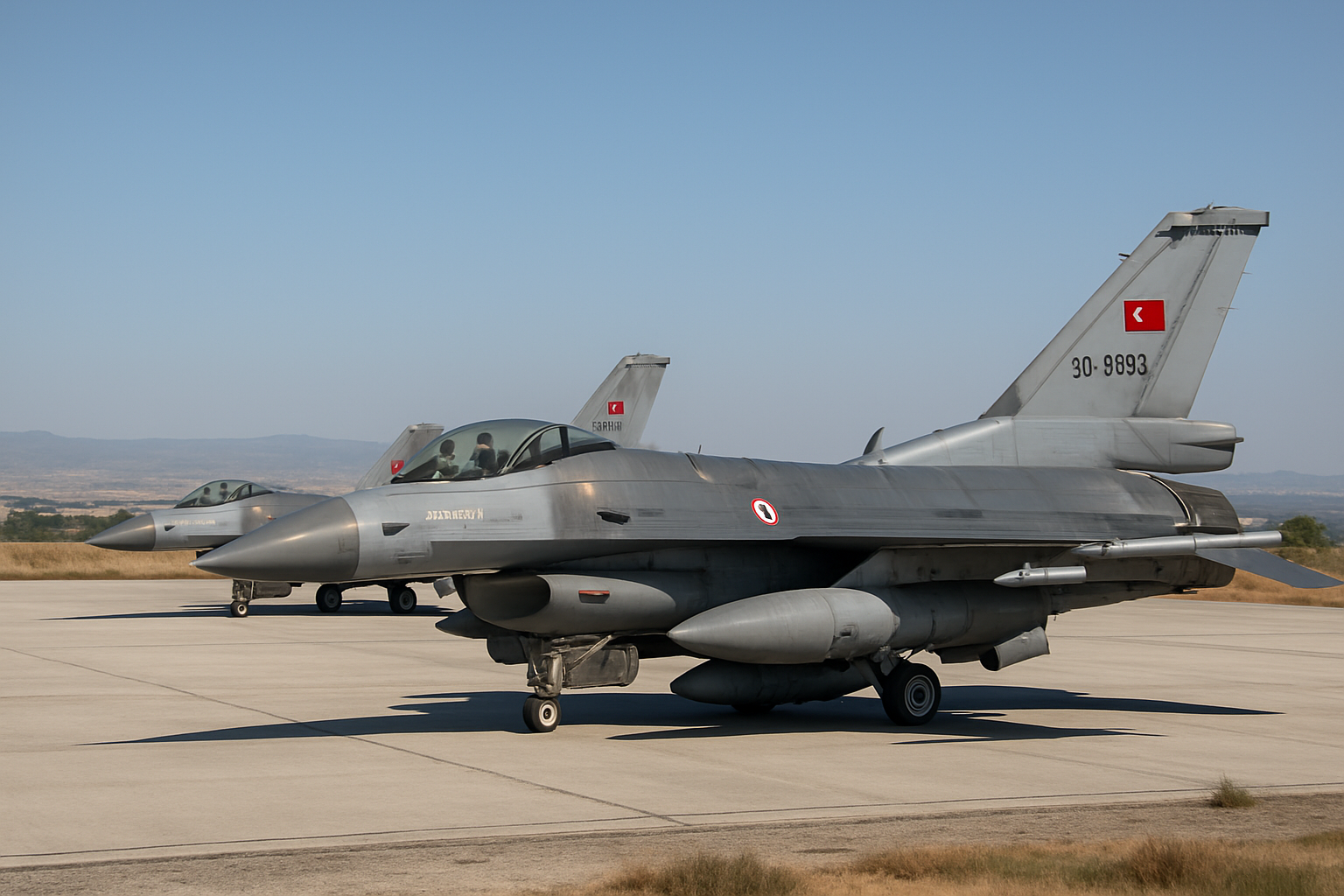
Turkey deployed six F-16 fighter jets and air defense systems to northern Cyprus on Monday, citing security concerns stemming from the expanding Middle East conflict that has already reached European territory for the first time since World War II.
The Turkish Defense Ministry announced the deployment as part of what it described as "phased planning" to bolster security in the region, warning that "additional measures will continue to be taken if necessary" depending on developments. The move represents Turkey's most significant military escalation in the Eastern Mediterranean since the ongoing Iran-US crisis began affecting European soil.
Strategic Context of Regional Crisis
Turkey's decision comes amid an unprecedented regional security crisis that has fundamentally altered the geopolitical landscape of the Eastern Mediterranean. The current conflict began with the collapse of US-Iran nuclear negotiations despite achieving a "broad agreement on guiding principles" in Geneva - the most progress since the JCPOA framework collapsed in 2018.
The situation dramatically escalated following Operation Epic Fury, the largest coordinated US-Israeli military operation since 2003, which resulted in the confirmed death of Iranian Supreme Leader Ali Khamenei on March 1, 2026. Iran's massive retaliation campaign, dubbed "Operation True Promise 4," has systematically targeted US and allied assets across the region with the Revolutionary Guard declaring "no red lines remain."
Most significantly, Iranian drones successfully struck RAF Akrotiri, the British sovereign base in Cyprus, marking the first attack on European territory by a Middle Eastern conflict since World War II. This watershed moment has fundamentally challenged traditional assumptions about geographic containment of regional conflicts.
European Military Response Unprecedented
Turkey's F-16 deployment to northern Cyprus follows an extraordinary coordinated European military response to protect the island. France deployed anti-missile systems and the frigate Languedoc, while ordering the aircraft carrier Charles de Gaulle from the Baltic Sea to the Mediterranean. Greece committed four F-16 fighter jets plus two naval frigates - the most significant Greek military support for Cyprus since 1974.
Britain has deployed HMS Dragon, a Type 45 destroyer equipped with Sea Viper missile systems, along with AW159 Wildcat helicopters specifically designed for counter-drone operations. Italy, Spain, and the Netherlands have also committed naval assets, creating what defense analysts describe as the most comprehensive European military coalition in the Eastern Mediterranean since the 1974 Turkish invasion of Cyprus.
"In the context of the latest developments in our region, six F-16 fighter jets and air defense systems have been deployed to the 'Turkish Republic of Northern Cyprus' as of today."
— Turkish Defense Ministry Statement
Cyprus at the Center of Global Crisis
Cyprus has found itself at the epicenter of what has become the most dangerous international crisis since the end of the Cold War. The island activated its ESTIA national evacuation plan for the first time in history, evacuating the village of Akrotiri and closing schools in surrounding areas including Asomatos, Episcopi, and Trachoni.
The crisis has exposed significant gaps in Cyprus's civil defense capabilities, with only 2,200 shelters available to protect approximately 30% of the population. Government spokesman Konstantinos Letymbiotis has coordinated the European response through emergency EU Foreign Affairs Council sessions, marking a watershed moment for European crisis management.
Cyprus's strategic position - located 100 miles from Lebanon and 200 miles from Syria - makes it particularly vulnerable to regional conflicts while hosting Western military assets and attempting to maintain diplomatic independence.
Turkey's Strategic Calculations
Turkey's deployment represents a calculated response to the unprecedented European military mobilization around Cyprus. The Turkish Cabinet discussed the F-16 deployment according to Greek media reports, with the timing suggesting coordination with broader regional security concerns.
Deputy Director of the Turkish-Cypriot "defense ministry" Askin Meseli confirmed the deployment, emphasizing Turkey's commitment to northern Cyprus security. The move expands Turkey's original plan from four to six aircraft, reflecting the deteriorating regional security environment.
Turkey's action occurs against the backdrop of the most significant Eastern Mediterranean military crisis since 1974, when Turkey invaded Cyprus following a coup attempt backed by the Greek military junta. The current deployment, while smaller in scale, carries profound symbolic weight given the historical context and ongoing European military presence in the south.
Regional Coalition Under Strain
The broader Middle East crisis has severely strained an unprecedented regional coalition that included Saudi Arabia, UAE, Qatar, and Egypt - all of whom had been backing diplomatic efforts to prevent military confrontation. Egyptian President Sisi has condemned attacks on "sisterly Arab countries," warning of "comprehensive chaos" as Iranian retaliation has directly targeted coalition member territories.
The crisis has caused massive global disruptions, with over 18,000 flights cancelled worldwide - the most extensive aviation disruption since COVID-19. Eight Middle Eastern countries have simultaneously closed their airspace, and oil prices have surged 10% past $80 per barrel as Iran declared the Strait of Hormuz "unsafe," affecting 40% of global oil transit.
Nuclear Governance Crisis
The current crisis unfolds against the backdrop of a broader nuclear governance breakdown. The New START treaty expired on February 5, 2026 - marking the first time in over 50 years without US-Russia nuclear constraints. Combined with China's nuclear expansion and Iran's continued uranium enrichment at 60% purity (approaching the 90% weapons-grade threshold), UN Secretary-General Guterres has warned that nuclear risks are at their "highest in decades."
International Evacuation Operations
The crisis has triggered the largest coordinated international evacuation since the Arab Spring in 2011, with nations extracting hundreds of thousands of citizens from Middle East conflict zones. Australia has 115,000 nationals trapped in the region, Germany is evacuating 30,000 tourists, and multiple European countries have activated emergency protocols.
The European Union activated Cyprus's ESTIA evacuation plan for European and third-country nationals for the first time, coordinating with British authorities to evacuate over 2,000 UAE nationals. This represents a critical test of European crisis management capabilities and demonstrates unprecedented coordination in civilian protection efforts.
Energy Security and Economic Implications
The regional crisis has exposed fundamental vulnerabilities in global energy and transportation networks. With Iran's closure of the Strait of Hormuz affecting 40% of global oil transit, over 150 tankers worth billions in cargo are stranded in the Persian Gulf. Natural gas prices have increased 24% in Europe and 78% in the United States.
Qatar's LNG production has been halted, further affecting European energy supplies already strained by ongoing geopolitical tensions. The crisis demonstrates how regional conflicts can instantly become global economic emergencies, affecting supply chains far beyond the immediate area of conflict.
Template-Setting Moment for 21st Century Security
Defense analysts view Turkey's F-16 deployment within the context of a broader template-setting moment for 21st-century security cooperation. The crisis represents the first time geographic boundaries have failed to contain a Middle Eastern conflict since World War II, with European territory directly targeted and affected.
The success or failure of the international response could influence diplomatic and military approaches to regional conflicts for decades to come. The crisis tests whether coordinated European defense responses can effectively manage extra-regional threats without relying solely on traditional NATO or US-led frameworks.
Future Implications and Outlook
Turkey's measured but significant response through F-16 deployments reflects the gravity of the current security environment while avoiding actions that could further escalate tensions. The deployment provides Turkey with enhanced defensive and deterrent capabilities in northern Cyprus while sending a clear message about its regional security interests.
As the crisis continues to unfold, the Eastern Mediterranean has become a focal point for broader questions about European strategic autonomy, NATO's role in managing extra-regional threats, and the future of international crisis management in an increasingly multipolar world.
The coming weeks will be decisive in determining whether the current crisis can be contained through diplomatic and defensive measures or whether it will expand into a broader regional conflict with far-reaching global implications. Turkey's careful but decisive military deployment to northern Cyprus represents one piece of a complex international response to what many experts consider the most dangerous moment in international relations since the Cold War's end.