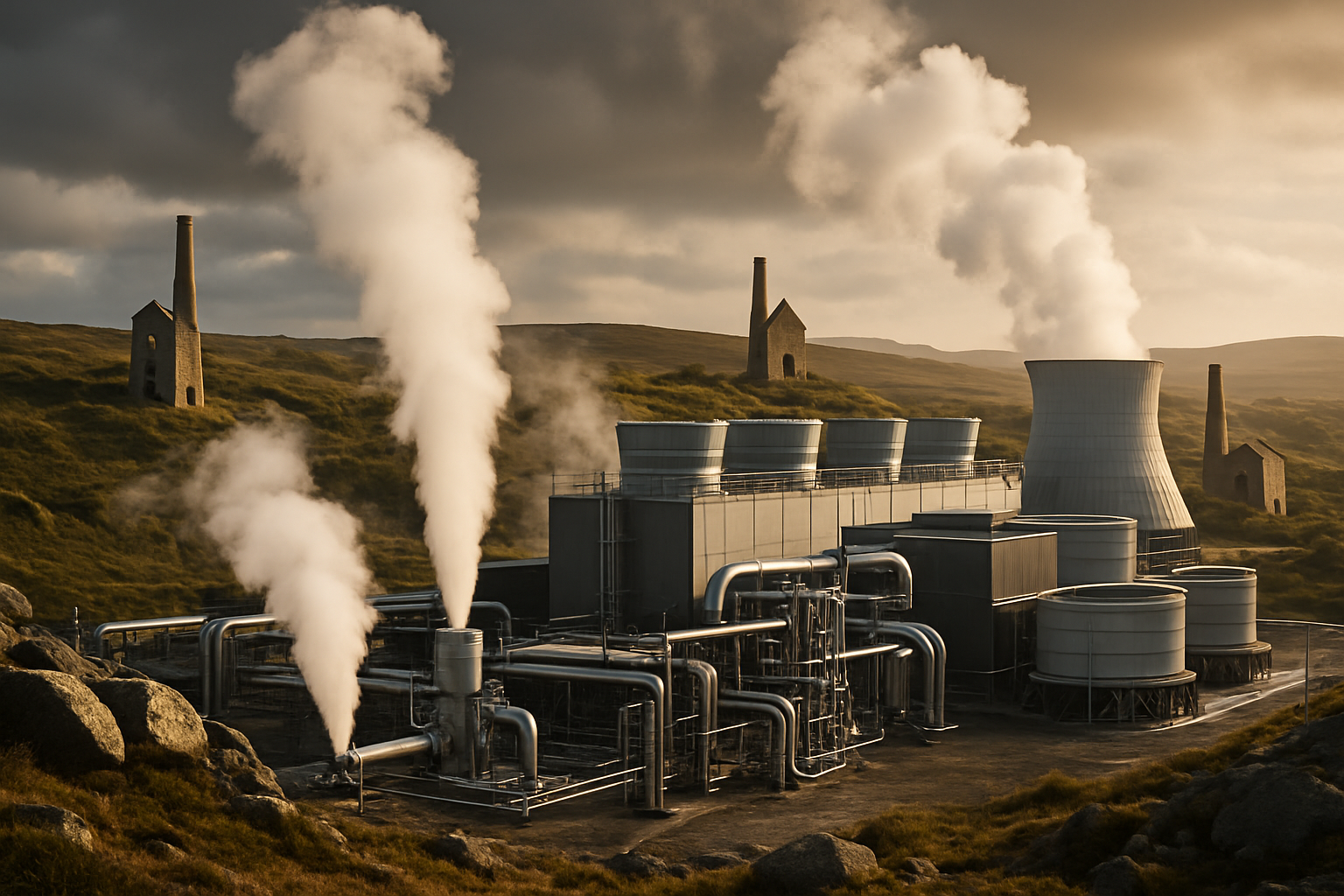
The United Kingdom has officially launched its first major geothermal power plant in Cornwall, representing a groundbreaking fusion of renewable energy generation and critical mineral extraction that will power 10,000 homes while producing the nation's first domestic supply of lithium.
The pioneering facility, located near Redruth in Cornwall's historic mining heartland, harnesses water super-heated by underground rocks to generate clean electricity while simultaneously extracting lithium – a critical mineral essential for battery production and the global clean energy transition. The project marks Britain's entry into an elite group of nations successfully operating commercial geothermal energy systems.
Historic Mining Legacy Meets Modern Innovation
The site presents a striking juxtaposition of old and new industries. Outside the perimeter fence stand the hulking remains of grand stone engine houses, testament to Cornwall's proud tin and copper mining history spanning centuries. Inside operates a shiny new mini power station and lithium extraction plant, once again accessing rich underground resources in the far southwest of Britain.
This symbolic transition from traditional mining to cutting-edge renewable energy extraction represents more than technological advancement – it demonstrates how Britain can leverage its geological heritage for 21st-century energy independence. Cornwall's unique geology, which made it a global mining center for over two millennia, now positions the region at the forefront of the UK's clean energy revolution.
Dual-Purpose Technology Breakthrough
The facility's innovative approach addresses two critical challenges facing Britain's energy transition: renewable electricity generation and secure access to battery materials. The geothermal system extracts super-heated water from deep underground, using it to generate clean electricity before processing the mineral-rich brine to extract lithium.
This dual-purpose technology offers significant advantages over traditional mining operations. Unlike conventional lithium extraction, which often requires large open-pit mines and extensive water usage in arid regions, the Cornwall facility produces minimal environmental impact while generating renewable energy as its primary output.
"This facility represents magic beneath the surface – we're unlocking Cornwall's underground resources in a completely sustainable way that benefits both local communities and national energy security."
— Local Project Manager
Strategic Timing Amid Global Supply Chain Crisis
The facility's launch comes at a critical moment for Britain's energy strategy. Recent analysis from EU auditors warns that climate goals across Europe are threatened by dangerous dependence on China, which controls 60% of global critical mineral production and 90% of refining capacity for lithium, cobalt, and rare earth elements essential for renewable energy infrastructure.
This supply chain vulnerability has prompted the UK to join the US-EU-Japan Critical Minerals Partnership, involving 55 countries working to diversify supply chains away from Chinese dominance. The Cornwall facility directly contributes to this strategic objective by providing domestic lithium production for the first time.
The timing is particularly significant given that January 2026 marked the 18th consecutive month of global temperatures exceeding 1.5°C above pre-industrial levels, demonstrating that human-induced climate change is overriding natural climate variability and creating urgent pressure for accelerated clean energy deployment.
Economic Impact and Job Creation
The geothermal project is expected to create thousands of specialized jobs across construction, maintenance, and technical operations, providing long-term employment opportunities in a region historically dependent on mining and agriculture. The facility represents a significant economic development for Cornwall, combining high-tech manufacturing with renewable energy production.
Local communities stand to benefit from both direct employment and the broader economic multiplier effects of hosting cutting-edge clean energy infrastructure. The project also positions Cornwall as a potential hub for geothermal expertise, with possibilities for technology export and consulting services to other regions exploring similar developments.
Technical Innovation and Environmental Benefits
The facility incorporates advanced digital monitoring systems, automated efficiency controls, and smart grid integration – representing the sophistication of modern renewable energy infrastructure. These systems enable precise measurement of both energy output and environmental benefits, crucial for demonstrating the technology's viability for broader deployment.
Environmental advantages extend beyond clean electricity generation. The geothermal system produces no direct carbon emissions during operation, requires minimal land use compared to solar or wind farms, and operates continuously regardless of weather conditions – providing reliable baseload power that complements intermittent renewable sources like wind and solar.
Integration with National Energy Strategy
The Cornwall facility aligns with the Labour government's ambitious target of achieving a virtually zero-carbon power grid by 2030. This goal requires massive infrastructure transformation, and geothermal energy offers unique advantages as a constant, weather-independent renewable source that can complement variable wind and solar generation.
The project builds on recent renewable energy momentum across the UK, including the government's record-breaking allocation of contracts to 190 renewable energy projects – the most ambitious renewable energy tender in recent British history. This included lifting the de facto ban on onshore wind farms, signaling renewed political commitment to clean energy development.
Regional and International Implications
Cornwall's success could catalyze similar developments across the UK and internationally. Britain possesses additional geothermal resources in other regions, and the Cornwall project provides a template for combining energy generation with critical mineral extraction – a model increasingly attractive to nations seeking energy security and supply chain resilience.
Internationally, the facility contributes to broader efforts to demonstrate that renewable energy development can support economic growth while reducing dependence on volatile international supply chains. This approach has particular relevance for other European nations exploring domestic alternatives to Chinese-controlled critical materials.
Challenges and Future Expansion
Despite its success, the project faces ongoing challenges typical of emerging technologies. These include scaling production to industrial levels, managing initial high capital costs, and developing expertise in both geothermal operations and lithium processing. However, the facility's dual-revenue model – selling both electricity and lithium – improves economic viability compared to single-purpose operations.
Future expansion possibilities include additional geothermal sites across Cornwall and other suitable UK regions. The success of the initial facility provides crucial operational experience and demonstrates commercial viability, potentially attracting additional investment in similar projects.
The Cornwall geothermal breakthrough represents more than a single renewable energy project – it demonstrates Britain's capacity for innovation in addressing multiple challenges simultaneously. By combining clean electricity generation with critical mineral production, the facility offers a template for energy independence that other nations are likely to study and potentially replicate.
As Britain continues pursuing its 2030 clean energy targets amid global supply chain vulnerabilities and accelerating climate change, the Cornwall facility stands as proof that innovative approaches to renewable energy can deliver both environmental benefits and strategic advantages in an increasingly complex global energy landscape.