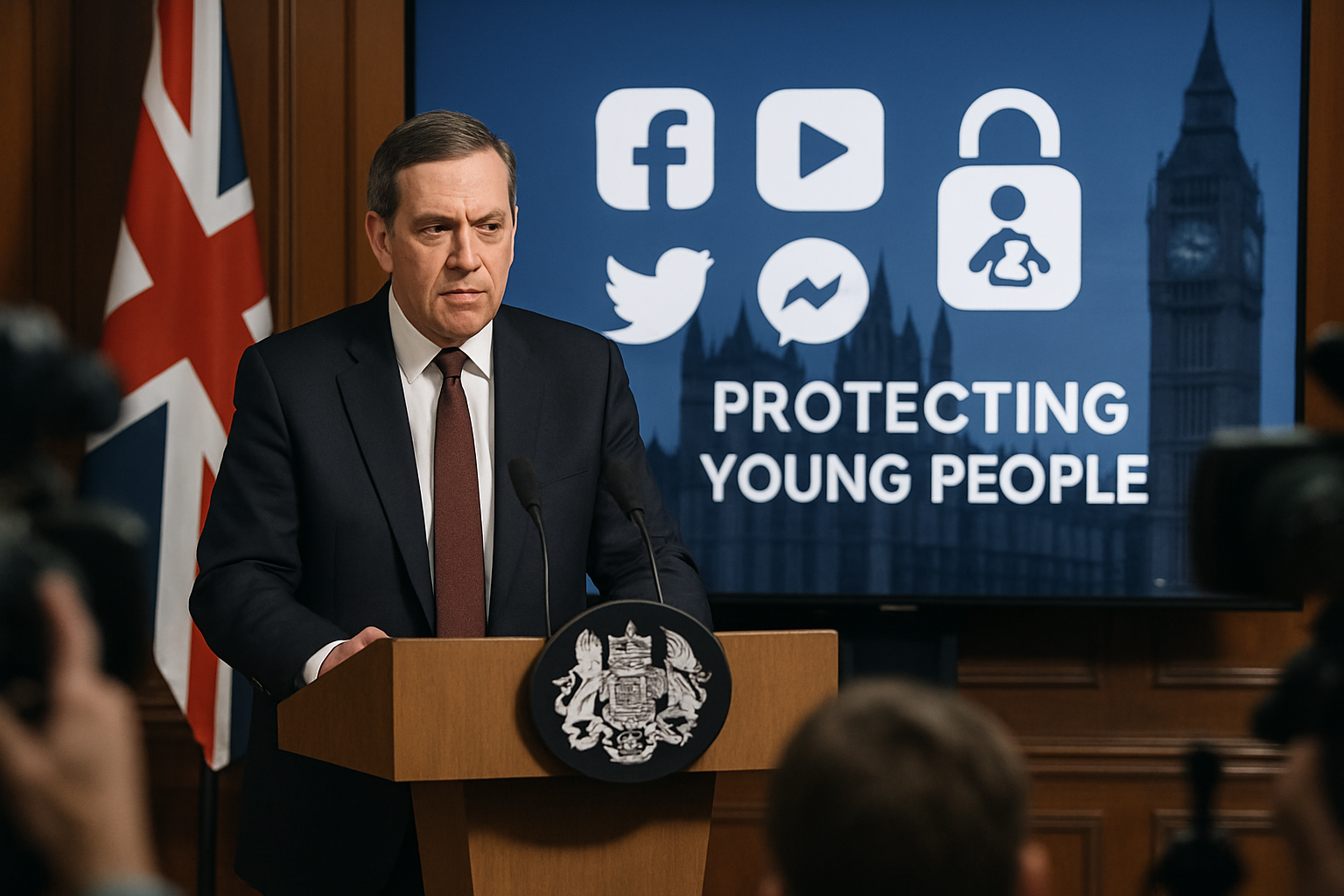
The United Kingdom government has officially launched a comprehensive three-month consultation examining potential social media restrictions for children under 16, marking the country's entry into an unprecedented global movement to protect youth from digital platform harms that has already transformed regulatory approaches across multiple continents.
The consultation, announced amid mounting scientific evidence linking early social media exposure to serious mental health impacts, will examine "measures to implement to protect children's wellbeing" and represents the UK's most significant step toward regulating youth access to digital platforms. Prime Minister Keir Starmer previously indicated the government was moving toward fast-track implementation of Australia-style restrictions, with Technology Minister Liz Kendall confirming legislative changes to enable rapid deployment following the consultation's conclusion.
Global Regulatory Revolution Gains Momentum
The UK consultation emerges during what experts describe as the most significant social media regulation wave in internet history. Australia's groundbreaking under-16 ban, implemented in December 2025, has already eliminated over 4.7 million teen accounts, providing a proven technical model for other nations to follow.
Spain leads the international charge with the world's most aggressive regulatory framework, including criminal executive liability that creates personal imprisonment risks for technology executives whose platforms harm children. The Spanish approach, announced at the World Government Summit in Dubai, encompasses five key components: complete under-16 social media prohibition, mandatory biometric age verification, legal definitions of algorithmic manipulation, criminal penalties for platform executives, and digital sovereignty protections.
European coordination continues to expand, with Greece approaching under-15 restrictions through its Kids Wallet system, while France, Denmark, and Austria conduct formal consultations. Germany's ruling Christian Democratic Union has passed motions supporting under-14 restrictions, and multiple Eastern European nations including Poland, Slovakia, and Slovenia have announced similar age-based prohibitions.
Scientific Evidence Driving Policy Changes
The consultation is grounded in mounting scientific research documenting serious harms from early social media exposure. Dr. Ran Barzilay's landmark research at the University of Pennsylvania demonstrates that smartphone exposure before age 5 causes persistent sleep disorders, cognitive decline, and weight management problems extending into adulthood.
Current statistics reveal the scope of youth exposure: 96% of children aged 10-15 use social media platforms, with 70% experiencing harmful content exposure and over 50% encountering cyberbullying. Large-scale US studies show children spending four or more hours daily on screens face a 61% increased risk of depression through sleep disruption and decreased physical activity.
"As dad of two teenagers, I know challenges parents face keeping kids safe online."
— Keir Starmer, UK Prime Minister
University of Macau research has definitively proven that short-form video consumption through smartphone "scrolling" negatively impacts children's cognitive development, causing social anxiety, insecurity, and academic disengagement. The European Commission has found major platforms like TikTok in violation of Digital Services Act requirements through "addictive design" features including unlimited scrolling, automatic video playback, and personalized recommendation systems designed to maximize user dependency over wellbeing.
Industry Resistance and Economic Implications
The technology industry has mounted coordinated resistance to regulatory efforts, with executives characterizing measures as authoritarian overreach. Elon Musk has called European restrictions "fascist totalitarian," while Telegram's Pavel Durov has issued warnings about "surveillance state" implications. Government officials across multiple countries have used this industry opposition as evidence supporting the necessity of stronger regulatory intervention.
The regulatory uncertainty has contributed to what analysts term the "SaaSpocalypse" of February 2026, which eliminated hundreds of billions in technology market capitalization. A global memory crisis, with sixfold increases in semiconductor prices affecting major manufacturers like Samsung, SK Hynix, and Micron, is constraining the technical infrastructure needed for age verification systems until new manufacturing facilities come online in 2027.
Implementation Challenges and Alternative Approaches
Real age verification systems present significant technical and privacy challenges, requiring biometric authentication or identity document validation that creates comprehensive databases. Privacy advocates warn that infrastructure designed for child protection could evolve into broader government surveillance systems vulnerable to sophisticated cyber attacks, as demonstrated by the Netherlands' Odido breach affecting 6.2 million customers.
Cross-border enforcement requires unprecedented international cooperation, as platforms operate across multiple jurisdictions. The coordinated timing of European regulations is specifically designed to prevent "jurisdictional shopping," where companies relocate to avoid oversight.
Alternative approaches emphasize education over regulation. Malaysia has focused on parental responsibility through comprehensive digital safety campaigns, with Communications Minister Datuk Fahmi Fadzil stressing that parents must control device access rather than using digital platforms as "babysitters." Oman has implemented "Smart tech, safe choices" educational initiatives focusing on conscious digital awareness rather than regulatory restrictions.
Criminal Liability Revolution
Spain's criminal executive liability framework represents the most significant shift in platform accountability since the internet's commercialization. Unlike traditional corporate penalties, this approach creates personal legal risks for technology executives, with potential imprisonment for platform designs that demonstrably harm children.
Meta CEO Mark Zuckerberg recently concluded historic testimony in a Los Angeles courtroom regarding Instagram's impact on youth mental health, facing internal company documents from 2014-2015 showing explicit goals to increase user engagement time by double-digit percentages. The trial represents a critical test of whether social media companies can be held legally responsible for design features allegedly harming users, particularly children.
Prevention-First Mental Health Revolution
The consultation occurs during what mental health professionals describe as the "Therapeutic Revolution of 2026," marking a fundamental shift from crisis-response to prevention-first healthcare approaches worldwide. Countries implementing prevention-focused strategies report substantial cost reductions through decreased crisis interventions while achieving superior population health outcomes.
Montana's mobile crisis teams have achieved an 80% reduction in police mental health calls through proactive community intervention. Healthcare providers increasingly report patient relief when therapy acknowledges the complexity of digital relationships rather than offering simplistic solutions.
Global Precedent Significance
The UK consultation represents a critical juncture in determining whether democratic institutions can effectively regulate multinational technology platforms while preserving beneficial aspects of digital connectivity. Success could trigger worldwide adoption of criminal liability frameworks and age restrictions, while failure might strengthen industry arguments against government intervention.
Parliamentary approval will be required across participating European nations throughout 2026 for coordinated year-end implementation. This represents the most sophisticated global technology governance attempt since the internet's commercialization, with outcomes affecting millions of children globally and establishing precedents for 21st-century technology governance.
Future Implications
The consultation's outcomes will fundamentally shape how an entire generation interacts with digital technology. As children increasingly live in what researchers describe as a "digital environment" rather than simply using digital tools, the stakes extend beyond regulatory debates to fundamental questions about childhood development, democratic governance, and human agency in an increasingly connected world.
The three-month consultation period will examine technical implementation options, privacy protections, enforcement mechanisms, and alternative approaches to protecting children's wellbeing online. The government has indicated that legislative changes are already being prepared to enable rapid deployment following the consultation's conclusion, suggesting strong political commitment to meaningful action.
As the global movement toward youth protection measures accelerates, the UK's approach could serve as a model for other democratic nations seeking to balance child safety, digital rights, and technological innovation in the digital age. The consultation represents not just a policy review, but a fundamental examination of how democratic societies should govern digital spaces that have become integral to modern childhood experience.