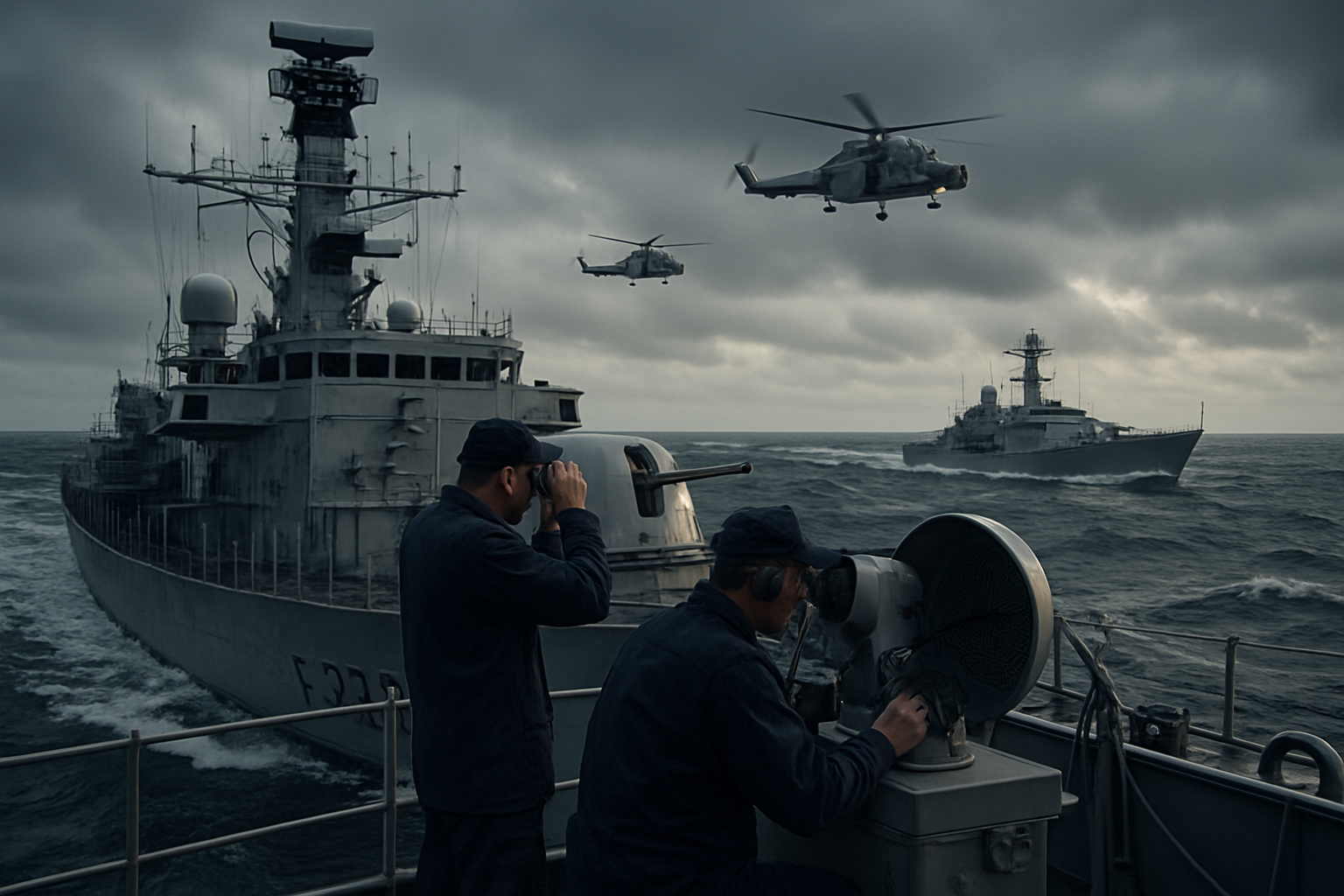
British Defence Secretary John Healey announced Thursday that UK naval forces, working in close cooperation with Norwegian allies, had successfully foiled a month-long Russian submarine operation targeting critical undersea infrastructure in North Atlantic waters.
The operation involved three Russian submarines—one attack submarine and two intelligence-gathering vessels—that had been conducting surveillance of undersea cables and energy pipelines vital to European security and global communications. The submarines departed northward after being detected and tracked by UK forces supported by P-8 Poseidon aircraft and Norwegian frigates.
Month-Long Tracking Operation
According to Healey's statement, the Russian submarines had been operating in and around British territorial waters for over a month before departing on Thursday. The Defence Secretary delivered a direct warning to Russian President Vladimir Putin, stating: "We see you. We see your activity over our cables and our pipelines."
Norwegian Defence Minister Tore O. Sandvik confirmed his country's participation in the operation, describing it as "both deterrence and defense." Norwegian forces contributed P-8 maritime patrol aircraft and naval frigates to the multinational effort, demonstrating the enhanced security cooperation between NATO allies in response to increased Russian activity in the region.
Strategic Importance of Undersea Infrastructure
The targeted infrastructure represents critical nodes in global communications and energy security. Undersea cables carry approximately 95% of global internet communications, making them essential for everything from financial transactions to military communications. The energy pipelines under surveillance are equally vital, providing heating and electricity to millions of Europeans.
The timing and nature of the Russian operation reflects Moscow's broader strategy of hybrid warfare, targeting civilian infrastructure that underpins Western economic and security systems. Previous incidents involving damage to undersea cables in the Baltic Sea and North Sea have heightened concerns about the vulnerability of these critical assets.
Enhanced NATO Arctic Sentry Response
The successful counter-operation builds upon NATO's Arctic Sentry mission, launched earlier this year as the alliance's most comprehensive Arctic security response since the Cold War. Under this framework, the UK has doubled its troop presence in Norway from 1,000 to 2,000 personnel over three years, while enhanced intelligence sharing protocols have improved maritime domain awareness across the region.
The operation demonstrates the practical implementation of NATO's burden-sharing evolution, with European allies taking greater leadership roles in regional security while maintaining close coordination with broader alliance frameworks. Finland has contributed operational planning expertise, while Sweden has deployed Gripen aircraft for Greenland exercises as part of the broader Arctic security initiative.
Escalating Russian Maritime Activity
Nordic intelligence agencies have documented a 23% increase in Russian military reconnaissance activity since Sweden and Finland joined NATO. This includes systematic submarine incursions, GPS jamming operations, and what Western officials describe as sabotage attempts against underwater infrastructure.
Lithuanian intelligence assessments warn that Russia could be ready for "limited military conflict" within 3-5 years if a Ukraine ceasefire permits force reconstitution and stockpile rebuilding. The pattern of provocations includes not only submarine operations but also drone incursions near NATO assets and systematic targeting of commercial shipping routes.
Technology and Surveillance Capabilities
The successful detection and tracking of the Russian submarines demonstrates the effectiveness of enhanced surveillance capabilities, including satellite monitoring, advanced sonar networks, and AI-powered maritime domain awareness systems. The operation required coordination across multiple platforms and jurisdictions, highlighting the importance of interoperability in modern naval operations.
Estonian officials have established a €10 million HIMARS maintenance center as part of broader regional defense cooperation, while advanced monitoring systems designed for Arctic conditions—capable of operating in temperatures as low as -70°C—provide comprehensive coverage of northern maritime approaches.
Nuclear Policy Context
The submarine incident occurs against the backdrop of significant nuclear policy shifts in the region. Finland is moving to lift its comprehensive nuclear weapons ban to meet NATO membership requirements, while Sweden has announced willingness to host nuclear weapons during wartime—decisions that break an 80-year Nordic nuclear taboo.
These policy changes reflect the changed security environment following the expiration of the New START Treaty in February 2026, which marked the first time in over 50 years that the United States and Russia operate without bilateral nuclear constraints. UN Secretary-General António Guterres has characterized current nuclear risks as the "highest in decades."
Energy Security Implications
The targeting of energy infrastructure comes as Europe faces broader energy security challenges. Recent attacks on Russian energy export facilities have disrupted global oil markets, pushing prices above $100 per barrel for the first time since 2022. The vulnerability of undersea energy infrastructure adds another dimension to European energy security calculations.
Estonia has emerged as a regional leader in energy independence, achieving 88% renewable electricity generation and operating continental Europe's largest battery storage facility. This energy independence model provides both a template for regional security and a target for adversary interference.
Regional Cooperation Framework
The successful operation exemplifies innovative approaches to regional security cooperation that extend beyond traditional military measures. Baltic national libraries have established unprecedented cooperation frameworks to address geopolitical challenges and protect cultural heritage—representing the first time cultural institutions have played explicit roles in democratic resilience strategies.
The Tallinn Cyber Diplomacy Winter School now hosts representatives from 33 countries, while the Latitude59 technology competition has facilitated €675,000 in investments across Estonian, Latvian, and Lithuanian companies. These initiatives demonstrate how comprehensive security approaches integrate technological innovation, cultural preservation, and economic development.
International Law and Deterrence
The public disclosure of the submarine operation serves multiple strategic purposes: demonstrating surveillance capabilities, providing deterrent messaging, and establishing precedents for responding to infrastructure threats. The measured response balances escalation management with clear communication of red lines regarding critical infrastructure protection.
Legal experts note that the operations occurred in a complex legal environment where international waters intersect with territorial seas and exclusive economic zones. The coordinated response by UK and Norwegian forces provides a template for collective defense of critical infrastructure while respecting international maritime law.
Future Implications
The successful counter-operation establishes important precedents for protecting critical infrastructure in an era of great power competition. The template of rapid multinational coordination, enhanced surveillance capabilities, and proportional response messaging may influence future incidents involving infrastructure threats.
As climate change opens new Arctic shipping routes and resource extraction opportunities, the strategic importance of the region—and the infrastructure that connects it to global markets—will only increase. The ability of democratic allies to coordinate effective responses to submarine reconnaissance will likely face additional tests in the coming years.
The operation's success demonstrates that enhanced international cooperation, advanced surveillance technology, and clear deterrent messaging can effectively counter sophisticated infrastructure threats without escalating to military conflict. This model of defensive cooperation may prove essential as hybrid warfare tactics increasingly target the civilian infrastructure upon which modern societies depend.