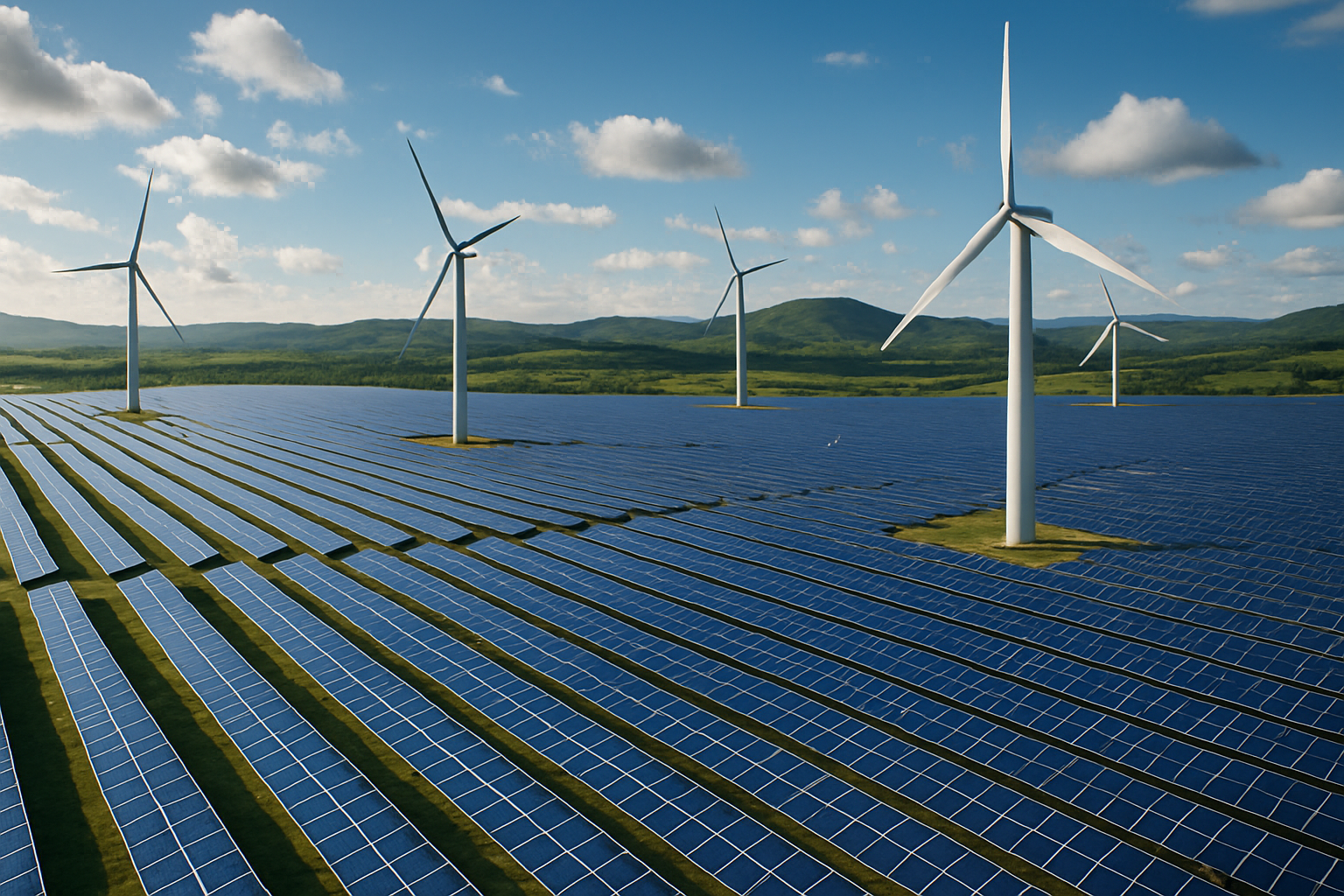
The United Kingdom has awarded government contracts to a record 190 renewable energy projects, including the largest onshore wind farm in England in over a decade, as the Labour government accelerates its push toward a virtually zero-carbon power grid by 2030.
The milestone announcement, revealed on February 10, 2026, encompasses major solar and wind installations across the country, with the Imerys project near St Austell in Cornwall leading the charge. The developments have been welcomed by climate and clean energy groups, though potential opposition from local communities remains a concern as the scale of renewable infrastructure expansion intensifies.
Breaking Records in Renewable Energy Auctions
According to The Guardian's reporting, the government has offered contracts for a record number of solar schemes alongside substantial support for onshore wind farms. This represents the most ambitious renewable energy tender in recent UK history, building on the Labour Party's decision to lift the de facto ban on new onshore wind farms after returning to power in 2024.
The Imerys wind farm project in Cornwall stands as a particularly significant achievement, marking the first major onshore wind development of its scale in England since the previous decade. The project's approval signals a dramatic shift in UK energy policy, prioritizing rapid decarbonization over previous planning restrictions that had effectively halted onshore wind development.
Global Context: Renewable Energy Infrastructure Boom
The UK's renewable energy surge occurs within a broader global acceleration of clean energy infrastructure development. Based on analysis of recent international developments, the global renewable energy sector is experiencing unprecedented growth, with countries across multiple continents launching major projects simultaneously.
In São Tomé and Príncipe, construction has begun on the country's first photovoltaic central with an 11-megawatt capacity in the Água Casada area of Lobata district. The project, resulting from an administrative investment agreement between the government and private company RELEASE SÃO TOMÉ UNIPESSOAL LDA, represents a significant milestone for the small island nation's energy independence.
This global momentum reflects a coordinated international response to climate change, with countries recognizing that rapid renewable energy deployment is essential for meeting 2030 climate targets. Recent projects span from Estonia's continental Europe's largest battery storage facility to Romania's €1 billion battery energy storage system, demonstrating the sophisticated integration of renewable generation with grid stability technologies.
Overcoming Supply Chain Challenges
The renewable energy expansion occurs against the backdrop of significant supply chain vulnerabilities that have emerged as a critical concern for global clean energy deployment. EU auditors have warned that climate goals are threatened by critical materials shortages, with China controlling 60% of global production and 90% of refining capacity for essential materials including lithium, cobalt, and rare earth elements.
These supply chain challenges have prompted coordinated international responses, including the US-EU-Japan Critical Minerals Partnership involving 55 countries, designed to diversify supply chains and reduce dependency on Chinese-controlled materials. The partnership includes seven African countries as alternative suppliers: Angola, Democratic Republic of the Congo, Guinea, Kenya, Morocco, Sierra Leone, and Zambia.
Despite these challenges, the renewable energy sector has demonstrated remarkable resilience and innovation. Countries are pursuing multiple strategies including strategic stockpiling, alternative supplier agreements, domestic production acceleration, and enhanced recycling investments to ensure continued clean energy infrastructure development.
Economic and Strategic Implications
The economic implications of this renewable energy surge extend far beyond energy generation. The UK's 190-project announcement is expected to create thousands of specialized jobs across construction, maintenance, and manufacturing sectors, while providing long-term economic benefits through reduced energy costs and enhanced energy independence.
For developing nations like São Tomé and Príncipe, renewable energy investments represent opportunities for economic transformation and reduced dependency on imported fossil fuels. The 11-megawatt solar installation, while relatively small in global terms, could significantly impact the island nation's energy security and economic development prospects.
The strategic timing of these developments is particularly significant, occurring during what has been identified as January 2026 - the hottest month in recorded history, with 18 of the past 19 months exceeding 1.5°C above pre-industrial levels. This unprecedented warming demonstrates the urgency of accelerating clean energy deployment to limit further climate impact.
Community Response and Implementation Challenges
While climate and clean energy groups have welcomed the UK's renewable energy expansion, the scale and pace of development raise important questions about community acceptance and environmental integration. Local opposition to large-scale renewable infrastructure projects remains a significant implementation challenge, requiring careful community engagement and benefit-sharing arrangements.
The experience of other countries provides valuable lessons for managing this transition. In Hungary, the commencement of Paks II nuclear power plant construction demonstrates how major clean energy projects can proceed with strong government backing and international cooperation. Portugal's innovative approach to water-air compressed energy storage systems offers alternatives to traditional battery storage that may be more acceptable to local communities.
Technology Integration and Grid Modernization
The success of renewable energy expansion depends critically on parallel investments in grid modernization and energy storage technologies. The UK's approach incorporates lessons learned from other countries' experiences, including Estonia's pioneering battery storage facility that serves 90,000 households and demonstrates the potential for large-scale energy storage to stabilize renewable-dependent grids.
Advanced technologies are playing an increasingly important role in renewable energy integration. Projects across multiple countries now incorporate smart grid management systems, digital monitoring capabilities, and robotics assembly processes that improve efficiency and reliability while reducing long-term operational costs.
International Cooperation and Climate Diplomacy
The renewable energy developments reflect broader patterns of international cooperation on climate action. Recent diplomatic initiatives, including energy partnerships between Turkey and Saudi Arabia, Algeria and Italy, and Armenia and Japan, demonstrate how clean energy development is becoming central to international relations and economic cooperation.
These partnerships often combine traditional energy cooperation with cutting-edge renewable energy development, creating comprehensive energy security frameworks that address both immediate needs and long-term sustainability goals. The diversity of approaches - from offshore wind development to solar installations to innovative storage systems - provides resilience against technological or supply chain disruptions affecting individual clean energy sectors.
Future Outlook and Global Implications
The renewable energy developments in the UK and São Tomé and Príncipe represent significant progress toward global climate targets, but also highlight the scale of transformation still required. Meeting the 2030 climate goals will require sustained acceleration of clean energy deployment, continued innovation in storage and grid technologies, and effective resolution of supply chain vulnerabilities.
The success of current renewable energy expansion will depend on several critical factors: maintaining political commitment across electoral cycles, securing adequate financing for infrastructure development, managing community relations effectively, and ensuring that supply chain diversification efforts succeed in reducing strategic vulnerabilities.
As countries worldwide pursue similar renewable energy expansions, the lessons learned from the UK's record-setting auction and São Tomé and Príncipe's pioneering solar installation will provide valuable guidance for the global clean energy transition. The integration of traditional energy systems with cutting-edge renewable technologies, combined with international cooperation on critical materials and technology transfer, offers a pathway toward energy independence and climate resilience that could transform global energy systems within the current decade.