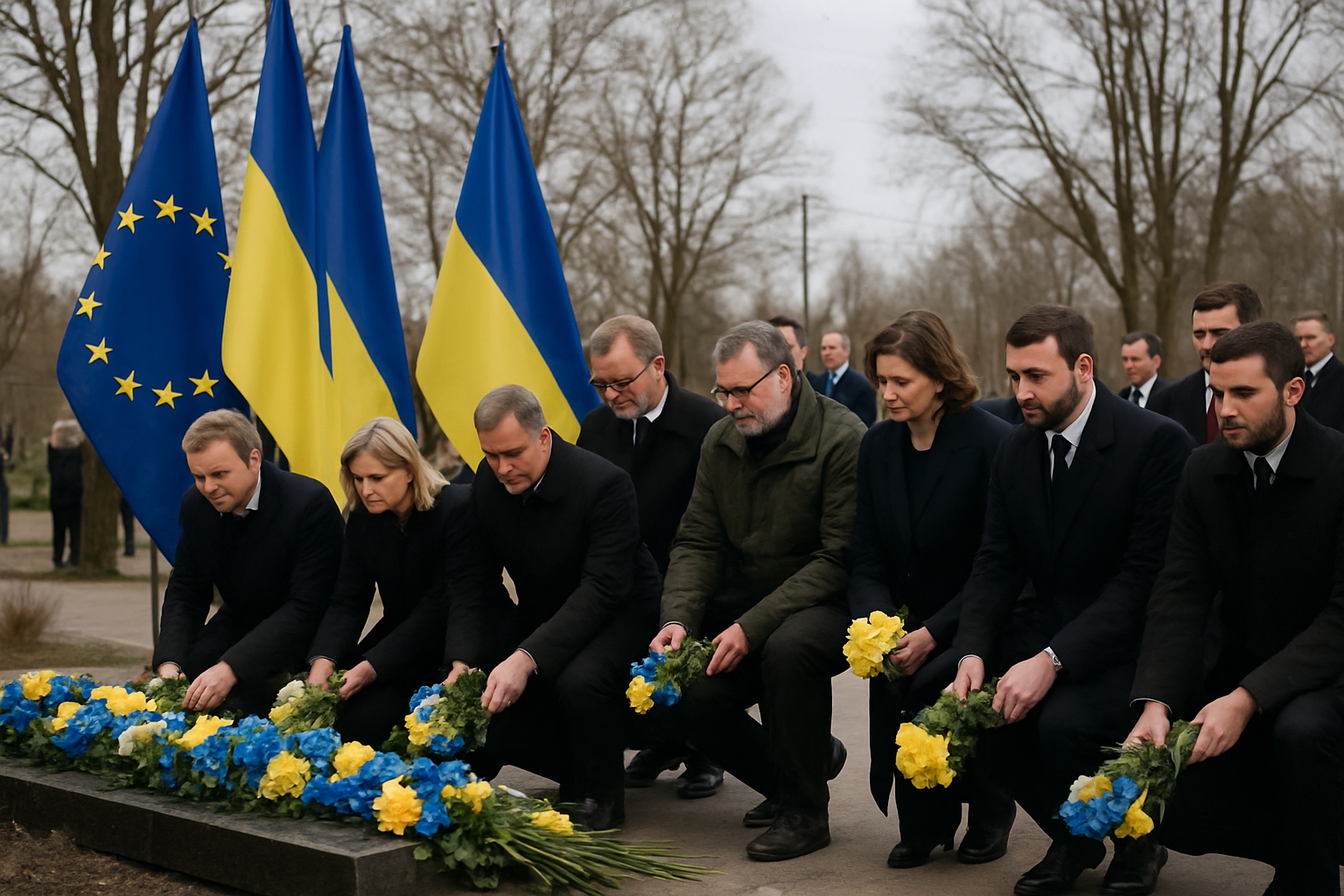
Ukraine solemnly commemorated the fourth anniversary of the Bucha massacre on March 31, 2026, with European Union's top diplomat Kaja Kallas and over a dozen EU foreign ministers visiting the town that has become symbolic of Russian war crimes, while diplomatic efforts for peace remain frozen as Moscow continues to reject ceasefire proposals.
The European delegation, led by EU foreign policy chief Kaja Kallas, arrived in Kyiv early Tuesday morning and traveled to the small town of Bucha, where Ukrainian officials and international rights groups documented the killing of more than 400 civilians by Russian troops during their occupation in early 2022. The visit underscored Europe's commitment to accountability even as peace negotiations remain indefinitely suspended.
European Solidarity Amid Diplomatic Deadlock
Ukrainian Foreign Minister Andrii Sybiha greeted the European delegation at Kyiv's central railway station, emphasizing that the international presence demonstrated "justice for Russian atrocities was inevitable." The timing of the visit carries particular significance as trilateral peace talks between Ukraine, Russia, and the United States have been postponed indefinitely due to the ongoing Iran crisis in the Middle East.
"Bucha has come to symbolise the cruelty of Russia's war," Kallas declared on social media, posting photographs from the memorial site. "The EU is committed to ensuring that these crimes do not go unpunished... Russia must be held accountable for what it has done to Ukraine."
The European "Big 5" observers—representatives from Germany, France, Italy, the United Kingdom, and Poland—joined the commemoration, representing the same coalition that had participated in Geneva peace talks in February 2026, which achieved "significant progress" on ceasefire monitoring mechanisms but failed to resolve fundamental territorial disputes.
Diplomatic Breakthrough Now Stalled
The anniversary commemoration takes place against the backdrop of a major diplomatic setback. Earlier in 2026, unprecedented progress had been achieved through the Abu Dhabi trilateral talks, which resulted in a historic 314-prisoner exchange—the first in five months—and the restoration of US-Russia military communications after a four-year suspension. Pentagon deconfliction protocols were established covering global operations in Syria, the Arctic, and Africa, representing the most substantial US-Russia military agreement since the conflict began.
However, these advances have been derailed by the Iranian crisis, which has prevented the high-level trilateral engagement necessary for territorial dispute resolution. President Zelensky confirmed that talks remain suspended, stating there are "no necessary signals for trilateral meeting until security allows," though he expressed hope that negotiations would resume "as soon as the security situation and general political context allow."
Russia Rejects Ukrainian Peace Overtures
Even as Ukraine marked the somber anniversary, Russia demonstrated its continued resistance to peace initiatives. Kremlin spokesperson Dmitry Peskov rejected Ukraine's proposal for an Easter ceasefire, describing President Zelensky's call as vague and insufficient for achieving lasting peace. The Russian official argued that Ukraine must "take appropriate decisions so that we achieve peace, and not a truce."
This rejection follows a pattern of Russian escalation during diplomatic moments. The Kremlin has consistently demanded territorial recognition of occupied Ukrainian territories and insists that any direct Putin-Zelensky talks must occur in Moscow—conditions that Ukraine categorically rejects as compromising its territorial integrity.
Continued Military Escalation
The memorial events occurred amid ongoing military violence. Russian forces have accelerated territorial gains, capturing 481 square kilometers in January 2026 compared to 260 square kilometers in December 2025—an 85% increase representing the fastest monthly territorial expansion in recent periods. Over 10,000 drones and bombs have been launched by Russia since January 2026, maintaining what Ukrainian officials describe as "energy terrorism" targeting civilian infrastructure.
The systematic targeting of civilian infrastructure has left over 1,170 Kyiv buildings without adequate heating during sub-zero temperatures, while Ukrainian nuclear plants were forced to halt electricity production for the first time in the conflict. This winter warfare strategy has been documented as violating Geneva Conventions protections for civilians during extreme weather conditions.
International Support Despite Internal Divisions
The EU demonstration of solidarity comes despite growing internal divisions within the European bloc. While the European Parliament approved a historic €90 billion loan package for Ukraine—the largest single-nation assistance package in EU history—Slovakia, Czech Republic, and Hungary refused to participate in its financing, exposing persistent disagreements over Ukraine policy.
Hungarian Prime Minister Viktor Orbán has threatened to veto both the loan package and the EU's 20th sanctions package against Russia over disputes related to the Druzhba oil pipeline. Lithuania's Foreign Minister warned that "the EU cannot become Budapest's hostage," highlighting tensions between national sovereignty and collective action during wartime.
Despite these divisions, international military support continues to flow. Germany has delivered approximately 35 Patriot missiles, while Sweden and Denmark have committed €246 million for air defense systems. Over 17.8 million Ukrainians are currently accessing winter support programs funded by international assistance.
Nuclear Governance Crisis Context
The anniversary commemoration occurs within an unprecedented nuclear governance crisis. The New START treaty between the United States and Russia expired on February 5, 2026, marking the first time in over 50 years without bilateral nuclear constraints between the superpowers. Both nations control approximately 80% of global nuclear weapons, with Russia possessing 4,380 warheads and the US holding 3,708.
UN Secretary-General António Guterres has described this as a "grave turning point," warning that nuclear risks are at their "highest in decades." The restored military communications between Washington and Moscow, achieved through the Abu Dhabi framework, now represent the only remaining formal diplomatic channel between the nuclear superpowers.
Human Cost and War Crimes Documentation
President Zelensky has disclosed that 55,000 Ukrainian soldiers have been officially killed, with a "large number" missing in action. International estimates suggest actual casualties may be two to three times higher. The systematic civilian targeting continues to violate international humanitarian law, with documented attacks on repair personnel, emergency services, and residential areas during life-threatening winter conditions.
The evidence collected after Russian troop withdrawal from Bucha has become central to international war crimes prosecutions. The town's experience—with bodies discovered in streets, systematic executions, and targeting of civilians—has provided crucial documentation for accountability mechanisms that EU officials emphasized remain a priority regardless of diplomatic developments.
Ukraine's Strategic Evolution
While commemorating past atrocities, Ukraine has simultaneously demonstrated its evolution from aid recipient to security provider on the global stage. Ukrainian military experts are now deployed to the UAE, Qatar, Jordan, Bahrain, and Kuwait, sharing expertise in combating Iranian Shahed drones—the same weapons that have devastated Ukrainian infrastructure. This represents a strategic pivot that leverages battlefield experience into international partnerships.
The UK has revealed the existence of four operational maintenance, repair, and operations (MRO) facilities in Ukraine servicing Western military equipment, with a fifth facility planned. This disclosure represents the first public acknowledgment of extensive military infrastructure supporting long-term Ukrainian defense capabilities.
Territorial Integrity vs. Diplomatic Compromise
The fundamental challenge that derailed previous peace efforts remains unchanged: how to resolve the status of eastern Ukrainian territories currently under Russian control. Russia continues to demand territorial recognition and insists on Moscow as the venue for any Putin-Zelensky summit, while Ukraine maintains its position on territorial integrity and seeks long-term security guarantees.
President Zelensky has categorically rejected territorial concessions, arguing that the Ukrainian people would reject "handing over territories" as a "failure story." This position has been reinforced by the international legal framework, which maintains that the 2014 Crimea annexation and subsequent territorial occupations violate international law and UN charter principles.
Framework for Future Negotiations
Despite the current suspension, diplomatic achievements remain intact and could be reactivated when conditions permit. The prisoner exchange mechanisms, Pentagon-Moscow deconfliction protocols, and structured negotiation format established through the UAE methodology have proven effective for producing concrete humanitarian results even amid military operations.
The Trump administration's previously established June 2026 deadline for comprehensive peace negotiations, with Washington as the potential venue for presidential-level engagement, remains technically active but uncertain due to Middle East priorities. The evolution from Abu Dhabi to Geneva to Washington had suggested deliberate diplomatic escalation, but the Iranian crisis has interrupted this progression.
Global Stakes and Template Implications
The success or failure of eventual resumed talks carries implications far beyond Ukraine and Russia, potentially serving as a template for 21st-century territorial dispute resolution. The stakes include European security architecture redefinition, international law enforcement credibility, and territorial sovereignty principles that could shape power competition frameworks for decades.
As noted during the Munich Security Conference earlier in 2026, the "post-war order no longer exists," according to German assessments, while France has begun exploring nuclear deterrent expansion beyond national scope for the first time since the Cold War. These developments underscore how the Ukraine conflict has fundamentally altered European strategic thinking.
Looking Forward: Uncertain Timeline
The timeline for resumed negotiations remains dependent on the resolution of the Iranian crisis, demonstrating how interconnected regional conflicts have become in the multipolar security environment. While military escalation continues with systematic civilian targeting and territorial gains, Ukraine's expansion of international security partnerships may provide new leverage when diplomatic conditions improve.
The preservation of the diplomatic framework, combined with continued international support despite European divisions, suggests that the foundation for peace negotiations remains available for reactivation. However, the fundamental territorial disputes that prevented breakthrough in previous talks await innovative compromise solutions that have yet to emerge.
As Ukraine commemorated the fourth anniversary of the Bucha massacre, the international community was reminded both of the human cost of the conflict and the urgent need for diplomatic solutions. The European show of solidarity, Russia's continued rejection of peace overtures, and the suspended state of international negotiations underscore the complex challenges facing efforts to end what has become Europe's deadliest conflict since World War II.