Russian forces unleashed devastating drone and missile attacks across Ukraine over the weekend, killing at least eight people in Dnipro and forcing thousands of residents from their homes as the conflict enters another deadly phase amid stalled diplomatic efforts.
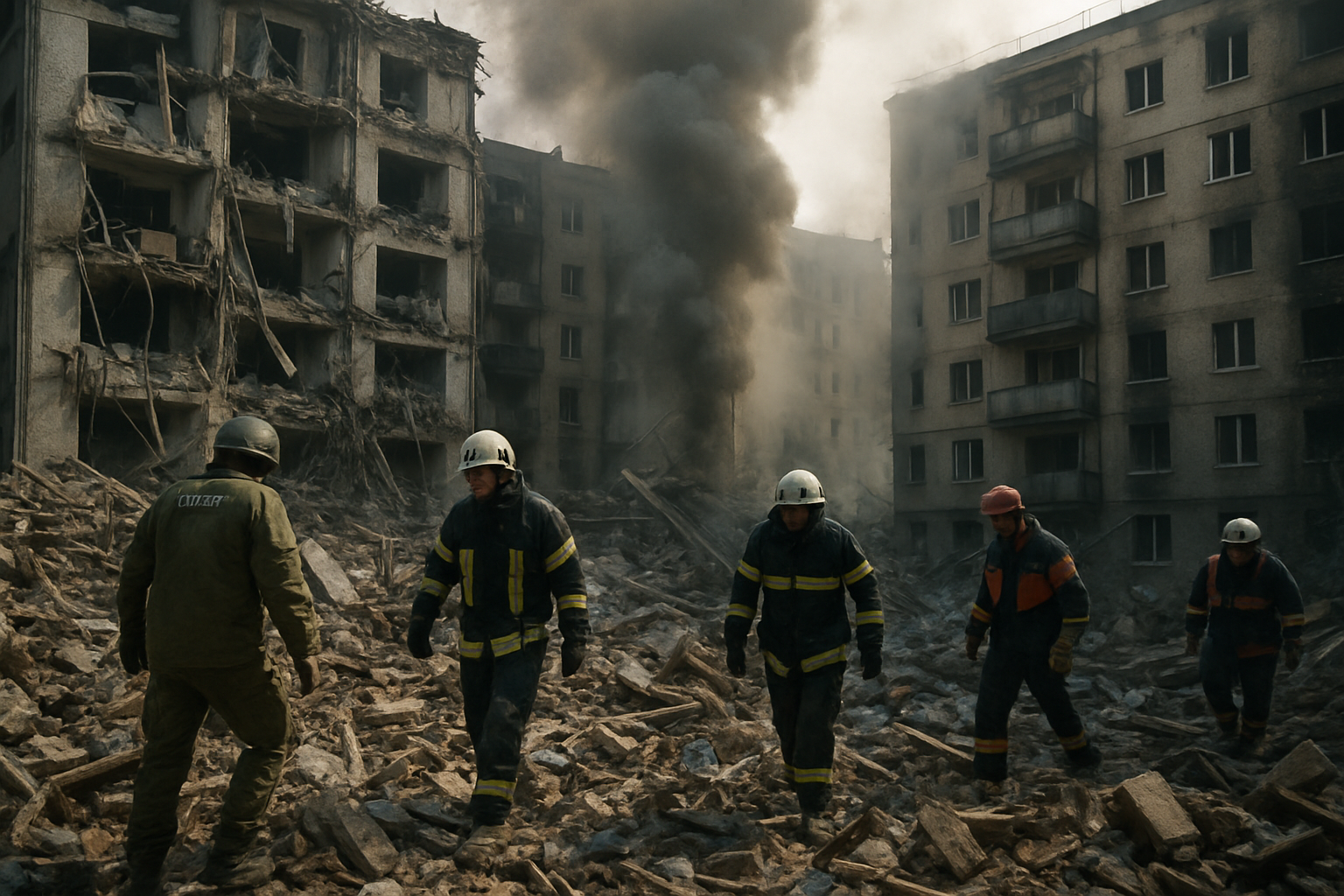
The latest wave of attacks struck multiple Ukrainian regions on April 26, 2026, with the eastern city of Dnipro bearing the heaviest casualties. According to regional military administration head Alexander Hanža, the strikes left 8 people dead and between 47-57 others wounded, including several children. A four-story residential apartment building was partially destroyed in the assault, with rescue operations continuing as authorities feared more casualties trapped beneath the rubble.
Massive Scale of Weekend Offensive
The Russian offensive deployed approximately 660 aerial targets in what represents one of the largest single-day attacks since the conflict began in February 2022. Ukrainian air defense forces managed to intercept 580 drones and 30 missiles, representing an 80% success rate for missiles and 94% for drones. However, the sheer volume of incoming projectiles overwhelmed defensive systems in several areas, allowing multiple strikes to penetrate civilian targets.
Beyond Dnipro, the attacks affected regions across Ukraine. In Sumy, near the Russian border, two men aged 48 and 72 were killed in drone strikes on the town of Bilopillia, located just five kilometers from the Russian frontier. The weekend toll brought the total casualties from Saturday's attacks on Dnipro to eight confirmed deaths.
Spillover into NATO Territory
The expanding geographic scope of the conflict was underscored when Russian drone fragments fell in Romania's Galati region, damaging an electricity pole and household annex. This marks the first documented property damage in a NATO country from Russian military debris, highlighting the growing risks of the conflict's spillover effects. Romanian authorities evacuated the affected area citing concerns about explosive charges, while NATO officials monitored the situation closely.
Peace Talks Remain Indefinitely Suspended
The latest violence comes as diplomatic efforts to end the conflict remain frozen due to the ongoing Iran crisis consuming American foreign policy attention. The trilateral Ukraine-Russia-US negotiations, which achieved significant breakthroughs in February 2026, have been suspended indefinitely since March.
Those February achievements included the largest prisoner exchange in five months, involving 314 individuals, and the restoration of US-Russia military communications after a four-year suspension. Geneva talks had also shown "significant progress" on ceasefire monitoring mechanisms, with European "Big 5" observers (Germany, France, Italy, UK, and Poland) participating for the first time.
"The framework for negotiations remains intact and can be reactivated when conditions permit, but the Iran situation continues to divert American diplomatic resources away from the European theater."
— Senior Western Diplomatic Source
Military Escalation Continues
Despite the diplomatic setbacks, military operations have intensified on both sides. Russian territorial gains accelerated to 481 square kilometers in January 2026 compared to 260 square kilometers in December 2025, representing an 85% increase and the fastest expansion in months. Russia now operates approximately 101,000 troops dedicated specifically to drone operations, creating the largest unmanned force in modern warfare history.
The systematic targeting of civilian infrastructure continues what Ukrainian officials term "energy terrorism." Over 1,170 buildings in Kyiv still lack adequate heating from previous attacks, while Ukrainian nuclear plants were forced to halt electricity production for the first time in the conflict. These tactics violate the Geneva Conventions' protections for civilian populations during armed conflict.
Ukraine's Strategic Transformation
As the conflict evolves, Ukraine has undergone a remarkable strategic transformation from aid recipient to security provider on the global stage. More than 200 Ukrainian military specialists have been deployed to Middle Eastern countries including the UAE, Qatar, Jordan, Bahrain, and Kuwait, where they share expertise in defending against Iranian Shahed drone attacks—the same weapons system being used against Ukrainian civilians.
This evolution has been supported by unprecedented international backing. The European Union's historic €90 billion loan package represents the largest single-nation assistance program ever implemented, though Slovakia, Czech Republic, and Hungary have refused participation, exposing divisions within the bloc.
Nuclear Governance Crisis
The conflict unfolds against the backdrop of an unprecedented nuclear governance crisis. The New START treaty between the United States and Russia expired on February 5, 2026, marking the first time in over 50 years that the two superpowers operate without bilateral nuclear constraints. Both nations control approximately 80% of the world's nuclear weapons, with Russia possessing 4,380 warheads and the US maintaining 3,708.
UN Secretary-General António Guterres has described this as a "grave turning point," warning that nuclear risks are now at their highest level in decades. The restored military communications between Pentagon and Russian General Staff officials represent the only remaining formal superpower diplomatic channel.
Humanitarian Toll Mounts
The human cost of the conflict continues to escalate dramatically. Ukrainian President Volodymyr Zelensky has disclosed that 55,000 Ukrainian soldiers have been officially killed, with a "large number" missing. International estimates suggest actual casualties may be two to three times higher when including undocumented deaths.
The systematic targeting of civilian infrastructure has created a humanitarian crisis affecting over 17.8 million Ukrainians accessing winter support programs. The documented killing of 15 DTEK energy workers while attempting to restore power represents clear violations of international humanitarian law prohibiting attacks on essential services personnel.
International Response and Support
Despite the ongoing violence, international support for Ukraine remains robust, albeit with notable divisions. The United Kingdom has revealed the operation of four Military Repair Organization (MRO) facilities within Ukraine servicing Western equipment, with a fifth facility planned. This represents the first public acknowledgment of extensive military infrastructure on Ukrainian soil.
Sweden and Denmark have committed €246 million for air defense systems, while Germany has delivered 35 Patriot missiles. These contributions demonstrate sustained international commitment to Ukrainian defense capabilities, even as diplomatic channels remain blocked by competing global crises.
Looking Forward: Uncertain Timeline
The timeline for resuming high-level diplomatic negotiations remains entirely dependent on the resolution of the Iran crisis. The preserved framework from February's breakthroughs—including prisoner exchange mechanisms, structured negotiation formats, and Pentagon-Moscow deconfliction protocols—can be reactivated when conditions permit.
However, fundamental territorial disputes remain unchanged. Russia continues to demand recognition of occupied eastern Ukrainian territories and insists on Moscow as the exclusive venue for any Putin-Zelensky talks. Ukraine maintains its position on territorial integrity while seeking long-term security guarantees from Western allies.
The stakes of eventual resumed negotiations extend far beyond Ukraine's borders. Success could provide a template for 21st-century territorial dispute resolution and potentially end Europe's deadliest conflict since World War II. Failure risks continued military escalation with global implications for territorial sovereignty principles and international law enforcement.
As the conflict approaches its fourth anniversary since Russia's full-scale invasion in February 2022, the international community faces a critical test of diplomatic innovation versus military solutions. The outcome will likely determine European security architecture and conflict prevention mechanisms for decades to come, while millions of Ukrainian civilians continue to bear the immediate human cost of this protracted war.