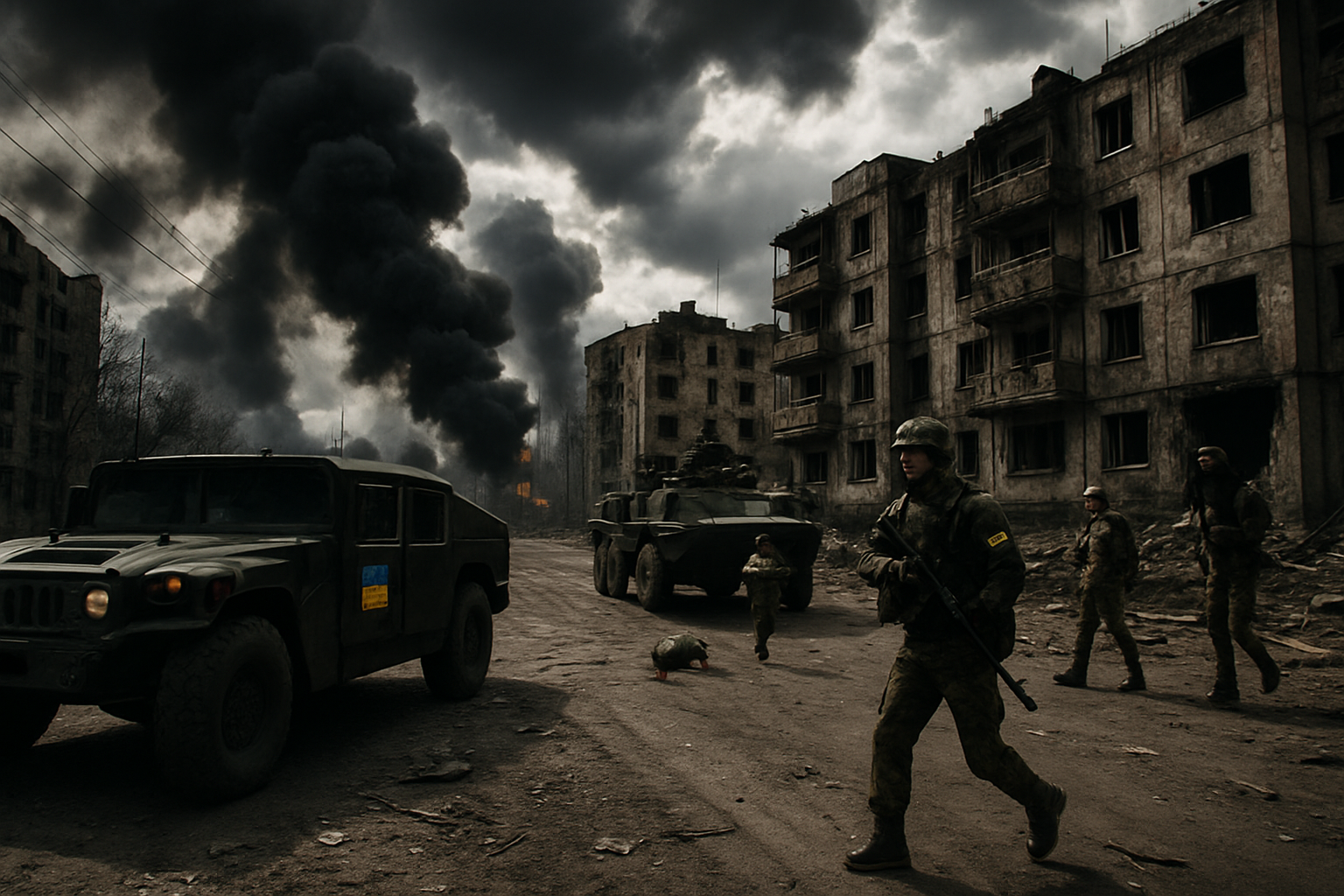
Russian forces launched devastating coordinated attacks across multiple Ukrainian regions on April 22, continuing a pattern of systematic civilian targeting while trilateral peace negotiations between Ukraine, Russia, and the United States remain indefinitely suspended due to the Iran crisis consuming American foreign policy attention.
The latest Russian assault included coordinated strikes on Zaporizhzhia, where a Ukrainian drone attack on Russian territory hit a residential building in Syzran, injuring 11 people including two children and collapsing part of a four-story apartment building. Meanwhile, Ukrainian air defenses successfully neutralized 189 of 215 Russian drones launched since the evening of April 21, demonstrating both the scale of the attacks and Ukraine's defensive capabilities.
Massive Aerial Campaign Targets Civilians
Russian forces recorded 231 combat engagements on the frontline over the past 24 hours, with over 50 attacks concentrated in the Pokrovsk sector alone. The assault pattern reflects Russia's deployment of 101,000 troops dedicated to drone operations by April 2026—the largest unmanned military force in modern warfare history.
Critical infrastructure bore the brunt of attacks, with a Russian drone striking a marshaling yard at the Zaporizhzhia railway station, killing a train engineer's assistant. In the Odesa region, port infrastructure sustained damage during the large-scale overnight drone assault, potentially affecting grain export operations vital to global food security.
"Ukraine's air defense forces neutralized 189 of the 215 drones launched by Russian invaders, demonstrating our continued defensive capabilities despite the overwhelming scale of attacks."
— Ukrainian Air Force Command
The systematic targeting of civilian infrastructure continues what Ukrainian officials describe as "energy terrorism"—a strategy that has left over 1,170 Kyiv buildings without adequate heating and forced nuclear plants to halt electricity production for the first time in the conflict.
Peace Process Stalled by Global Tensions
The suspension of trilateral Ukraine-Russia-US peace negotiations since March 2026 represents a significant setback to diplomatic momentum that had shown historic promise. The February 2026 breakthrough in Abu Dhabi achieved a 314-prisoner exchange—the largest in five months—and restored US-Russia military communications after a four-year suspension.
Geneva talks in February had achieved "significant progress" on ceasefire monitoring mechanisms, with European "Big 5" observers (Germany, France, Italy, UK, Poland) participating for the first time. However, the Iran crisis has diverted American attention from the Ukrainian peace process, leaving the framework preserved but timeline uncertain.
The EU has convened a high-level meeting in Brussels on May 11 specifically addressing the deportation of Ukrainian children to Russia, with Brussels declaring that "Moscow has stolen childhoods." This initiative, organized jointly with Ukraine and Canada, aims to identify, return, and reintegrate the tens of thousands of Ukrainian children forcibly relocated to Russian territory.
Nuclear Governance Crisis Deepens
The conflict unfolds against an unprecedented nuclear governance crisis following the expiration of the New START treaty on February 5, 2026—the first time in over 50 years without US-Russia nuclear constraints. Both nations control 80% of global nuclear weapons, with Russia possessing 4,380 warheads and the US holding 3,708.
Ukraine's Prosecutor General Ruslan Kravchenko revealed that Russia has repeatedly launched drones and missiles on flight paths near the decommissioned Chernobyl nuclear plant, elevating risks of a major accident as Ukraine prepares to mark the 40th anniversary of the 1986 disaster. Thirty-five Kinzhal hypersonic missiles have been documented flying near both Chernobyl and the Khmelnytskyi nuclear plant since the invasion began.
Military Casualties and Human Cost
The latest Ukrainian military assessment reports total Russian combat losses of approximately 1,321,450 personnel from February 24, 2022, to April 22, 2026, including 1,140 troops killed in the past day alone. Ukrainian forces also reported destroying 38 Russian artillery systems and multiple armored vehicles in recent operations.
Ukraine has officially disclosed that 55,000 soldiers have been killed, with "large numbers" missing, though international estimates suggest actual casualties may be 2-3 times higher. The systematic targeting of civilian infrastructure has resulted in 17.8 million Ukrainians requiring winter support programs.
Ukraine's Strategic Transformation
Despite the defensive pressures, Ukraine has undergone a strategic transformation from aid recipient to security provider. Over 200 military specialists have been deployed to UAE, Qatar, Jordan, Bahrain, and Kuwait, sharing expertise in combating Iranian Shahed drones—the same weapons being used to attack Ukrainian infrastructure.
The UK has revealed four operational maintenance, repair, and overhaul (MRO) facilities within Ukraine servicing Western-supplied equipment, with a fifth facility planned. This represents the first public acknowledgment of extensive military infrastructure on Ukrainian soil and signals long-term Western commitment to Ukrainian defense capabilities.
Ukrainian forces have demonstrated sophisticated long-range strike capabilities, with the Armed Forces successfully targeting Russian positions using digital officers deployed in key military units to implement advanced technological solutions.
International Support and Divisions
The European Union has approved a historic €90 billion loan package for Ukraine—the largest single-nation assistance package ever provided. However, significant divisions persist, with Slovakia, Czech Republic, and Hungary refusing participation in the financing arrangement.
Additional international support includes Sweden-Denmark's €246 million air defense systems, Germany's delivery of 35 Patriot missiles, and continued World Bank funding for energy infrastructure restoration. These commitments demonstrate sustained international backing despite internal European disagreements.
Territorial Disputes and Strategic Implications
Eastern Ukrainian territories under Russian control remain the fundamental sticking point in any potential peace negotiations. Russia demands territorial recognition and insists on Moscow as the venue for Putin-Zelensky talks, while Ukraine maintains its territorial integrity position and seeks long-term security guarantees.
Russian territorial gains accelerated to 481 square kilometers in January compared to 260 square kilometers in December 2025—an 85% increase representing the fastest expansion in months. This acceleration potentially strengthens Russia's bargaining position should negotiations resume.
"The European Union stands firmly committed to ensuring that Russian war crimes and atrocities do not go unpunished, as demonstrated by our continued support for international accountability mechanisms."
— EU Foreign Policy Chief Kaja Kallas
Path Forward Uncertain
The timeline for resumed peace negotiations depends on resolution of the Iran situation and broader Middle East stability. Military escalation continues with systematic civilian targeting while Ukraine expands its international partnerships and maintains operational capabilities across multiple fronts.
The stakes extend far beyond Ukraine, encompassing European security architecture redefinition, international law enforcement credibility, and territorial sovereignty principles for the 21st century. Success in eventual resumed talks could end Europe's deadliest war since World War II and provide a conflict resolution template. Failure may intensify operations globally and undermine diplomatic credibility for territorial disputes worldwide.
Despite the current suspension, the diplomatic framework achievements remain intact—prisoner exchange mechanisms, Pentagon-Moscow deconfliction protocols covering operations in Syria, Arctic, and Africa, and structured negotiation formats proven effective for humanitarian results. The UAE methodology of working groups by topic and joint position synchronization has demonstrated that concrete progress is possible even amid military operations.
As the conflict enters its fourth year, the international community watches whether diplomatic innovation can ultimately overcome military escalation in determining European security trajectory with implications lasting decades. The preservation of the peace framework offers hope for reactivation when favorable conditions return, but the immediate priority remains protecting Ukrainian civilians from systematic targeting that continues to violate international humanitarian law.