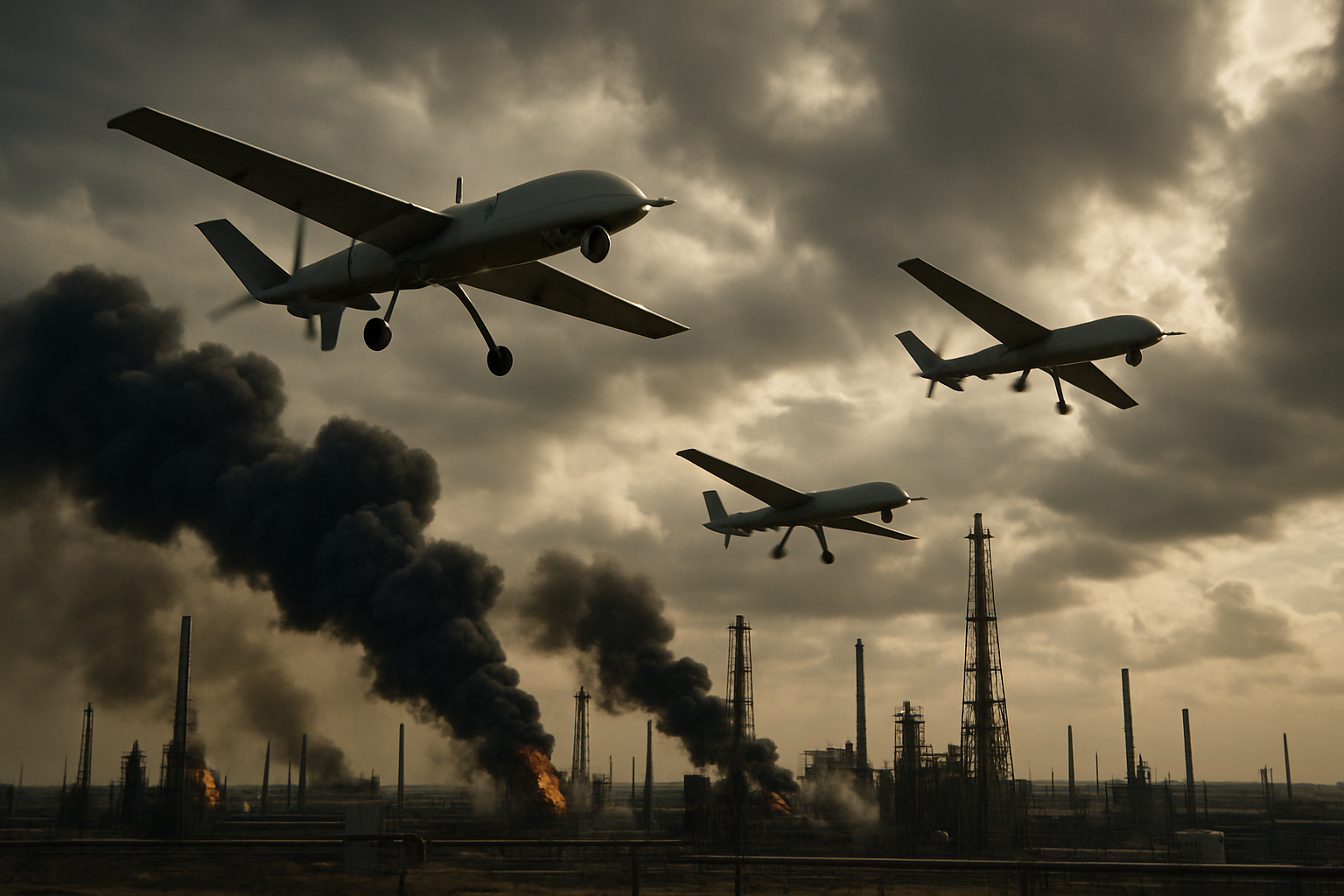
March 2026 became the most extensive month in terms of strategic enterprises struck on Russian territory, with Ukrainian Defense Forces successfully targeting five factories and 10 oil refining facilities in operations spanning from temporarily occupied Crimea to deep rear areas within the Russian Federation.
The unprecedented scale of Ukrainian military operations in March represents a fundamental shift in the conflict's strategic dynamics, demonstrating enhanced long-range capabilities that extend over 2,000 kilometers from Ukrainian territory. These coordinated strikes have targeted critical infrastructure supporting Russia's war effort while dealing significant economic blows to Moscow's energy export revenues.
Strategic Infrastructure Campaign
Ukrainian forces demonstrated remarkable operational reach during March, successfully striking multiple high-value targets across Russian territory. The campaign included precision attacks on the Transneft Port Primorsk terminal, a major Baltic Sea oil export hub near the Finnish border, and the Bashneft-Ufaneftekhim oil refinery in Ufa, operations that forced suspension of critical export facilities.
According to Reuters analysis, Ukrainian operations have successfully disrupted Russian oil export capabilities by approximately 40%, creating substantial economic pressure on Moscow's primary revenue streams. The systematic targeting of western ports and energy infrastructure has stranded dozens of shadow fleet tankers in the Gulf of Finland, with facilities handling up to 700,000 barrels per day forced to halt petroleum loading operations.
"March became one of the most extensive months in terms of the number of strategic enterprises struck in Russia – five factories and 10 oil refining facilities."
— Ukrainian Defense Forces Statement
Crimean Operations Intensify
Operators of the 1st Separate Center of the Unmanned Systems Forces, working in coordination with the Main Intelligence Directorate of Ukraine's Defense Ministry, carried out a series of operations against Russian military targets in temporarily occupied Crimea on April 2. These operations specifically targeted drone depots, aircraft, and radar installations, representing a systematic degradation of Russian operational capabilities in the occupied peninsula.
The Crimean strikes included successful attacks on three BM-30 Smerch/Tornado-S multiple rocket launchers, advanced artillery systems that represent significant military assets. Ukrainian forces also destroyed transport vehicles and fuel tanks, demonstrating the comprehensive nature of their targeting strategy against Russian military infrastructure.
Energy Warfare Evolution
The strategic targeting of Russian energy infrastructure represents a sophisticated evolution in Ukraine's military capabilities. Previous operations throughout the conflict have included strikes on oil depots, refineries, and energy distribution networks across Russian territory, but March's campaign achieved unprecedented scale and coordination.
Estonian intelligence reports confirm that these operations have created lasting economic pressure beyond immediate military impact. Expert Raivo Vare noted that Moscow faces mounting problems with every day that exports are delayed, highlighting the strategic effectiveness of targeting revenue-generating infrastructure rather than purely military assets.
The energy warfare campaign has global implications, occurring against the backdrop of the most severe energy crisis since the 1970s oil shocks. Oil prices surged past $100 per barrel for the first time since 2022, with the International Energy Agency deploying record strategic petroleum reserves to stabilize markets.
Technological and Operational Capabilities
The March operations demonstrate Ukraine's remarkable advancement in long-range strike capabilities, utilizing sophisticated intelligence gathering, precise targeting systems, and successful penetration of Russian air defenses. The use of domestically produced Flamingo cruise missiles in some operations, including strikes reaching 1,400 kilometers into Russian territory, represents a significant technological achievement.
Ukrainian forces have also employed innovative drone swarm tactics, with operations involving hundreds of unmanned aircraft simultaneously challenging modern air defense systems. The largest single operation involved 283 drones targeting multiple Russian facilities, described by Russian sources as "the most massive Ukrainian drone attack" they had faced.
These capabilities reflect the benefits of international military cooperation and technology sharing that have evolved throughout the conflict. The UK has revealed four operational maintenance, repair, and overhaul (MRO) facilities within Ukraine servicing Western-supplied equipment, with a fifth facility planned, representing the first public acknowledgment of extensive military infrastructure on Ukrainian soil.
Regional Security Implications
The extended range and success of Ukrainian operations carry significant regional security implications, particularly given their proximity to NATO territories. Strikes near the Finnish border, including attacks on the Ust-Luga oil export terminal in Leningrad region, demonstrate the conflict's geographic expansion and potential spillover effects.
Several incidents have already occurred involving Ukrainian drones in neighboring countries during operations against Russian targets. Estonia confirmed fewer than 10 drones entered Estonian airspace, with at least one crash in Tartu County, while Latvia and Romania also reported drone debris discoveries during major Ukrainian offensive operations targeting Russian Baltic facilities.
"The attack was repelled by joint efforts of Russian Defense Ministry forces and mobile task forces, preventing damage to the Gazprom PJSC facility."
— Gazprom Statement on TurkStream Pipeline Defense
Diplomatic Context and Peace Efforts
The intensification of Ukrainian strikes occurs amid a complex diplomatic landscape where peace negotiations remain indefinitely suspended due to the Iran crisis consuming American foreign policy attention. The February 2026 breakthrough that achieved a historic 314-prisoner exchange and restored US-Russia military communications after a four-year suspension has been stalled by competing international priorities.
Despite the suspension, the diplomatic framework remains preserved for potential reactivation when conditions permit. The achievements include prisoner exchange mechanisms, Pentagon-Moscow deconfliction protocols covering Syria, Arctic, and Africa operations, and structured negotiation formats that proved effective in achieving concrete humanitarian results.
President Zelensky has maintained firm positions on territorial integrity, categorically rejecting any territorial concessions in the Donbas region. The fundamental sticking point remains unchanged: eastern Ukrainian territories under Russian control, with Russia demanding territorial recognition while Ukraine maintains its territorial integrity position.
Strategic Transformation and Global Partnerships
Ukraine's military capabilities have evolved significantly beyond traditional defensive postures. The country has transformed from an aid recipient to a security provider, with Ukrainian military experts now deployed to five Middle East countries—UAE, Qatar, Jordan, Bahrain, and Kuwait—to combat Iranian Shahed drone attacks, the same weapons systems that have devastated Ukrainian infrastructure.
This evolution represents a strategic pivot that leverages hard-earned battlefield experience into new international partnerships. The cooperation with Gulf states includes comprehensive defense agreements focusing on joint production chains and expertise exchange in missile and drone defense systems.
Humanitarian and Economic Impact
The systematic targeting of infrastructure occurs against a backdrop of severe humanitarian challenges. Over 17.8 million Ukrainians are accessing winter support programs, while systematic civilian targeting continues to violate Geneva Conventions. The disclosure that 55,000 Ukrainian soldiers have been officially killed, with estimates suggesting actual casualties may be two to three times higher, underscores the human cost of the conflict.
Russian energy terrorism has left more than 1,170 Kyiv buildings without adequate heating, while Ukrainian nuclear plants were forced to halt electricity production for the first time in the conflict following grid attacks. This "winter weapon" strategy deliberately targets civilian infrastructure during extreme weather conditions.
International Response and Support
The international community has maintained unprecedented support for Ukraine despite political divisions within the European Union. The historic €90 billion EU loan package represents the largest single-nation assistance package in European history, though Slovakia, Czech Republic, and Hungary have refused participation, exposing persistent divisions in unified Western policy.
Military support continues with Germany providing 35 Patriot missiles, Sweden and Denmark contributing €246 million for air defense systems, and various nations supplying advanced weaponry. However, competing global priorities, particularly the Iran crisis, have strained resources and political attention.
Looking Forward: Strategic Implications
The March 2026 operations represent a watershed moment in the conflict, demonstrating Ukraine's capability to conduct sophisticated, coordinated strikes against strategic Russian assets while maintaining defensive positions across multiple fronts. These operations signal a potential shift toward more proactive targeting of Russian war-supporting infrastructure at its source.
The success of these operations may influence the eventual resumption of peace negotiations, potentially providing Ukraine with enhanced leverage when diplomatic conditions improve. However, the timeline for renewed negotiations depends heavily on resolution of the Iran crisis and broader Middle East stability.
The strategic implications extend far beyond the immediate conflict, affecting 21st-century approaches to territorial disputes, energy security, and international conflict resolution. Success or failure in eventual resumed negotiations will carry global implications for territorial sovereignty principles, European security architecture, and the credibility of diplomatic versus military solutions to international disputes.
As Ukraine continues to expand its international partnerships and enhance operational capabilities, the March campaign serves as a template for how modern conflicts may evolve, combining traditional military operations with economic warfare and strategic partnerships that transcend geographic boundaries. The outcome will significantly influence international relations and conflict prevention mechanisms for decades to come.