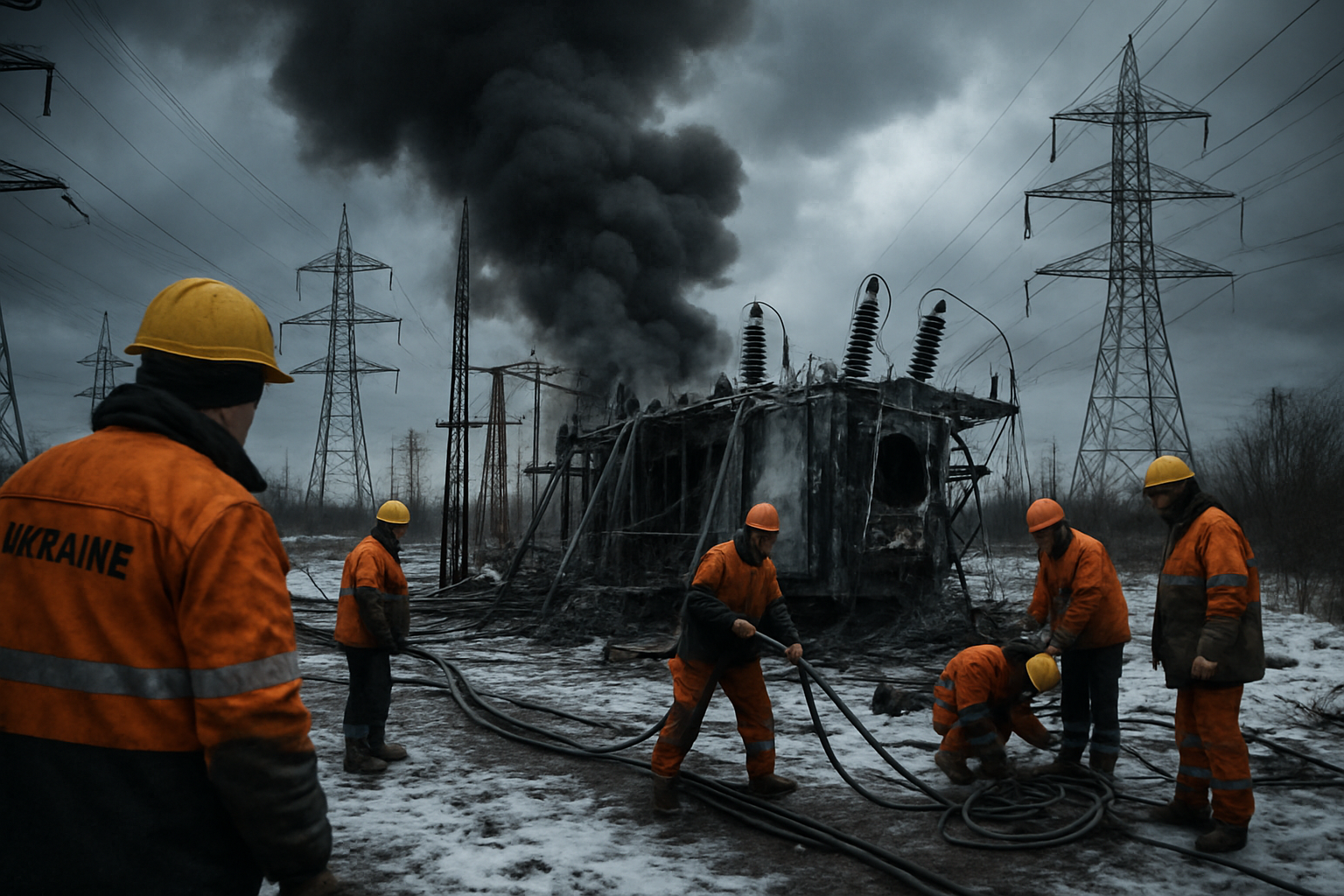
Ukrainian President Volodymyr Zelensky announced Monday evening that Ukraine has proposed a mutual energy infrastructure truce to Russia through American mediators, even as both countries continue devastating attacks on power facilities that have killed multiple civilians and left thousands without electricity.
"If Russia is prepared to stop strikes on our energy sector, we are ready to respond in the same manner," Zelensky declared during his evening address, revealing that this proposal had already been transmitted to Moscow through U.S. intermediaries. The offer comes as Ukraine faces one of its most challenging winters since the war began, with systematic targeting of civilian infrastructure continuing to claim lives and disrupt essential services.
Deadly Attacks Continue Despite Diplomatic Overtures
The energy truce proposal was announced against the backdrop of continued violence across multiple Ukrainian regions. In the Black Sea port city of Odesa, Russian drone strikes overnight Monday killed at least three people, including a 30-year-old woman and her two-year-old daughter, while damaging residential buildings and energy infrastructure according to regional governor reports.
The casualties in Odesa represent just the latest in a pattern of systematic civilian targeting that has characterized Russia's approach throughout the conflict. Chinese media reports indicated that 15 residents were injured in the attack, including a pregnant woman and two children, when a drone struck a multi-story residential building in what officials describe as deliberate targeting of civilian areas.
Meanwhile, attacks on Ukraine's energy infrastructure have left approximately 10,000 consumers without power in the Chernihiv region after strikes on energy facilities. The systematic nature of these attacks has led Ukrainian officials to characterize them as "energy terrorism" - a deliberate strategy to weaponize winter conditions against the civilian population.
Context of Stalled Peace Negotiations
Zelensky's energy truce proposal comes as comprehensive peace negotiations between Ukraine, Russia, and the United States remain indefinitely suspended due to the Iran crisis consuming American foreign policy attention. The diplomatic stalemate represents a significant setback from the breakthrough momentum achieved in February 2026.
Those February achievements included a historic 314-prisoner exchange - the first in five months - and the restoration of U.S.-Russia military communications after a four-year suspension. The Geneva talks in February had shown "significant progress" on ceasefire monitoring mechanisms, with European "Big Five" observers (Germany, France, Italy, UK, Poland) participating for the first time in the trilateral format.
However, the framework established through those negotiations remains preserved and could be reactivated when the Iranian crisis permits American refocus on European security issues. The Pentagon-Moscow deconfliction protocols covering operations in Syria, the Arctic, and Africa continue to function, representing the only remaining formal diplomatic channel between the nuclear superpowers.
Energy Infrastructure as a Weapon of War
The targeting of energy infrastructure has become a defining feature of Russia's military strategy, particularly during winter months when power outages can prove life-threatening. Over 1,170 buildings in Kyiv still lack adequate heating from previous attacks, while Ukrainian nuclear plants were forced to halt electricity production for the first time in the conflict following Russian strikes on electrical distribution networks.
The systematic nature of these attacks extends beyond mere infrastructure destruction. Reports indicate that 15 DTEK energy workers have been killed while attempting to restore power systems, suggesting a deliberate targeting of repair personnel to maximize the long-term impact of infrastructure damage. This pattern has been documented as violations of the Geneva Conventions' protections for civilian infrastructure and emergency services personnel.
Ukrainian officials have characterized this strategy as "energy terrorism," noting that attacks consistently intensify during diplomatic engagement periods, appearing to serve as both a military tactic and a negotiating pressure tool. The World Bank has allocated $40 million specifically for energy restoration efforts, while the EU has approved a historic €90 billion loan package - the largest single-nation assistance package in EU history.
Nuclear Governance Crisis Adds Urgency
The energy truce proposal comes against the backdrop of an unprecedented nuclear governance crisis. The New START treaty between the United States and Russia expired on February 5, 2026, marking the first time in over 50 years without bilateral nuclear constraints between the two superpowers who control approximately 80% of global nuclear weapons.
UN Secretary-General António Guterres has described this as a "grave turning point," warning that nuclear risks are now at their "highest in decades." The restored military communications channel between Pentagon and Russian General Staff operations represents the only remaining formal diplomatic connection between the nuclear superpowers, adding extraordinary urgency to any potential diplomatic breakthrough.
The intersection of energy warfare and nuclear facilities has created particular concern among international observers. Ukrainian Foreign Minister Dmytro Kuleba has warned that attacks on energy infrastructure put "all of Europe at risk of nuclear incident," highlighting how regional conflicts can have continent-wide implications in the modern interconnected world.
Ukraine's Strategic Evolution
While proposing the energy truce, Ukraine has simultaneously evolved from an aid recipient to a security provider on the global stage. Ukrainian military experts have been deployed to the UAE, Qatar, Jordan, Bahrain, and Kuwait to share expertise in combating Iranian Shahed drones - the same weapons being used to attack Ukrainian infrastructure.
This strategic pivot demonstrates how battlefield experience is being leveraged into new international partnerships that could provide Ukraine with additional diplomatic leverage when negotiations eventually resume. The UK has also revealed four operational Maintenance, Repair, and Operations (MRO) facilities in Ukraine servicing Western-supplied equipment, with a fifth facility planned, representing the first public acknowledgment of extensive military infrastructure on Ukrainian soil.
Humanitarian Crisis Deepens
The human cost of the energy warfare strategy continues to mount. President Zelensky has disclosed that 55,000 Ukrainian soldiers have been officially confirmed killed, with a "large number" still missing in action. International estimates suggest actual casualties could be 2-3 times higher when including undocumented deaths and missing personnel.
Over 17.8 million Ukrainians are accessing winter support programs, highlighting the scale of the humanitarian crisis created by systematic infrastructure targeting. The attacks on civilian facilities during extreme winter conditions represent calculated humanitarian pressure tactics that international legal experts have documented as violations of international humanitarian law.
International Response and Support
Despite the ongoing crisis, international support for Ukraine remains substantial, though not without divisions. The EU's €90 billion loan package faced opposition from Slovakia, Czech Republic, and Hungary, who refused to participate in the financing, exposing persistent divisions within European unity on Ukraine policy.
Sweden and Denmark have provided €246 million for air defense systems, including advanced Tridon Mk2 systems, while Germany has supplied 35 Patriot missiles. However, these defensive measures struggle to counter the sheer volume of attacks, with Russia launching over 700 drones in recent 24-hour periods according to Ukrainian air defense reports.
Hungarian Prime Minister Viktor Orbán's threats to veto both the loan package and sanctions over the Druzhba pipeline dispute have created what Lithuania's Foreign Minister has called a crisis where the "EU cannot become Budapest's hostage," highlighting how domestic European politics can impact Ukraine's defensive capabilities.
Territorial Disputes Remain Unchanged
Despite the energy truce proposal, fundamental territorial disagreements that have prevented comprehensive peace remain unresolved. Russia continues to demand recognition of occupied eastern Ukrainian territories and insists that any Putin-Zelensky talks must occur in Moscow. Ukraine maintains its territorial integrity position while seeking long-term security guarantees from Western partners.
Russian territorial gains accelerated to 481 square kilometers in January 2026 compared to 260 square kilometers in December 2025, representing an 85% increase and the fastest monthly expansion in the conflict. This acceleration potentially strengthens Moscow's bargaining position for any eventual resumed negotiations while demonstrating that military pressure continues alongside diplomatic overtures.
Looking Ahead: Uncertain Timeline
The timeline for renewed comprehensive negotiations depends largely on the resolution of the Iran crisis that has consumed American foreign policy attention since March 2026. The Trump administration's June 2026 deadline for Washington venue talks remains uncertain due to competing Middle East priorities, though the diplomatic framework established through earlier negotiations remains preserved for potential reactivation.
The energy truce proposal represents both an opportunity and a test of genuine commitment to protecting civilians from the effects of modern warfare. Success could provide a model for reducing humanitarian suffering in contemporary conflicts, while failure could normalize the targeting of civilian infrastructure as an acceptable military strategy.
Global Implications
The stakes extend far beyond Ukraine and Russia, affecting the broader international order and setting precedents for 21st-century conflict resolution. The systematic targeting of civilian infrastructure during extreme weather conditions represents a new dimension in modern warfare that could influence how future conflicts are conducted globally.
European security architecture faces potential redefinition based on the outcome of any resumed negotiations. Success could end Europe's deadliest war since World War II and provide a template for territorial dispute resolution, while failure could intensify military operations globally and undermine confidence in diplomatic solutions to territorial disputes.
The energy truce proposal, while modest in scope compared to comprehensive peace negotiations, represents a crucial test of whether humanitarian considerations can transcend military objectives in contemporary warfare. As Ukraine enters what President Zelensky has called the "most difficult winter since the beginning of the war," the international community watches to see whether even limited agreements to protect civilian infrastructure remain possible in an increasingly polarized global security environment.