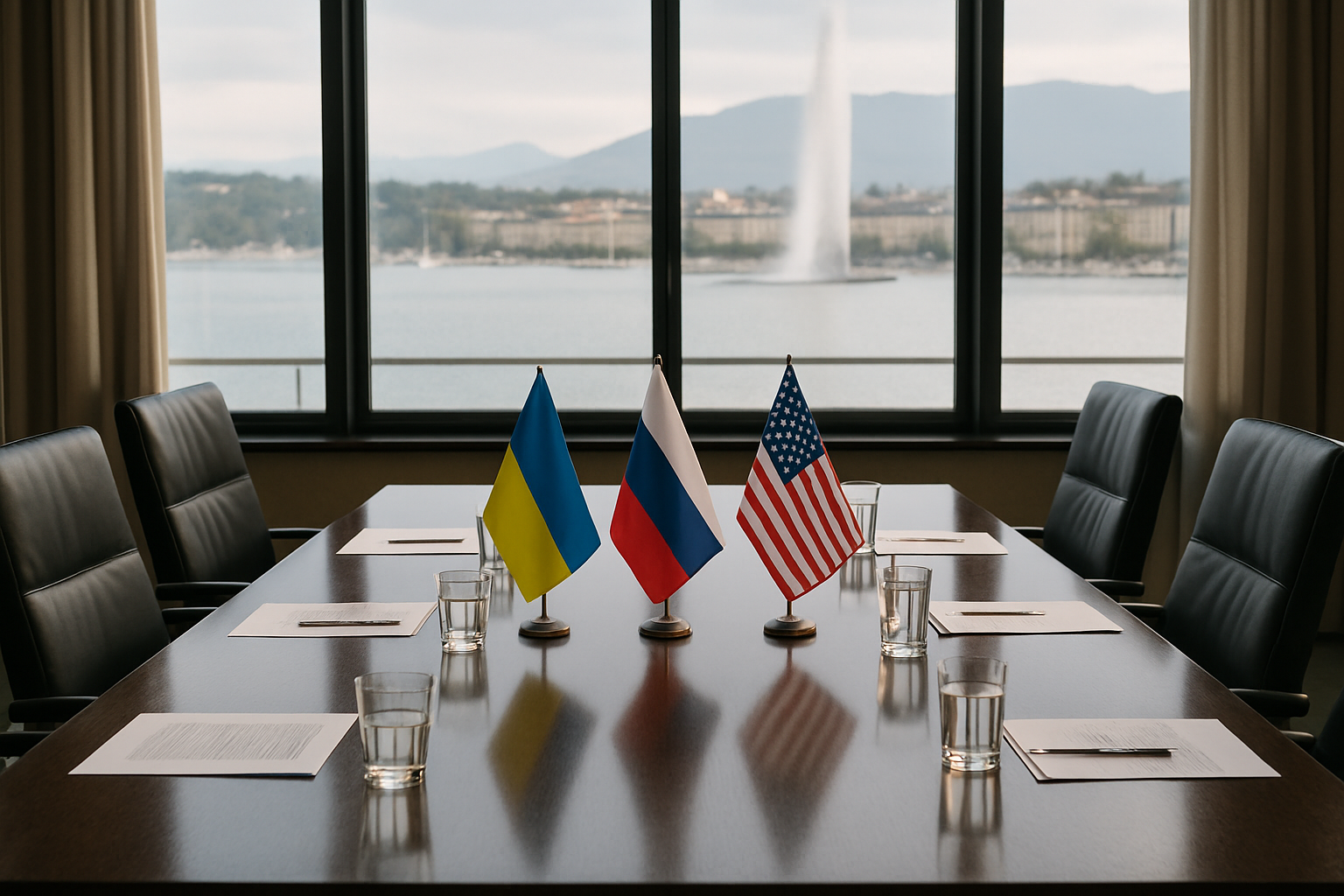
Ukrainian Defense Secretary Rustem Umerov has begun crucial meetings with Trump administration officials Steve Witkoff and Jared Kushner in Geneva, building on recent diplomatic breakthroughs that have achieved significant progress on ceasefire monitoring mechanisms despite ongoing territorial disputes between Ukraine and Russia.
The meetings represent the latest evolution in peace negotiations that began with the historic Abu Dhabi breakthrough earlier this month, which achieved a 314-prisoner exchange - the first in five months - and restored US-Russia military communications after a four-year suspension.
Geneva Talks Build on Diplomatic Momentum
According to multiple diplomatic sources, the current Geneva discussions are focusing on economic recovery measures for Ukraine, with Umerov stating that delegations will "work on measures of economic support and recovery for Ukraine." The talks come as the Trump administration has established a June 2026 deadline for comprehensive peace negotiations to move to Washington, potentially involving presidential-level engagement.
Recent peace talks in Geneva from February 17-18 marked a significant diplomatic milestone, with US Special Envoy Steve Witkoff reporting "significant progress" on ceasefire monitoring mechanisms. For the first time, the European "Big 5" nations - Germany, France, Italy, UK, and Poland - participated as observers, adding institutional weight to the trilateral format.
"We are working on measures of economic support and recovery for Ukraine"
— Rustem Umerov, Ukrainian Defense Secretary
Massive Russian Attacks Continue
Even as diplomatic efforts continue, Russia launched one of its largest attacks of 2026 this week, targeting eight Ukrainian regions with dozens of missiles and hundreds of drones. The systematic targeting of civilian infrastructure has left over 1,170 Kyiv buildings without heating during temperatures reaching minus-30°C, representing what Ukrainian officials describe as "energy terrorism."
Russian Foreign Minister Sergei Lavrov declared that Russia has "no deadlines" for ending the war, while Moscow has demanded that European nations should "stay under the negotiating table" as they were "not invited" to talks. Russian spokesperson Maria Zakharova stated Europeans "should be silent, they have cheated and deceived."
The attacks have resulted in significant casualties, with Ukrainian President Volodymyr Zelensky disclosing that 55,000 Ukrainian soldiers have been officially killed, with a "large number" missing. International estimates suggest actual casualties may be 2-3 times higher.
Body Exchanges Amid Conflict
In a rare humanitarian gesture amid the violence, Russia returned the bodies of 1,000 Ukrainian soldiers in exchange for the remains of 35 Russian troops, according to Kremlin adviser Vladimir Medinsky. This exchange represents part of ongoing repatriation efforts, with Ukraine having received approximately 18,000 bodies from Russia since the start of the full-scale invasion.
The prisoner and body exchanges serve as confidence-building measures that have enabled continued diplomatic engagement despite fundamental disagreements over territorial control.
Nuclear Crisis Backdrop
The peace talks occur against the backdrop of an unprecedented nuclear governance crisis. The New START treaty between the US and Russia expired on February 5, 2026 - marking the first time in over 50 years without bilateral nuclear constraints between the superpowers who control 80% of global nuclear weapons.
UN Secretary-General António Guterres has warned of a "grave turning point," stating that nuclear risks are at their "highest in decades." The restoration of US-Russia military communications through the Abu Dhabi framework represents the only remaining formal diplomatic channel between the nuclear superpowers.
International Support Remains Strong
Despite the ongoing violence, international support for Ukraine continues at historic levels. The European Union has approved a €90 billion loan package - the largest single-nation assistance ever provided. However, Slovakia, Czech Republic, and Hungary have refused to participate in the financing, revealing continued divisions within the EU.
Additional support includes Sweden and Denmark providing €246 million for air defense systems, and Germany supplying 35 Patriot missiles. Over 17.8 million Ukrainians are currently accessing winter support programs as the country faces systematic attacks on its energy infrastructure.
Cross-Border Violence Continues
The conflict has also seen escalation on Russian territory, with Ukrainian drone strikes killing 2 people in the border regions of Belgorod and Kursk. These areas regularly face attacks from Ukraine as the war extends beyond Ukrainian borders. Meanwhile, Ukrainian forces have successfully struck Russian military infrastructure, including radar stations in occupied Crimea.
The International Crimea Platform participants have reaffirmed their commitment to Ukraine's territorial integrity, maintaining non-recognition of Russia's illegal annexation of Crimea and Ukraine's Donetsk, Luhansk, Kherson, and Zaporizhzhia regions.
Territorial Disputes Remain Central Challenge
The fundamental sticking point in all negotiations remains the status of eastern Ukrainian territories currently under Russian control. Russia has accelerated territorial gains, capturing 481 square kilometers in January compared to 260 square kilometers in December 2025 - an 85% increase representing the fastest territorial expansion in months.
Russia demands territorial recognition and insists that any Putin-Zelensky summit must occur in Moscow. Ukraine maintains its position on territorial integrity while seeking long-term security guarantees. Zelensky has demanded 20-30 year security guarantees from the US, compared to reported American proposals for 15-year arrangements.
Strategic Stakes for Global Order
The current diplomatic efforts represent the most significant opportunity to end what has become Europe's deadliest conflict since World War II. Success could provide a template for 21st-century conflict resolution, while failure may lead to intensified military operations and undermine diplomatic credibility for territorial disputes worldwide.
The stakes extend beyond Ukraine and Russia, affecting European security architecture, international law enforcement, and territorial sovereignty principles that will shape global power competition for decades to come.
Looking Toward June Deadline
The Trump administration's June 2026 deadline for Washington-venue talks creates unprecedented pressure for innovative territorial compromise solutions. The evolution from Abu Dhabi to Geneva to potential Washington negotiations suggests a deliberate diplomatic escalation strategy aimed at achieving breakthrough solutions.
However, with fundamental positions remaining far apart on territorial control and the continued military escalation amid diplomatic engagement, the coming months will test whether sustained diplomatic innovation can overcome decades-old challenges or whether the conflict will continue its devastating trajectory.
Polish Foreign Minister has noted that the Ukraine war will decide the "third pillar" of global order, emphasizing the far-reaching implications of these negotiations for international stability and the rule of law in the 21st century.