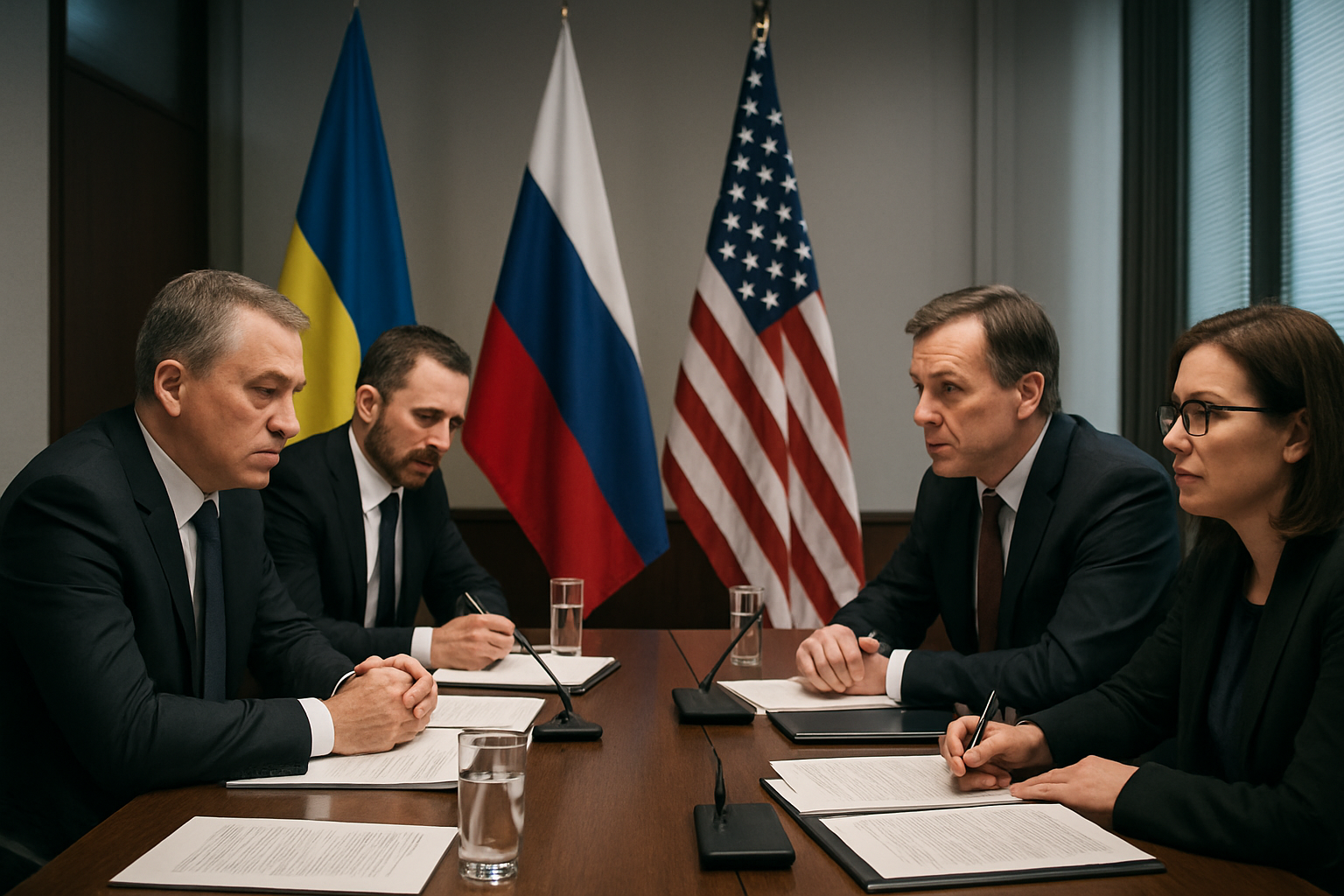
Ukrainian President Volodymyr Zelensky has revealed that the timing of the next round of peace negotiations depends entirely on the United States' position, as the Trump administration has ordered indefinite delays in trilateral talks with Russia citing complications from the Iran crisis.
Speaking to reporters on March 13, Zelensky confirmed that Ukraine was "ready to travel to Turkey" for the next round of negotiations but was informed by American officials that the talks would be postponed. "We were ready to travel to Turkey. They postponed this meeting. It was specifically the American side that postponed it, saying: 'Let's do it next week,'" Zelensky stated during his visit to Paris.
Historic Diplomatic Momentum Interrupted
The postponement represents a significant setback to what had been the most promising diplomatic progress since the conflict began nearly four years ago. The talks had evolved through three successful phases: the groundbreaking Abu Dhabi summit in February, the Geneva negotiations featuring European observers, and a planned Washington venue that would potentially involve presidential-level engagement.
The February breakthrough in Abu Dhabi achieved historic results, including a 314-prisoner exchange—the first in five months—and the restoration of US-Russia military communications after a four-year suspension. These developments established Pentagon deconfliction protocols covering global operations in Syria, the Arctic, and Africa, representing the most substantial US-Russia military agreement since the conflict began.
"Due to the situation around Iran, there are still no necessary signals for trilateral meeting, but talks will resume as soon as the security situation and general political context allow."
— Volodymyr Zelensky, Ukrainian President
Iran Crisis Derails European Security Priorities
The indefinite postponement stems from competing Middle East priorities, as the Iran crisis has diverted Western air defense systems away from Ukraine to Gulf states. Zelensky noted the stark disparity in resources, revealing that Gulf nations used more PAC-3 missiles against Iran in recent days than Ukraine has received from the US over four years.
This resource reallocation has forced Ukraine to pivot strategically, with Zelensky announcing the deployment of Ukrainian military experts to Persian Gulf states including the UAE, Qatar, Jordan, Bahrain, and Kuwait. These experts will help combat Iranian Shahed drone attacks—ironically, the same weapons that have been devastating Ukrainian infrastructure.
Territorial Disputes Remain Core Challenge
Despite the humanitarian breakthroughs achieved in earlier rounds, the fundamental territorial sticking point remains unchanged. Eastern Ukrainian territories under Russian control continue to be the core disagreement between the parties. Russia demands territorial recognition and insists that any Putin-Zelensky talks must occur in Moscow, while Ukraine maintains its territorial integrity position and seeks long-term security guarantees.
The military context continues to deteriorate, with Russian territorial gains accelerating to 481 square kilometers in January 2026 compared to 260 square kilometers in December 2025—an 85% increase representing the fastest gains in months. Over 10,000 Russian drones and bombs were launched in January alone, part of a systematic "energy terrorism" strategy that has left more than 1,170 buildings in Kyiv without heating during sub-zero temperatures.
Nuclear Governance Crisis Adds Urgency
The diplomatic delays occur against the backdrop of an unprecedented nuclear governance crisis. The New START treaty expired on February 5, 2026, marking the first time in over 50 years without US-Russia nuclear constraints. Both superpowers control 80% of global nuclear weapons—Russia with 4,380 warheads and the US with 3,708—making the restored military communications the only remaining formal diplomatic channel between the nuclear powers.
UN Secretary-General António Guterres has described this as a "grave turning point," warning that nuclear risks are at their "highest in decades." The nuclear governance vacuum adds extraordinary urgency to resolving the conflict through diplomatic means.
International Support Remains Strong Despite Divisions
Despite the diplomatic setback, international support for Ukraine continues at historic levels. The European Union has approved a €90 billion loan package—the largest single-nation assistance in EU history—though Slovakia, Czech Republic, and Hungary have refused participation, exposing deep divisions within the bloc.
Additional military support includes Sweden-Denmark's €246 million air defense package featuring Tridon systems, Germany's delivery of 35 Patriot missiles, and ongoing World Bank funding for energy restoration. Over 17.8 million Ukrainians continue to access winter support programs as the energy infrastructure remains under systematic attack.
Humanitarian Cost Continues to Mount
The human cost of the conflict continues to escalate dramatically. President Zelensky has disclosed that 55,000 Ukrainian soldiers have been officially killed, with a "large number" still classified as missing in action. International estimates suggest actual casualties could be two to three times higher when including undocumented deaths and missing personnel.
Systematic targeting of civilians continues in violation of Geneva Conventions. Recent attacks in Bohodukhiv killed four civilians including three children—two one-year-olds and one two-year-old—plus their father. This represents the second deadly attack on the same town within three days, demonstrating a pattern of systematic civilian targeting.
June Deadline in Jeopardy
The Trump administration had established a June 2026 comprehensive peace timeline with a Washington venue that would potentially involve presidential-level engagement. This deadline now faces uncertainty due to competing Middle East priorities and the indefinite postponement of trilateral negotiations.
The evolution from Abu Dhabi to Geneva to Washington had represented a deliberate diplomatic escalation strategy, with each venue offering unique advantages: UAE neutral hosting, Swiss institutional mediation, and US executive implementation authority. This carefully constructed framework now risks collapse due to external crises.
Framework Preservation Critical for Future
Despite the postponement, diplomatic achievements from earlier rounds remain intact and can be reactivated when conditions permit. The UAE methodology—utilizing working groups by topic followed by joint position synchronization—proved effective for achieving concrete humanitarian results. The prisoner exchange mechanisms and structured negotiation format provide a tested foundation for future engagement.
The Pentagon deconfliction protocols with Moscow represent the most significant US-Russia agreement since the conflict began, covering global operations and including transparency mechanisms to reduce escalation. This framework serves as the sole remaining formal diplomatic channel between the superpowers.
Strategic Stakes for Global Order
The postponed talks represent more than a bilateral Ukraine-Russia issue—they constitute a test of 21st-century conflict resolution mechanisms. Success could provide a template for territorial dispute resolution and end Europe's deadliest war since World War II. Failure may intensify military operations globally and undermine the credibility of diplomatic solutions to territorial disputes worldwide.
The stakes extend to fundamental questions of European security architecture, international law enforcement, and territorial sovereignty principles that will shape power competition for decades to come. The international community now faces the challenge of managing multiple simultaneous crises while preserving momentum for Europe's most significant security challenge since the Cold War.
Looking Ahead
The timeline for resumed negotiations depends entirely on resolving the Iran situation and Western strategic priorities. Military escalation continues with systematic civilian targeting while Ukraine expands its international partnerships through its new role as a security provider in the Middle East.
When talks eventually resume, they will face the ultimate test of whether territorial compromise innovation can bridge fundamental positions that remain far apart. The success or failure of this diplomatic initiative will determine whether innovative solutions can resolve complex territorial disputes or whether military escalation remains the dominant approach to international conflict resolution.
As Zelensky noted, Ukraine remains ready to participate in peace negotiations, but the timing now rests entirely with American strategic calculations and the broader geopolitical landscape. The world watches to see whether competing priorities will permanently derail the most significant diplomatic opportunity since the conflict began, or whether the framework can be preserved for future reactivation when conditions permit.