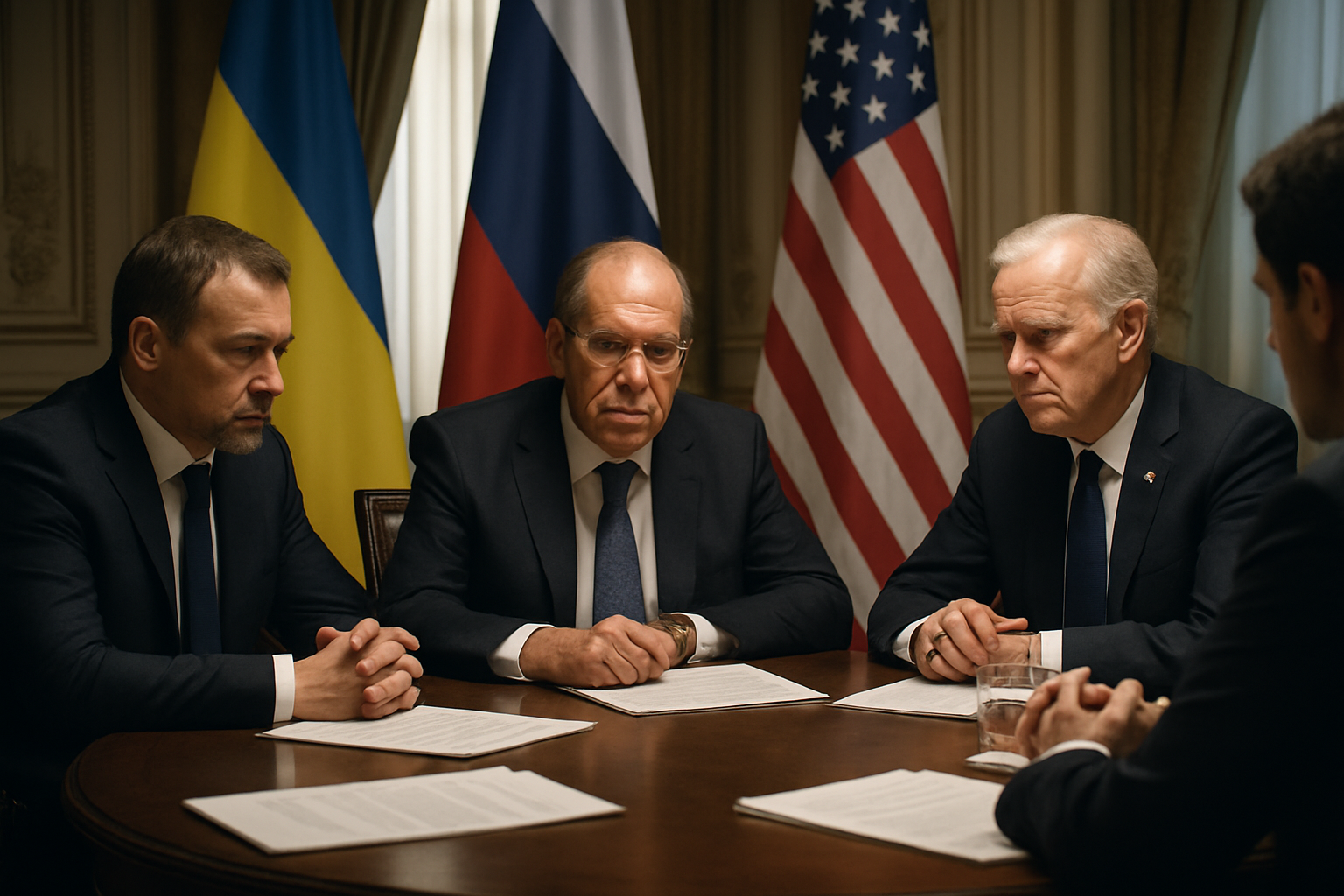
Promising peace negotiations between Ukraine, Russia, and the United States have been suspended indefinitely due to the escalating Iran crisis, President Volodymyr Zelensky announced Saturday, dealing a major blow to diplomatic efforts that had achieved unprecedented breakthroughs including prisoner exchanges and restored military communications.
Speaking to reporters, Zelensky confirmed Ukrainian negotiators had departed for the United States for weekend meetings with American officials but emphasized that trilateral talks remain on hold. "Due to the situation around Iran, there are still no necessary signals for trilateral meeting," the Ukrainian president stated, adding that negotiations would resume "as soon as the security situation and general political context allow."
Diplomatic Framework at Risk
The suspension represents a critical setback for what had emerged as the most significant diplomatic opportunity since Russia's February 2022 invasion. The trilateral negotiation framework had achieved remarkable progress in recent months, including a historic 314-prisoner exchange in February — the first such swap in five months — and the restoration of US-Russia military communications after a four-year suspension.
Austrian sources revealed additional tensions, reporting that Russian President Vladimir Putin had allegedly offered the United States a deal to withhold Russian targeting data from Iran if Americans stopped providing similar intelligence to Ukraine. This proposal highlights the complex interconnections between regional conflicts that are now derailing Ukrainian peace efforts.
The Geneva talks in February had achieved "significant progress" on ceasefire monitoring mechanisms according to US Special Envoy Steve Witkoff, with European "Big Five" observers (Germany, France, Italy, UK, Poland) participating for the first time. The evolution from Abu Dhabi to Geneva to a planned Washington venue had suggested deliberate diplomatic escalation toward potential presidential-level engagement.
Military Situation Deteriorates
While diplomacy stalls, military operations continue to intensify across Ukraine. Russian forces have accelerated territorial gains, capturing 481 square kilometers in January 2026 compared to 260 square kilometers in December 2025 — an 85 percent increase representing the fastest expansion in months. Ukrainian officials report Russia launched over 10,000 drones and bombs in January alone.
Recent attacks have demonstrated Russia's continued targeting of civilian infrastructure. Parts of Kyiv lost electricity and water Saturday evening due to power grid incidents, affecting areas east of the Dnipro River. Emergency crews were dispatched immediately to restore services, but the outages highlight Ukraine's ongoing vulnerability to systematic infrastructure attacks.
In the Kursk region, Ukrainian military operations resulted in damage to five vehicles and a private residence according to Russian military sources, indicating continued cross-border activities despite diplomatic efforts. Ukrainian forces also targeted oil facilities in Russia's Krasnodar region, demonstrating their capability for long-range strikes.
Strategic Pivot to Middle East
In a significant strategic evolution, Ukraine has begun deploying military experts to Middle Eastern nations including the UAE, Qatar, Jordan, Bahrain, and Kuwait to combat Iranian "Shahed" drone attacks — the same weapons that have devastated Ukrainian infrastructure. This shift from aid recipient to security provider leverages Ukraine's battlefield experience into new strategic partnerships.
The deployment represents more than military cooperation; it potentially creates new negotiating leverage for Ukraine while addressing regional security concerns. Ukrainian officials view this as demonstrating their country's evolution into a valuable security partner, not merely a nation requiring assistance.
Nuclear Governance Crisis
The diplomatic suspension occurs against the backdrop of an unprecedented nuclear governance crisis. The New START treaty between the United States and Russia expired on February 5, 2026, marking the first time in over 50 years that the two nuclear superpowers operate without bilateral nuclear constraints. Together, the US and Russia control approximately 80 percent of the world's nuclear weapons.
UN Secretary-General António Guterres has described this as a "grave turning point," warning that nuclear risks are at their highest level in decades. The restored military communications between Washington and Moscow, achieved through the Abu Dhabi framework, now represent the only remaining formal diplomatic channel between the superpowers.
European Unity Under Strain
International support for Ukraine continues at historic levels, with the European Union maintaining its €90 billion loan package — the largest single-nation assistance program ever. However, European unity faces challenges as Slovakia, Czech Republic, and Hungary have refused participation in the financing, exposing persistent divisions within the bloc.
Additional military aid continues flowing to Ukraine, including Sweden-Denmark's €246 million air defense package and Germany's delivery of 35 Patriot missile systems. The UK has revealed four operational Maintenance, Repair, and Operations (MRO) facilities in Ukraine servicing Western-supplied equipment, with a fifth facility planned — the first public acknowledgment of such extensive military infrastructure.
Human Cost Mounts
President Zelensky has disclosed that 55,000 Ukrainian soldiers have been officially confirmed killed since the invasion began, with a "large number" still classified as missing in action. International estimates suggest actual military casualties could be two to three times higher when including undocumented deaths and missing personnel.
Civilian casualties continue mounting from systematic targeting that violates international humanitarian law. Over 17.8 million Ukrainians are currently accessing winter support programs as energy infrastructure attacks have left more than 1,170 buildings in Kyiv with inadequate heating during sub-zero temperatures.
Territorial Disputes Unchanged
Despite diplomatic progress on humanitarian issues, the fundamental territorial dispute remains unresolved. Eastern Ukrainian territories under Russian control continue to be the core disagreement preventing a comprehensive peace agreement. Russia demands territorial recognition and insists that any Putin-Zelensky meeting must occur in Moscow, while Ukraine maintains its territorial integrity position and seeks long-term security guarantees.
Zelensky has categorically rejected any territorial concessions, stating that the Ukrainian people would reject "handing over territories" as a "failure story." The accelerating Russian territorial gains potentially strengthen Moscow's bargaining position, while unprecedented international support helps maintain Ukrainian leverage.
Framework Preservation
Despite the indefinite postponement, diplomatic achievements remain intact and could be reactivated when conditions permit. The Abu Dhabi methodology — utilizing working groups by topic with joint position synchronization — proved effective for achieving concrete humanitarian results amid ongoing military operations.
Pentagon-Moscow deconfliction protocols covering operations in Syria, the Arctic, and Africa represent the most substantial US-Russia military agreement since the conflict began. These mechanisms, along with prisoner exchange procedures and structured negotiation formats, provide a foundation for future diplomatic engagement.
Strategic Implications
The suspension of what many considered the most significant diplomatic opportunity since the invasion began carries profound implications for 21st-century conflict resolution. Success could have provided a template for ending Europe's deadliest war since World War II and established innovative approaches to territorial dispute resolution. Failure may intensify military operations globally and undermine diplomatic credibility for resolving complex territorial disputes.
The stakes extend beyond Ukraine to include European security architecture redefinition, international law enforcement credibility, and territorial sovereignty principles that will shape power competition for decades. The interconnected nature of regional conflicts in today's multipolar security environment demonstrates how crises in one region can derail promising diplomatic initiatives elsewhere.
As the international community manages multiple simultaneous crises, preserving momentum in Europe's most significant security challenge since the Cold War becomes increasingly difficult. Ukraine's strategic pivot to becoming a security provider in the Middle East may create new forms of leverage, but the core territorial sovereignty challenges await more favorable conditions for resumed diplomatic engagement.