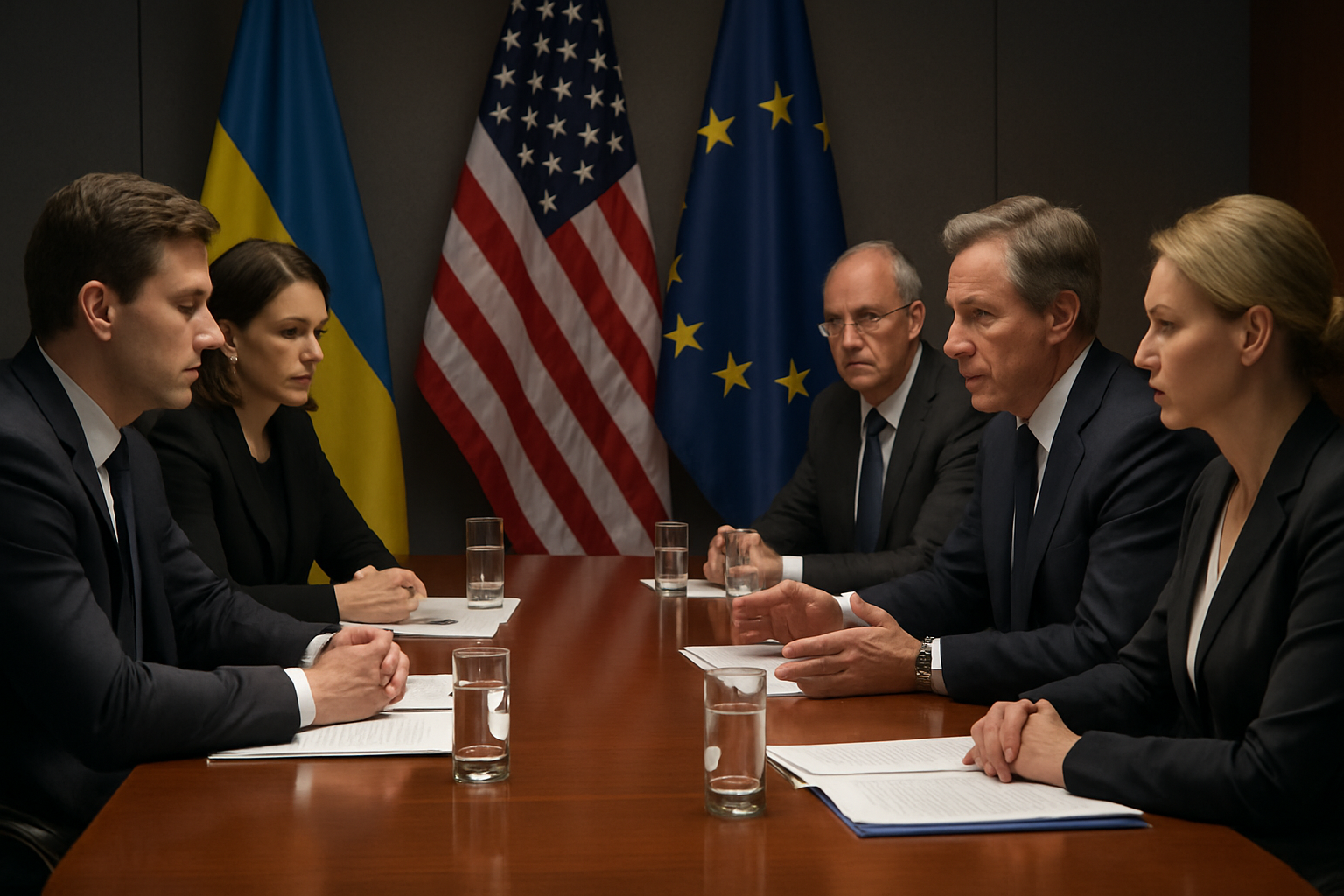
Ukrainian President Volodymyr Zelensky declared at the Munich Security Conference that Ukraine requires security guarantees extending 20-30 years beyond the United States' proposed 15-year framework, as diplomatic momentum from the historic Abu Dhabi breakthrough drives toward critical Geneva peace talks scheduled February 17-18, 2026.
The announcement comes amid unprecedented diplomatic progress following the February 5 Abu Dhabi trilateral negotiations that achieved a 314-prisoner exchange—the first in five months—and restoration of US-Russia military communications after a four-year suspension. Ukrainian Defense Minister Rustem Umerov described the talks as "substantial and productive," establishing concrete frameworks for ceasefire monitoring and verification mechanisms.
Security Guarantees Become Central Sticking Point
Speaking to the 62nd Munich Security Conference under the theme "Era of Disruptive Politics," Zelensky emphasized that while Washington has offered 15-year security commitments, Ukraine's strategic position requires extended protection. "Today we have a proposal from the American side for 15 years of guarantees, and we want to have 20 years, 30 years," he stated, highlighting the gap between American proposals and Ukrainian security needs.
The security guarantee negotiations reflect broader concerns about long-term stability in post-conflict Ukraine. According to multiple diplomatic sources familiar with the talks, the Trump administration has established a June 2026 deadline for achieving a comprehensive peace agreement, with future negotiations potentially escalating to presidential-level engagement in Washington.
"In this war, weapons evolve faster than the decisions that should stop them," Zelensky told the Munich conference, emphasizing the urgency of matching diplomatic innovation to military realities.
— President Volodymyr Zelensky, Munich Security Conference
Geneva Framework Builds on Abu Dhabi Success
The February 17-18 Geneva talks represent a significant evolution from the neutral UAE hosting to European territory, signaling increased international commitment to the peace process. Russia will send Vladimir Medinsky, Putin's chief advisor and lead negotiator, while Ukraine's delegation continues under Umerov's leadership. US Special Envoy Steve Witkoff maintains his crucial mediation role following his success in facilitating the recent prisoner exchange.
The prisoner swap, involving 157 military personnel from each side plus three Russian Kursk civilians, demonstrated that sustained diplomatic engagement can produce concrete humanitarian results even amid continued military operations. Pentagon officials confirmed that the restored military communications include deconfliction protocols, incident prevention measures, and advance notification systems extending beyond the Ukraine conflict to global operations in Syria, the Arctic, and Africa.
Military Escalation Continues Despite Diplomatic Progress
The diplomatic breakthrough occurs against a backdrop of intensifying military operations. Russian forces captured 481 square kilometers in January 2026 compared to 260 square kilometers in December 2025, demonstrating accelerated territorial gains. Over 10,000 Russian drones and bombs were launched in January alone, with systematic targeting of Ukrainian energy infrastructure continuing as a "winter weapon" strategy.
The February 11 Russian drone strike on Bohodukhiv in the Kharkiv region killed four civilians, including three young children—two one-year-old boys and a two-year-old girl—alongside their 34-year-old father. This attack marked the second deadly strike on the same town within three days, illustrating the systematic nature of civilian targeting that violates Geneva Convention protections.
Energy terrorism has left more than 1,170 buildings in Kyiv without heating during temperatures reaching minus-30°C. Ukrainian nuclear plants were forced to halt electricity production for the first time during the conflict following Russian attacks on electrical distribution networks, prompting International Atomic Energy Agency Director Rafael Grossi to confirm the unprecedented shutdown.
International Support Reaches Historic Levels
European commitment to Ukraine reached new heights with the European Parliament's approval of a €90 billion loan package—the largest EU financial assistance ever provided to a single nation. The package passed with 458 votes in favor, 140 against, and 44 abstentions, though Slovakia, the Czech Republic, and Hungary refused participation, revealing persistent divisions within the EU despite broad support.
Sweden and Denmark announced a €246 million air defense package featuring Tridon Mk2 systems, while Germany confirmed delivery of 35 Patriot missiles. The World Bank allocated $40 million for energy restoration efforts as 17.8 million Ukrainians access winter support programs.
NATO Secretary-General Mark Rutte made a surprise visit to Kyiv during the energy attacks, condemning the strikes as a "bad signal" before negotiations. His parliamentary address emphasized the alliance's continued support while highlighting the paradox of diplomatic engagement occurring alongside escalated civilian targeting.
Nuclear Context Creates Unprecedented Urgency
The peace negotiations unfold against the backdrop of a critical nuclear governance crisis. The New START treaty between the United States and Russia expired February 5, 2026—marking the first time in over 50 years without bilateral nuclear arms control between the superpowers. UN Secretary-General António Guterres warned of a "grave turning point" with nuclear weapon use risks "higher than at any time in decades."
Russia controls approximately 4,380 warheads with 1,710 deployed, while the United States maintains 3,708 warheads with 1,670 deployed. Together, these arsenals represent over 80% of global nuclear weapons, making the restored military communications the sole remaining formal diplomatic channel between the nuclear superpowers.
Eastern Territories Remain Fundamental Challenge
Despite humanitarian breakthroughs, the core territorial dispute remains unchanged. Eastern Ukrainian territories under Russian control represent the fundamental sticking point in all peace negotiations. Russia demands territorial recognition of its gains, while Ukraine maintains its position on territorial integrity based on international law and UN positions regarding the illegality of territorial acquisition through force.
Ukrainian officials acknowledge the complexity of any territorial compromise while emphasizing that innovative solutions must respect sovereignty principles. The acceleration of Russian territorial gains in January potentially strengthens Moscow's bargaining position as negotiations advance toward more substantive political discussions.
June Deadline Creates Diplomatic Innovation Pressure
The Trump administration's June 2026 deadline represents unprecedented pressure for diplomatic innovation in territorial dispute resolution. The evolution from Abu Dhabi's neutral hosting to Geneva's European setting and potential Washington venue suggests a deliberate escalation toward higher-level engagement, possibly including direct presidential involvement.
European leaders emphasized the stakes at Munich, with German Chancellor Friedrich Merz declaring that the "post-war order no longer exists" and calling for immediate action to "repair and revive transatlantic trust." French President Emmanuel Macron's closing remarks emphasized that "without Europeans, there will be no peace" regarding Ukraine negotiations, reflecting European determination to maintain influence in continental security decisions.
Democratic Transition Under Extraordinary Circumstances
The peace process coincides with discussions about Ukrainian presidential elections, representing an unprecedented democratic transition during active conflict. Multiple sources confirm the Trump administration has pressured Ukraine to announce elections by May 15, 2026, which would end the martial law period in effect since February 2022 and mark the first Ukrainian elections since Zelensky's 2019 victory.
Zelensky has emphasized that elections can only occur "when there are all appropriate security guarantees" and a ceasefire is achieved with Russia. The integration of democratic renewal with peace negotiations represents extraordinary complexity requiring coordination between ceasefire implementation, territorial dispute resolution, and international oversight mechanisms.
Strategic Implications for Global Conflict Resolution
The Ukraine peace negotiations represent the most significant diplomatic opportunity since the conflict began nearly four years ago. Success could end Europe's deadliest war since World War II and provide an innovative template for international conflict resolution in the 21st century. Failure might intensify global military operations and undermine diplomatic solutions' credibility for territorial disputes worldwide.
The stakes extend beyond Ukraine to fundamental questions about European security architecture, NATO's eastern flank, international law enforcement, and democratic governance principles under extraordinary circumstances. The combination of humanitarian breakthroughs achieved through sustained diplomatic engagement, alongside continued military escalation and civilian targeting, demonstrates the complex paradoxes inherent in modern conflict resolution.
As the Geneva talks approach, the international community watches for whether territorial compromise innovations can bridge decade-old challenges or whether the negotiations represent another phase in the cycle of diplomatic engagement and military pressure. The coming weeks will determine if innovative solutions can resolve Europe's most serious security crisis since the Cold War's end, with implications extending far beyond Ukraine's borders to the foundations of international order in an era of great power competition.