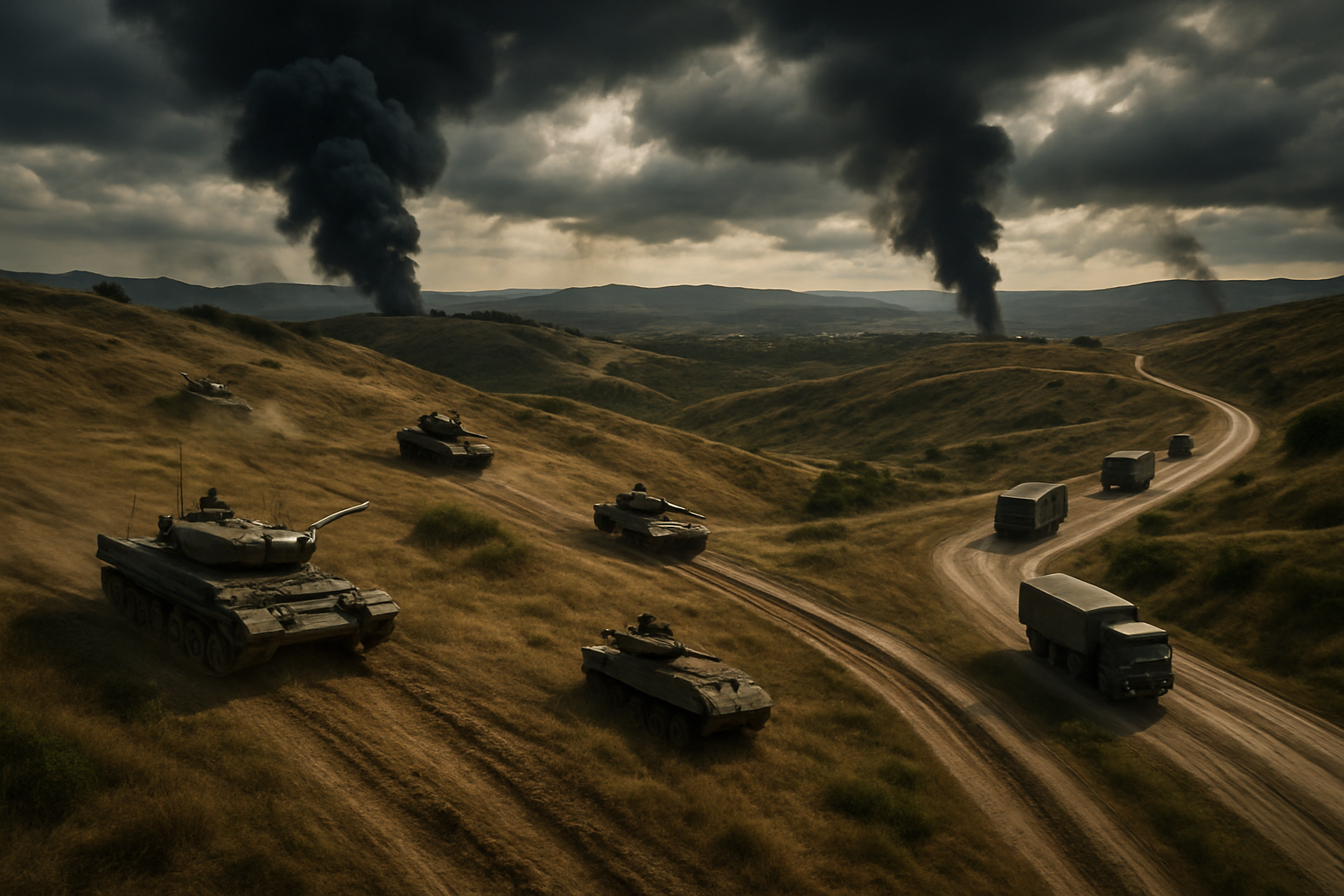
Military operations between Russia and Ukraine have intensified dramatically in April 2026, with massive coordinated assaults and partisan supply line disruptions marking a dangerous escalation as peace talks remain suspended indefinitely due to the Iran crisis consuming American diplomatic attention.
Russian forces launched one of their largest coordinated assaults of the conflict, deploying over 700 drones in a 24-hour period targeting civilian infrastructure across multiple Ukrainian regions. The attacks killed at least 15 civilians and wounded dozens more, representing a systematic escalation in what Ukrainian officials describe as "energy terrorism."
Massive Russian Drone Operations
The scale of recent Russian attacks has reached unprecedented levels, with military expert Andrey Marochko claiming Russian troops are achieving successes in key sectors "almost daily." The coordinated assault included strikes on:
- Cherkasy region Zolotonosha district: 4 killed in targeted civilian areas
- Nikopol, Dnipropetrovsk: 10 wounded from drone and artillery strikes
- Poltava community: 4 injured including a child from UAV crash
- Zakarpattia region: Critical infrastructure attacked, 1 injured
- Ternopil region: Enterprise fire from drone strike
- Cherkasy region: Bus passengers injured from falling drone debris
According to Ukrainian President Volodymyr Zelensky, Russian forces have launched over 1,750 strike drones, 1,530 guided aerial bombs, and 39 missiles in the past week alone, demonstrating Moscow's commitment to maintaining military pressure despite previous diplomatic momentum.
Ukrainian Partisan Operations Target Supply Lines
In a significant development highlighting the conflict's asymmetric nature, Ukrainian partisan movement "ATESH" conducted successful sabotage operations targeting Russian supply lines. Agents executed two simultaneous acts of sabotage on a railway section between Stary Oskol and Urazove in the Kharkiv region, specifically targeting the Kupiansk sector.
These operations represent a critical vulnerability in Russian military logistics, as the targeted railway serves as a key supply route for Moscow's forces operating in eastern Ukraine. The disruption of these supply lines could significantly impact Russian military capabilities in the region.
"Russian information resources have intensified a campaign promoting the narrative that Ukraine is allegedly a 'terrorist state,' using topics such as strikes on Russian territory."
— SPRAVDI Intelligence Report
Russian Information Warfare Campaign
Parallel to military operations, Russian propaganda has intensified significantly, with intelligence sources reporting over 500 fake publications portraying Ukraine as a "terrorist state." This information campaign uses strikes on Russian territory, accusations against Baltic countries, and speculation around Ukraine's diplomatic initiatives to shape international perception.
The propaganda effort appears coordinated with military operations, suggesting Moscow's recognition that the information domain remains crucial to achieving strategic objectives alongside kinetic operations.
Peace Talks Indefinitely Suspended
The most significant diplomatic development has been the indefinite suspension of trilateral peace negotiations between Ukraine, Russia, and the United States. The talks, which had shown promising momentum in February 2026 with a historic 314-prisoner exchange and restoration of US-Russia military communications after a 4-year suspension, have been postponed due to the Iran crisis consuming American foreign policy attention.
President Zelensky confirmed there are "no necessary signals for trilateral meeting" until the security situation allows, dealing a major blow to what had been the most significant diplomatic opportunity since the invasion began. The February breakthrough had included:
- The largest prisoner exchange in 5 months (314 individuals)
- Restoration of Pentagon-Russian General Staff communications
- Geneva talks achieving "significant progress" on ceasefire monitoring
- European "Big 5" observer participation for the first time
Nuclear Governance Crisis Backdrop
The conflict continues against the backdrop of an unprecedented nuclear governance crisis. The New START treaty expired on February 5, 2026, marking the first time in over 50 years without US-Russia nuclear constraints. Both nations control approximately 80% of global nuclear weapons, with Russia possessing 4,380 warheads and the US maintaining 3,708.
UN Secretary-General António Guterres has described this as a "grave turning point," warning that nuclear risks are at their "highest in decades." The restored military communications channel between the Pentagon and Russian General Staff remains the only formal diplomatic channel between the nuclear superpowers.
Russian Territorial Gains Accelerate
Despite Ukrainian resistance, Russian forces have achieved significant territorial gains, capturing 481 square kilometers in January compared to 260 square kilometers in December 2025 - an 85% increase representing the fastest monthly territorial expansion in recent months. Current military operations show 64 combat clashes concentrated in the Pokrovsk, Kostiantynivka, and Huliaipole sectors.
Russian territorial claims have become increasingly bold, with Moscow asserting full control over Ukraine's Luhansk region. While no immediate Ukrainian comment has been provided on these Kremlin assertions regarding Donbas industrial area advances, such claims would represent a major shift in territorial control if accurate.
International Support Amid Divisions
Despite the challenging military situation, Ukraine continues to receive unprecedented international support, including the EU's historic €90 billion loan package - the largest single-nation assistance ever provided. However, this support reveals significant European divisions, as Slovakia, Czech Republic, and Hungary refused to participate in the financing.
Military support continues with the UK revealing four operational MRO (maintenance, repair, and overhaul) facilities in Ukraine servicing Western-supplied equipment, with a fifth planned. This represents the first public acknowledgment of extensive military infrastructure on Ukrainian soil and demonstrates long-term commitment to Ukrainian military modernization.
Humanitarian Crisis Deepens
The humanitarian toll continues to mount, with Zelensky having disclosed that 55,000 Ukrainian soldiers have been officially killed, with a "large number" missing. International estimates suggest actual casualties could be 2-3 times higher. Over 17.8 million Ukrainians are currently accessing winter support programs as systematic targeting of civilian infrastructure continues.
The systematic nature of civilian targeting has been documented as violations of the Geneva Conventions, with 15 DTEK energy workers killed while restoring power infrastructure. This "energy terrorism" strategy has left over 1,170 Kyiv buildings with inadequate heating and forced nuclear plants to halt electricity production for the first time in the conflict.
Ukraine's Strategic Transformation
In a significant strategic development, Ukraine has evolved from an aid recipient to a security provider, deploying military experts to Middle Eastern nations including the UAE, Qatar, Jordan, Bahrain, and Kuwait to combat Iranian Shahed drones - the same weapons that have been devastating Ukrainian infrastructure.
This transformation leverages Ukraine's battlefield experience into strategic partnerships and potentially creates new negotiating leverage. Zelensky noted that "our interceptors already show results" in expanding Middle East cooperation, demonstrating Ukraine's growing international security role.
Economic Impact Beyond Ukraine
The conflict's impact extends far beyond Ukrainian borders, particularly affecting global economic stability. The suspension of peace talks coincides with a severe global energy crisis caused by the Iran situation, which has pushed oil prices past $119.50 per barrel and disrupted 40% of global oil transit through the Strait of Hormuz.
Russian airline Azimuth's reported approach to bankruptcy reflects the broader economic pressures affecting Russian commercial aviation and other sectors under international sanctions.
Looking Forward: Framework Preservation
Despite the suspension of peace talks, diplomatic achievements from February 2026 remain intact. The prisoner exchange mechanisms, structured negotiation format, and Pentagon-Moscow deconfliction protocols covering operations in Syria, the Arctic, and Africa can be reactivated when conditions permit.
The UAE methodology has proven effective in achieving concrete humanitarian results amid ongoing military operations, providing a foundation for future engagement when the Iranian crisis allows renewed focus on the European conflict.
Strategic Stakes and Global Implications
The indefinite suspension of what had been the most significant diplomatic opportunity since the invasion began carries profound implications for 21st-century conflict resolution. The stakes extend beyond Ukraine to affect European security architecture, international law enforcement credibility, and territorial sovereignty principles that will shape global security for decades.
Success in eventually resuming and concluding productive negotiations could end Europe's deadliest war since World War II and provide a conflict resolution template for future territorial disputes. Failure risks continued escalation with global implications for diplomatic solutions to territorial conflicts worldwide.
The current phase demonstrates the complex challenges facing the international community in managing multiple simultaneous crises while preserving momentum on Europe's most significant security challenge since the Cold War. As Ukrainian forces maintain operational capabilities and expand international partnerships, the eventual resumption of diplomatic efforts will be critical to determining whether innovative territorial dispute resolution can overcome military approaches in shaping European security's future trajectory.