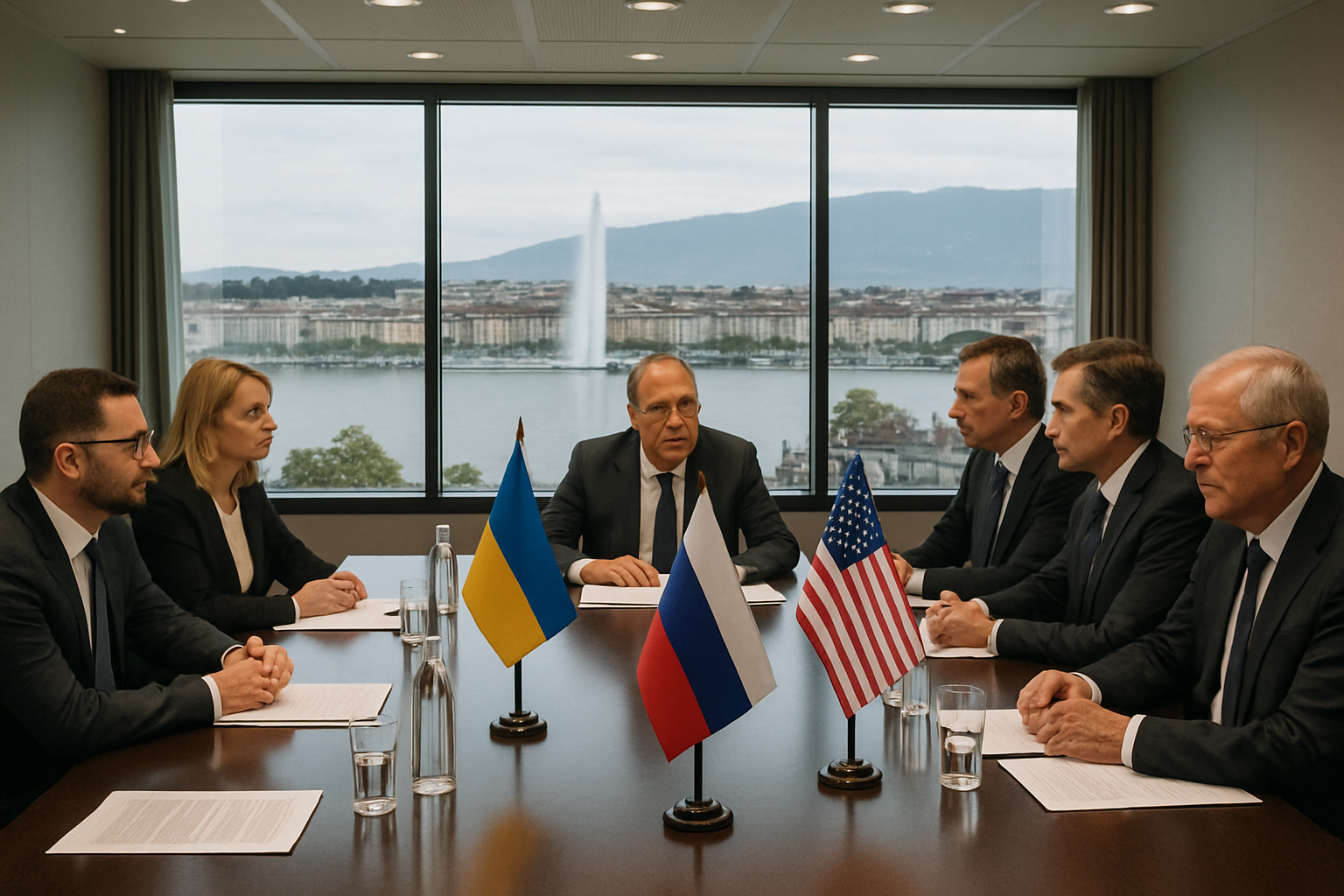
A crucial new round of peace negotiations between Ukraine, Russia, and the United States began on February 17, 2026, in Geneva, Switzerland, as President Trump publicly pressured Kyiv to come to the negotiating table "and quickly" while setting an ambitious June deadline for a comprehensive peace agreement.
The trilateral talks, representing an evolution from the breakthrough Abu Dhabi negotiations to European neutral territory, commenced amid unprecedented diplomatic momentum following the historic 314-prisoner exchange in February - the first such swap in five months. Trump's public statements aboard Air Force One left little doubt about American expectations.
"Ukraine better come to the table for talks and quickly. We are in a position where we want them to come to the table for negotiations"
— President Donald Trump
The Geneva talks build upon the foundation established in Abu Dhabi, where Ukrainian Defense Minister Rustem Umerov, Russian military intelligence director Igor Kostyukov, and US Special Envoy Steve Witkoff achieved the most significant diplomatic breakthrough since the conflict began. The prisoner exchange involved 157 military personnel from each side, plus three Russian civilians from the Kursk region.
Diplomatic Framework and Key Players
The Ukrainian delegation is led by officials preparing for what sources describe as the most substantial negotiations since Russia's invasion began nearly four years ago. The shift from Abu Dhabi to Geneva signals growing international investment in diplomatic resolution, with Switzerland leveraging its traditional role as a neutral mediator for sensitive international negotiations.
The talks coincide with a critical nuclear governance crisis - the New START treaty between the United States and Russia expired on February 5, 2026, marking the first time in over 50 years without nuclear arms control constraints between the two superpowers. This vacuum adds unprecedented urgency to diplomatic solutions.
Perhaps most significantly, the Pentagon confirmed the restoration of high-level US-Russia military communications after a four-year suspension, establishing deconfliction protocols and incident prevention measures. The agreement includes transparency mechanisms and reduced escalation protocols through the European Command and Russian General Staff channels.
Military Escalation Continues Despite Diplomatic Progress
The peace talks are proceeding against a backdrop of continued military escalation. Russian forces have accelerated territorial gains, capturing 481 square kilometers in January 2026 compared to 260 square kilometers in December 2025. Over 10,000 Russian drones and bombs were launched in January alone.
Most concerning has been Russia's systematic targeting of civilian energy infrastructure during extreme winter conditions - what Ukrainian officials describe as "energy terrorism." The attacks left over 1,170 buildings in Kyiv without heating during minus-30°C temperatures, forcing Ukrainian nuclear plants to halt electricity production for the first time since the conflict began.
Recent civilian casualties underscore the human cost of continued fighting. A Russian drone strike on Bohodukhiv killed four civilians including three young children - two one-year-old boys and one two-year-old girl - along with their 34-year-old father. This marked the second deadly attack on the same town within three days, demonstrating systematic targeting that violates Geneva Conventions protections for civilians.
Historic International Support
Despite ongoing military operations, international support for Ukraine has reached historic levels. The European Union approved a €90 billion loan package - the largest financial assistance package ever provided by the EU to a single nation. The package covers the 2026-2027 period including both defense and reconstruction funding, though Slovakia, Czech Republic, and Hungary have refused participation, showing persistent European divisions.
Additional support includes Sweden and Denmark's €246 million air defense package featuring Tridon Mk2 systems, Germany's provision of 35 Patriot missiles, and the World Bank's $40 million energy restoration funding. Over 17.8 million Ukrainians are currently accessing winter support programs as the country endures what officials describe as deliberate humanitarian pressure tactics.
The Territorial Sticking Point
The fundamental challenge remains unchanged: eastern Ukrainian territories currently under Russian control represent the core disagreement preventing comprehensive peace. Russia demands territorial recognition and insists that any Putin-Zelensky summit must occur in Moscow. Ukraine maintains its territorial integrity position while seeking long-term security guarantees.
President Zelensky previously disclosed that 55,000 Ukrainian soldiers have been officially confirmed killed, with a "large number" still classified as missing in action. International research estimates suggest actual military casualties could be two to three times higher when including undocumented losses.
The acceleration of Russian territorial gains in January potentially strengthens Moscow's bargaining position, while the historic scale of international support helps maintain Ukrainian leverage in negotiations.
June Deadline and Washington Venue
The Trump administration has established a June 2026 comprehensive peace timeline, with talks potentially evolving to Washington venue - suggesting possible presidential-level involvement. This evolution from Abu Dhabi to Geneva to potentially Washington represents deliberate diplomatic escalation.
Zelensky confirmed that Americans are "proposing parties end war by beginning of summer, will pressure both sides according to timeline." The June deadline creates unprecedented pressure for innovative territorial dispute resolution, requiring compromise mechanisms that bridge fundamental positions that have remained far apart for nearly four years.
European Diplomatic Divisions
European approaches to the peace process reveal significant divisions. Germany opposes direct talks with Putin, citing "maximalist demands," while France and Italy support broader diplomatic engagement. These differences reflect broader debates about how to balance deterrence with diplomatic openings.
NATO Secretary-General Mark Rutte made a surprise visit to Kyiv, addressing Parliament and condemning Russian attacks as sending a "bad signal" during diplomatic engagement. The alliance continues coordinating military assistance while supporting negotiation efforts.
Nuclear Governance Crisis
The broader context includes an unprecedented nuclear governance crisis. With the New START treaty expired, both Russia and the United States are technically free to expand their nuclear arsenals without bilateral constraints. Russia possesses approximately 4,380 warheads with 1,710 deployed, while the US has 3,708 warheads with 1,670 deployed - together controlling over 80% of global nuclear weapons.
UN Secretary-General António Guterres has warned of a "grave turning point" with nuclear risks at their "highest in decades." The restoration of military communications between the superpowers provides the only remaining major diplomatic channel and includes crucial incident prevention protocols for operations in Syria, the Arctic, and Africa.
Strategic Implications
The Geneva talks represent the most significant diplomatic opportunity since the conflict began. Success could end Europe's deadliest war since World War II and provide a template for 21st-century conflict resolution. However, failure might intensify military operations and undermine diplomatic credibility globally.
The humanitarian breakthroughs achieved through sustained diplomatic engagement - prisoner exchanges and communications restoration - demonstrate that concrete results are possible even amid military operations. This creates both hope and pressure for territorial dispute breakthrough solutions.
The stakes extend far beyond Ukraine and Russia, affecting European security architecture, international law enforcement, and territorial sovereignty principles for decades to come. The success or failure of diplomatic innovation in resolving modern territorial challenges will influence global conflict prevention mechanisms.
Coming Phase Critical
The February 17-18 Geneva talks will test whether humanitarian breakthroughs can translate to progress on territorial disputes. The international community is watching for innovative diplomatic solutions versus traditional limitations that have characterized previous efforts.
The framework established through Abu Dhabi's success provides a tested methodology for complex multilateral negotiations. The shift to Geneva signals growing diplomatic seriousness while maintaining the neutral territory advantages that proved crucial for concrete results.
With Trump's pressure for rapid negotiations and the June deadline approaching, the coming weeks will determine whether sustained diplomatic engagement can produce unprecedented territorial compromise or whether fundamental positions remain unbridgeable despite the significant momentum achieved through recent humanitarian successes.