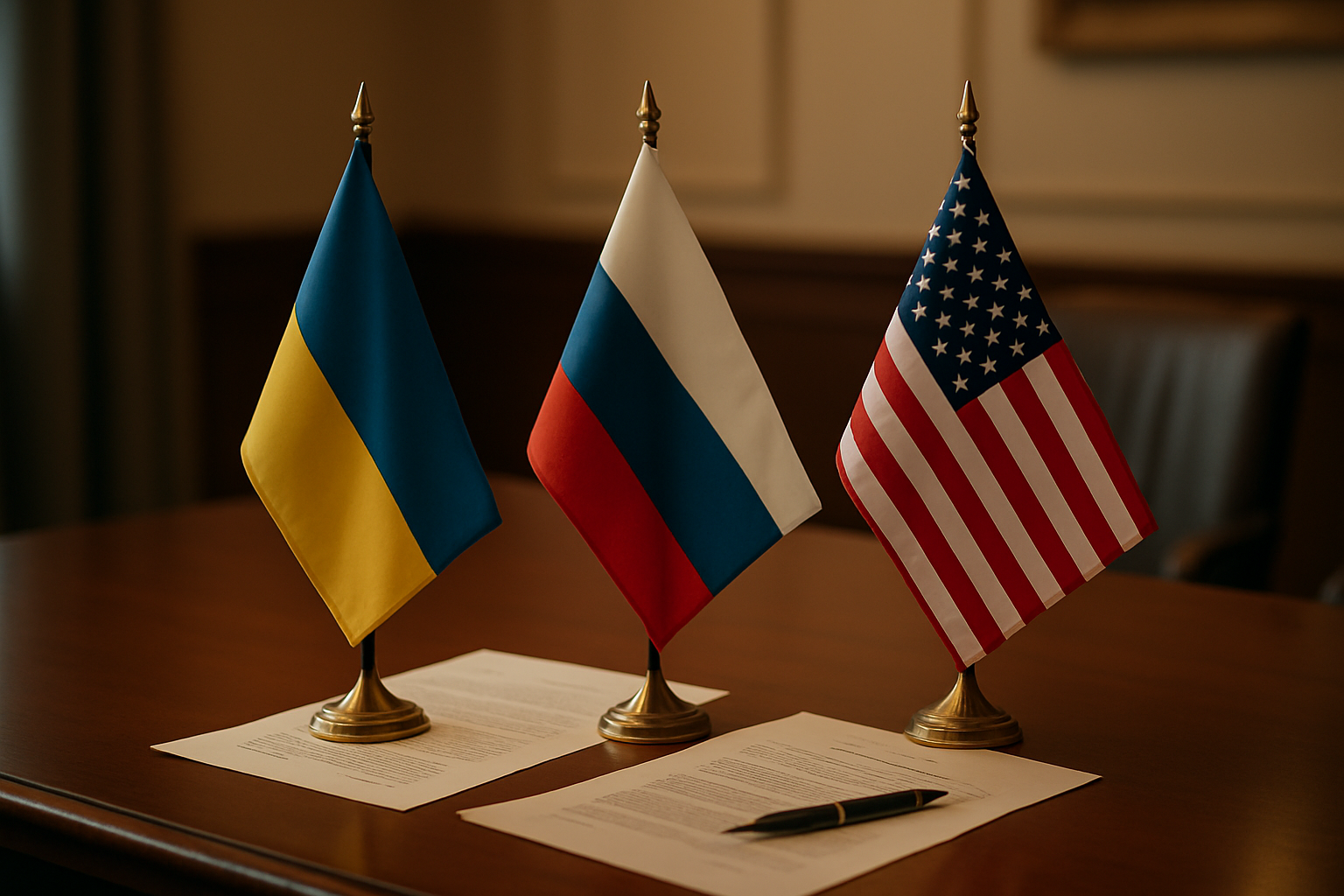
Ukrainian President Volodymyr Zelensky announced Saturday that the United States has established a June deadline for Ukraine and Russia to reach a peace agreement ending their nearly four-year conflict, while confirming that new trilateral talks will be held in Washington next week for the first time.
Speaking to reporters, Zelensky stated that "the Americans are proposing that the parties end the war by the beginning of the summer and will probably put pressure on both sides according to precisely this timeline." The announcement represents the most definitive timeline yet established by the Trump administration for resolving Europe's deadliest conflict since World War II.
Washington Talks Mark New Phase
The Ukrainian leader confirmed that the United States has proposed hosting the next round of negotiations between Ukrainian and Russian delegations in Washington, possibly in Miami, marking the first time such talks would occur on American soil. "For the first time, America proposed that the negotiating teams of Ukraine and Russia meet in the United States, perhaps in Miami, next week. We confirmed our participation," Zelensky said.
This development follows the successful conclusion of trilateral peace talks in Abu Dhabi on February 5-6, which achieved a historic prisoner exchange of 314 individuals and restored US-Russia military communications after a four-year suspension. The talks involved Ukrainian Defense Minister Rustem Umerov, Russian military intelligence director Igor Kostyukov, and US Special Envoy Steve Witkoff.
Building on Abu Dhabi Breakthrough
The February Abu Dhabi negotiations marked a significant diplomatic achievement, with Ukrainian officials describing the discussions as "substantial and productive." The talks resulted in the 71st prisoner exchange since Russia's invasion began, with 157 military personnel exchanged by each side, plus three Russian civilians from the Kursk region returned from Ukrainian custody.
"We have substantial and productive discussions covering methods for implementing ceasefire and monitoring cessation of hostilities."
— Rustem Umerov, Ukrainian Defense Minister
Crucially, the talks also led to the restoration of US-Russia military-to-military communications through European Command and Russian General Staff channels, providing what Pentagon officials described as "means to increase transparency and reduce escalation" through deconfliction protocols and incident prevention measures.
Territorial Disputes Remain Central
Despite diplomatic progress, fundamental disagreements persist over eastern Ukrainian territories currently under Russian control. Sources familiar with the negotiations indicate this remains the primary sticking point, with Russia insisting that any Putin-Zelensky summit must occur in Moscow, while Ukraine seeks security guarantees and territorial integrity assurances.
Russian forces have accelerated their territorial gains, capturing 481 square kilometers in January 2026 compared to 260 square kilometers in December 2025, according to the Institute for the Study of War. Over 10,000 Russian drones and bombs were launched in January 2026 alone, demonstrating the continued intensity of military operations alongside diplomatic efforts.
International Context and Pressure
The June deadline comes amid significant international diplomatic momentum. The talks coincide with the expiration of the New START nuclear treaty between the US and Russia on February 5, marking the first time in over 50 years without bilateral nuclear arms control between the superpowers. This has created additional urgency for diplomatic solutions across multiple fronts.
European responses to the peace process remain divided. While France and Italy support diplomatic engagement with Russia, Germany maintains opposition to direct Putin talks due to what officials describe as "maximalist demands." NATO Secretary-General Mark Rutte has provided cautious support while emphasizing the need for Ukrainian territorial integrity.
Humanitarian and Military Backdrop
The diplomatic initiatives occur against a backdrop of intensified Russian attacks on Ukrainian infrastructure. Despite achieving the prisoner exchange, Russia launched what energy company DTEK described as the "most powerful blow" of 2026 against Ukrainian energy infrastructure, leaving over 1,170 buildings in Kyiv without heating during minus-30°C temperatures and breaking an informal energy truce.
Zelensky has disclosed that 55,000 Ukrainian soldiers have been officially confirmed killed since the invasion began, though he emphasized this figure represents only confirmed battlefield deaths, with a "large number" still classified as missing in action. International estimates suggest actual military casualties could be significantly higher.
Economic Support and Reconstruction
The European Union has approved a historic €90 billion loan package for Ukraine's defense and reconstruction needs, representing the largest EU financial assistance package in history. This economic commitment demonstrates sustained international support for Ukraine regardless of the diplomatic timeline.
Sweden and Denmark have announced a €246 million air defense package, while Poland continues providing crucial logistical support. Over 17.8 million Ukrainians are currently accessing winter support programs, highlighting the humanitarian scope of the crisis.
Challenges and Opportunities Ahead
The June deadline creates both pressure and opportunity for innovative diplomatic solutions. US negotiators are reportedly pushing for a March agreement timeline followed by potential Ukrainian elections in May, though territorial disputes over eastern Ukraine remain the fundamental obstacle.
The restoration of US-Russia military communications provides a crucial channel for preventing escalation while negotiations continue. This represents the most significant US-Russia military agreement since the Ukraine conflict began, demonstrating that sustained diplomatic engagement can produce concrete results even amid ongoing hostilities.
Regional and Global Implications
Success in reaching a peace agreement by June could provide a template for resolving other international conflicts and demonstrate the effectiveness of multilateral diplomatic frameworks. However, failure might result in intensified military operations and could undermine international conflict resolution mechanisms.
The UAE's neutral hosting proved crucial for the Abu Dhabi breakthrough, and the transition to Washington-hosted talks suggests an evolution toward higher-level negotiations potentially involving President Trump and President Putin directly. Zelensky has indicated that future talks will "most likely" occur in the United States rather than Moscow, marking a significant diplomatic development.
As the international community watches these critical negotiations unfold, the June deadline represents both the most ambitious peace timeline established since the conflict began and a test of whether diplomatic innovation can overcome seemingly intractable territorial disputes. The coming weeks will prove decisive for determining whether this diplomatic momentum can translate into a sustainable resolution of Europe's most devastating conflict in decades.