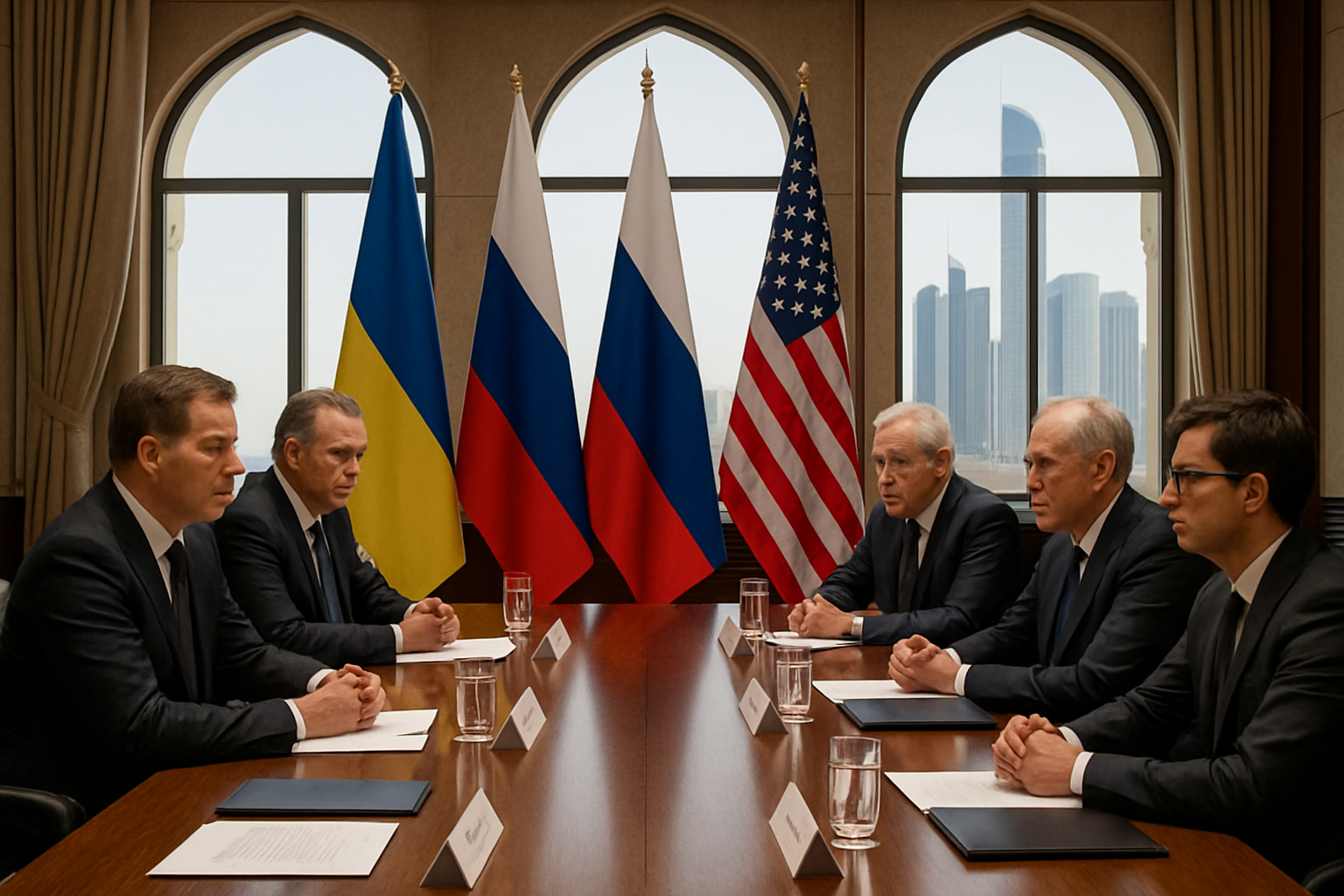
The second round of US-brokered trilateral peace talks between Ukraine, Russia, and the United States concluded Thursday in Abu Dhabi with a breakthrough agreement to exchange 314 prisoners of war—the first such swap in five months—while establishing a framework for continued negotiations toward ending Europe's deadliest conflict since World War II.
Ukrainian Defense Minister Rustem Umerov, who led Kiev's delegation, described the two-day negotiations as "substantial and productive," confirming that 157 military personnel from each side would be released immediately. The exchange was facilitated by US Special Envoy Steve Witkoff, who emphasized that while "significant work remains, steps like this demonstrate that sustained diplomatic engagement is delivering tangible results and advancing efforts to end the war in Ukraine."
Immediate Humanitarian Breakthrough
The prisoner exchange, which Russian state media confirmed was executed within hours of the agreement, represents the 71st such swap since Russia's full-scale invasion began in February 2022. Beyond the 314 military personnel, three Russian civilians from the Kursk region were also returned from Ukrainian custody, according to multiple diplomatic sources.
Russian negotiator Kirill Dmitriev told state media that "things are moving forward in a good, positive direction," while confirming that active work was underway to restore Russia's relations with the US within a newly established working group framework.
"This prisoner exchange serves as a confidence-building measure for broader territorial and political issues resolution. The main sticking point remains eastern Ukrainian territories under Russian control."
— Diplomatic source familiar with negotiations
Substantive Diplomatic Framework Established
The Abu Dhabi talks, which followed a structured format with separate working groups addressing specific topics before joint position synchronization, focused extensively on practical implementation mechanisms. Ukrainian sources confirmed that delegations spent considerable time discussing "methods for implementing a ceasefire and monitoring the cessation of hostilities."
The negotiations occurred against the backdrop of continued military escalation, with Russia launching what DTEK called the "most powerful blow" of 2026 against Ukrainian energy infrastructure just days before the talks began. The massive attack left over 1,170 buildings in Kyiv without heating during minus-30°C temperatures, effectively breaking an informal Trump-Putin energy truce.
Despite this escalation, all parties maintained their commitment to the diplomatic process. NATO Secretary-General Mark Rutte made a surprise visit to Kyiv before the talks, condemning the attacks as sending "a bad signal" before negotiations while reaffirming Western support for Ukraine's position.
Restored US-Russia Military Communications
In a significant parallel development, the Pentagon officially announced the restoration of high-level military-to-military communications between the US and Russia after a suspension lasting over four years since autumn 2021. The agreement, reached during the Abu Dhabi talks, establishes crucial deconfliction mechanisms designed to prevent unintended escalation while military operations continue.
General Alexus Grynkewich of US European Command characterized the restored dialogue as "an important factor in stability and global peace" that provides "means to increase transparency and reduce escalation." The framework initially focuses on incident prevention protocols and advance notification systems for military activities.
Complex Strategic Context
The diplomatic breakthrough comes at a critical juncture, coinciding with the expiration of the New START nuclear treaty between the US and Russia on February 5, 2026—ending over 50 years of bilateral nuclear arms control agreements between the superpowers. This development adds urgency to broader US-Russia diplomatic engagement efforts.
European divisions over engagement with Russia remain pronounced, with Germany maintaining opposition to direct Putin talks while France and Italy support continued diplomatic channels. However, the concrete results from Abu Dhabi may influence this debate, particularly given the successful prisoner exchange and military communication restoration.
The talks also proceed against a backdrop of significant military developments on the ground. Russian forces captured 481 square kilometers in January 2026 versus 260 square kilometers in December 2025, according to the Institute for Study of War, indicating accelerated territorial gains despite diplomatic efforts.
International Support and Next Steps
The UAE's neutral hosting role proved crucial for substantive negotiations producing concrete results, with multiple international sources praising Abu Dhabi's diplomatic facilitation. The structured approach, involving working groups addressing complex multi-dimensional aspects of the conflict, has established a tested framework that could be replicated in future rounds.
According to Ukrainian sources, the delegations "agreed to report back to their respective capitals" and plan to "agree on dates for new meetings" continuing the UAE dialogue framework. Ukrainian President Volodymyr Zelensky has indicated that future talks will "most likely be held in the US," suggesting an evolution toward higher-level negotiations.
"After two days of constructive trilateral talks in Abu Dhabi, the delegations agreed to report back to their respective capitals. We maintain cautious optimism about achieving lasting and dignified peace."
— Rustem Umerov, Ukrainian Defense Minister
Humanitarian Crisis Continues
The diplomatic progress occurs amid ongoing humanitarian challenges, with over 17.8 million Ukrainians accessing winter support programs following repeated attacks on energy infrastructure. President Zelensky's recent disclosure that 55,000 Ukrainian soldiers have been officially confirmed killed since February 2022—with a "large number" still classified as missing in action—adds concrete urgency to peace efforts.
International support mechanisms continue expanding, with the European Union recently approving a historic €90 billion loan package for Ukraine's defense and reconstruction—the largest EU aid package in history. Sweden and Denmark announced a €246 million air defense package, while Poland has deployed fighter jets in support of Ukraine's defense efforts.
Strategic Implications
The Abu Dhabi talks represent the most significant diplomatic opportunity for sustainable peace in Europe's deadliest conflict since WWII. The successful prisoner exchange demonstrates that sustained diplomatic engagement can produce humanitarian results even amid ongoing military operations, potentially serving as a model for addressing other aspects of the conflict.
However, fundamental positions remain far apart, with continued Russian territorial gains and Ukrainian insistence on territorial integrity representing core unresolved issues. The main sticking point continues to be the long-term status of eastern Ukrainian territories currently under Russian control.
The restoration of US-Russia military communications, while focused on tactical deconfliction, could provide a foundation for broader multilateral security discussions. This development gains particular significance given the New START treaty expiration and the need for new frameworks addressing global nuclear security.
Looking Forward
The success in Abu Dhabi establishes momentum for continued diplomatic engagement, with all parties committed to pursuing negotiations "in the coming weeks." The concrete results—prisoner exchange and military communication restoration—provide tangible evidence that diplomatic processes can yield humanitarian benefits even during active conflict.
The structured working group approach pioneered in Abu Dhabi offers a practical methodology for addressing the conflict's complex dimensions, from immediate humanitarian concerns to longer-term territorial and political arrangements. Future negotiations will likely build on this framework while addressing the fundamental territorial disputes that remain at the conflict's core.
As the international community watches these developments, the Abu Dhabi talks demonstrate that even in the midst of Europe's most devastating conflict since World War II, sustained diplomatic engagement backed by international support can produce meaningful progress toward ending human suffering and establishing foundations for lasting peace.