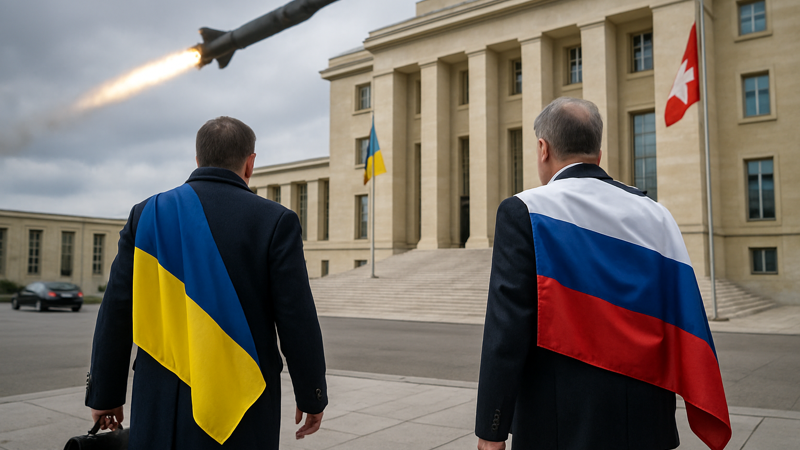
Russian forces launched a record 91 ballistic missiles targeting Ukraine in January 2026, marking the highest monthly total since the conflict began, while Ukrainian and Russian delegations prepared for critical peace negotiations in Geneva as diplomatic momentum builds following historic prisoner exchanges and restored military communications.
The escalating missile barrage coincides with significant territorial gains by Russian forces, who captured 201 square kilometers of Ukrainian territory in just five days last week—the largest area recovered since Ukraine's summer 2023 counteroffensive, according to analysis by the Institute for the Study of War (ISW).
Geneva Talks Mark Diplomatic Evolution
A Ukrainian delegation departed for Geneva to participate in a new round of negotiations with representatives from the United States and Russia, building on the diplomatic momentum established through recent Abu Dhabi trilateral talks. The negotiations represent an evolution from Gulf mediation to European neutral territory, signaling growing international seriousness about finding a resolution to Europe's deadliest conflict since World War II.
"Ukrainian delegation preparing for Geneva talks represents the next phase in our diplomatic efforts."
— Dmytro Lytvyn, Ukrainian Official
The Geneva venue marks a strategic shift from the February Abu Dhabi framework, where Ukraine, Russia, and the United States achieved a historic 314-prisoner exchange—the first such swap in five months. That breakthrough also restored U.S.-Russia military communications after a four-year suspension, establishing deconfliction protocols and transparency mechanisms that Pentagon officials described as providing "means to increase transparency and reduce escalation."
Military Pressure Intensifies Amid Diplomacy
Despite diplomatic progress, military operations have intensified dramatically. Ukrainian Armed Forces reported recovering the significant territorial gains between Wednesday and Sunday, largely attributed to Russia's loss of Starlink satellite internet access that has disrupted Russian communications and command systems, according to ISW analysis.
The territorial advances come as Russian forces continue systematic attacks on civilian infrastructure. Recent strikes have targeted energy facilities and residential areas, leaving over 1,170 buildings in Kyiv without heating during temperatures as low as minus-30°C. Ukrainian President Volodymyr Zelensky warned that Russia is preparing "a new massive attack" and called on authorities to "prepare the necessary measures."
Nuclear Crisis Adds Urgency
The peace negotiations occur against the backdrop of a nuclear governance crisis. The New START Treaty between the United States and Russia expired on February 5, 2026, marking the first time in over 50 years without bilateral nuclear constraints between the superpowers. This development has eliminated verification mechanisms, data exchanges, and confidence-building measures that have prevented nuclear miscalculation since the Cold War era.
UN Secretary-General António Guterres described the treaty's expiration as a "grave turning point," warning that nuclear risks are now "higher than at any time in decades." The crisis adds urgency to diplomatic efforts, as both nations are now technically free to expand their nuclear arsenals without bilateral constraints.
International Support and Division
European support for Ukraine continues with the approval of a historic €90 billion loan package—the largest EU financial assistance ever provided to a single nation. However, divisions persist within the alliance, with Slovakia, Czech Republic, and Hungary refusing to participate in the financing despite broad parliamentary support.
Additional military aid includes Sweden and Denmark providing €246 million in air defense systems, featuring advanced Tridon Mk2 technology, while Germany has committed 35 Patriot missiles to strengthen Ukraine's defensive capabilities.
Humanitarian Crisis Deepens
The human cost of the conflict continues to mount. President Zelensky previously disclosed that 55,000 Ukrainian soldiers have been officially confirmed killed since the invasion began, with a "large number" still missing in action. International estimates suggest actual casualties could be 2-3 times higher when including undocumented losses.
Civilian casualties from systematic targeting have also increased, with recent attacks in Bohodukhiv killing four people, including three young children. Such attacks on residential areas housing families represent clear violations of international humanitarian law under the Geneva Conventions.
"Attacks on civilians are evolving in combination with various weapons, including drones and missiles, requiring special defense and partner support."
— Volodymyr Zelensky, President of Ukraine
Over 17.8 million Ukrainians are currently accessing winter support programs as the energy infrastructure attacks continue what officials describe as "energy terrorism" during life-threatening winter conditions.
Territorial Control Remains Key Challenge
The fundamental sticking point in negotiations remains the status of eastern Ukrainian territories currently under Russian control. Russia has accelerated territorial gains, capturing 481 square kilometers in January 2026 compared to 260 square kilometers in December 2025, demonstrating a clear acceleration in ground operations.
Russian forces have launched over 10,000 drones and bombs since January 2026, while maintaining demands for territorial recognition and insisting that any future talks between Presidents Putin and Zelensky must occur in Moscow. Ukraine maintains its position on territorial integrity while seeking comprehensive security guarantees.
June Deadline Creates Pressure
The Trump administration has established a June 2026 deadline for a comprehensive peace agreement, with talks potentially evolving to Washington venues that could involve presidential-level engagement. This timeline creates unprecedented pressure for innovative solutions to territorial disputes that have persisted for nearly four years.
The diplomatic framework established through the Abu Dhabi talks—including working groups organized by topic followed by joint position synchronization—has proven effective for producing concrete humanitarian results. The UAE's neutral hosting methodology provided a tested model for complex multi-dimensional conflict resolution that could be adapted for the Geneva format.
Global Implications
Success in the Geneva negotiations could end Europe's deadliest conflict since World War II and provide a template for international conflict resolution in the 21st century. However, failure might intensify military operations and undermine diplomatic solutions' credibility for territorial disputes globally.
The stakes extend beyond Ukraine and Russia to encompass European security architecture, international law enforcement, and the principles of territorial sovereignty. The negotiations also coincide with other critical diplomatic efforts, including Iran-U.S. nuclear talks, creating a complex global diplomatic landscape.
Looking Ahead
As the Geneva talks approach, the international community watches for signs of breakthrough versus continued deadlock. The restoration of U.S.-Russia military communications provides an essential channel for preventing escalation, while the proven framework from Abu Dhabi offers a pathway for substantive progress.
The coming weeks will determine whether diplomatic innovation can resolve the decade-old challenges of territorial compromise while preserving sovereignty principles, or whether the conflict will continue its military trajectory with global implications for conflict prevention and international security architecture in the coming decades.