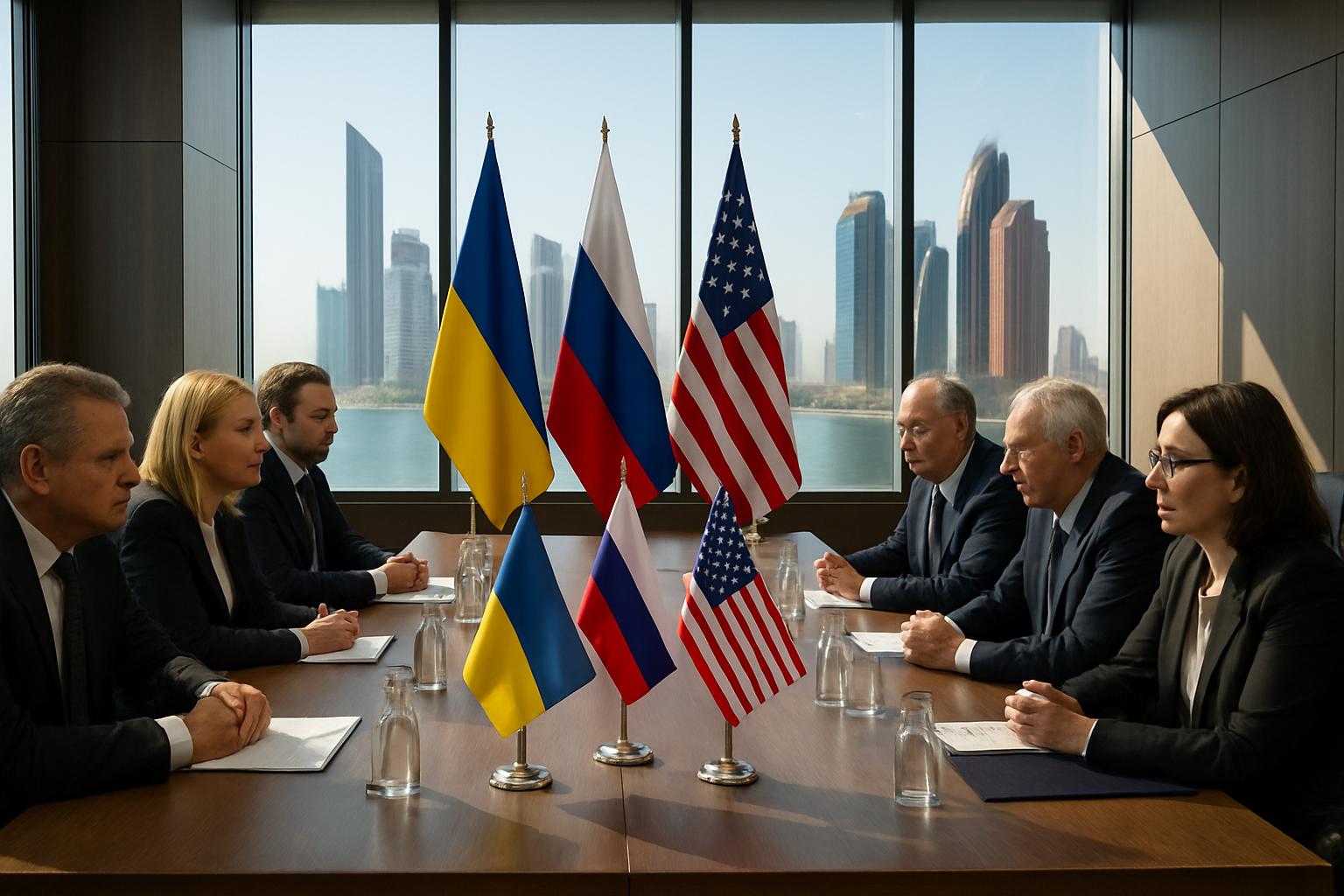
American and Ukrainian negotiators have discussed ambitious plans to reach peace agreements with Russia by March 2026, followed by potential Ukrainian elections and a referendum in May, according to multiple diplomatic sources familiar with ongoing trilateral negotiations.
The discussions represent the most concrete timeline for ending Europe's deadliest conflict since World War II, following a series of breakthrough negotiations in Abu Dhabi between Ukraine, Russia, and the United States that concluded with historic prisoner exchanges and restored military communications.
Diplomatic Breakthrough in Abu Dhabi
The developments emerged from the second round of trilateral peace talks held in Abu Dhabi on February 5-6, 2026, which Ukrainian Defense Minister Rustem Umerov described as "substantial and productive." The negotiations, led by US Special Envoy Steve Witkoff and Russian military intelligence director Igor Kostyukov, achieved concrete humanitarian results including a 314-prisoner exchange - the first such swap in five months.
"The Russians have finally begun to take them more seriously. The discussions were truly constructive."
— American expert consulting Ukrainians, speaking to Politico
Bulgarian media reports indicated that negotiators achieved "four breakthroughs in Abu Dhabi," with Russian officials showing renewed seriousness about the peace process. The UAE's neutral hosting proved crucial in facilitating structured negotiations with working groups addressing different aspects of the conflict.
March Peace Agreement Timeline
According to Greek and Azerbaijani sources, American and Ukrainian delegations discussed an ambitious target of reaching peace agreements with Moscow by March 2026, though the timeline may be subject to change given ongoing military operations and territorial disputes.
Russian officials, including Kremlin spokesperson Dmitri Peskov, confirmed that a third round of negotiations would occur "soon," though no exact date has been set. The talks have evolved from technical discussions to substantive political negotiations addressing ceasefire implementation and monitoring mechanisms.
The main sticking point remains the fate of eastern Ukrainian territories currently under Russian control. Russia has captured 481 square kilometers in January 2026 alone, compared to 260 square kilometers in December 2025, showing accelerated territorial gains despite diplomatic progress.
May Elections Proposal
Perhaps more significantly, sources indicate that US and Ukrainian officials are discussing holding elections and a referendum in Ukraine in May 2026. According to Reuters reports cited by Russian news agency TASS, the US negotiating team told Ukrainian officials during recent Abu Dhabi meetings "that it would be best if that vote occurred soon."
The proposal for Ukrainian elections represents a major shift in wartime governance, as President Volodymyr Zelensky has maintained martial law throughout the conflict, which began with Russia's full-scale invasion in February 2022. Elections would signal a transition toward post-conflict political normalization.
However, Western sources suggest President Zelensky's attitude toward elections remains complex, given ongoing security concerns and the need to maintain unity during peace negotiations.
Military Context and Challenges
The diplomatic progress comes despite continued military escalation. Russia launched what DTEK described as the "most powerful blow" of 2026 against Ukrainian energy infrastructure just before the Abu Dhabi talks, leaving over 1,170 buildings in Kyiv without heating during minus-30°C temperatures.
This attack broke an informal Trump-Putin agreement to avoid targeting energy facilities, demonstrating Russia's strategy of using humanitarian pressure to strengthen its negotiating position. NATO Secretary-General Mark Rutte made a surprise visit to Kyiv, condemning the attacks as a "bad signal" before negotiations.
The human cost of the conflict has been enormous. President Zelensky disclosed in a France 2 interview that exactly 55,000 Ukrainian soldiers have been officially confirmed killed since the invasion began, with a "large number" still classified as missing in action. International researchers estimate actual military deaths could be 2-3 times higher.
International Support and Divisions
The peace talks have revealed divisions within the international community. Germany opposes direct talks with Putin due to what it calls "maximalist demands," while France and Italy support continued diplomatic engagement. The UK and France have pledged troop deployments to enforce any future peace agreement, prompting Russian threats.
Meanwhile, the European Union approved a historic €90 billion loan package for Ukrainian defense and reconstruction - the largest EU aid package in history. Sweden and Denmark announced a €246 million air defense package, while Poland has provided fighter jets and other military support.
The Pentagon's announcement of restored US-Russia military communications after a four-year suspension represents another significant breakthrough, establishing deconfliction protocols and incident prevention measures to reduce escalation risks.
Future Negotiations Framework
President Zelensky has indicated that future talks will "most likely" occur in the United States, suggesting an evolution toward higher-level negotiations potentially involving heads of state. However, Russia maintains that any Putin-Zelensky summit must take place in Moscow.
The UAE framework has proven successful in producing concrete results, with both sides agreeing to "dates for new meetings" continuing the structured approach. The prisoner exchange serves as a confidence-building measure for addressing broader territorial and political issues.
Obstacles and Realities
Despite diplomatic momentum, fundamental disagreements persist. Russia continues to demand recognition of territorial gains, while Ukraine insists on territorial integrity. The ongoing military operations, with Russia launching over 10,000 drones and bombs in January 2026 alone, highlight the challenge of achieving a lasting ceasefire.
The March timeline for peace agreements appears ambitious given the complexity of territorial disputes, security guarantees, and reconstruction funding. Similarly, May elections would require careful coordination with ceasefire implementation and security provisions.
As Bulgarian sources noted, peace agreement work would require "at least 1.5 months" minimum, suggesting that even if March agreements are reached, implementation would extend well beyond that timeframe.
Strategic Implications
The discussions represent the most significant diplomatic opportunity since the conflict began. Success could provide a framework for ending Europe's deadliest war since 1945, while failure might intensify military operations with global consequences.
The restoration of US-Russia military dialogue, combined with structured negotiation frameworks and concrete humanitarian results, demonstrates that sustained diplomatic engagement can produce results even amid ongoing military operations.
However, the 71st prisoner exchange since the invasion began, while significant as a confidence-building measure, also underscores the enormous human cost of a conflict that has fundamentally altered European security architecture and international law.
The coming weeks will be critical in determining whether the diplomatic momentum generated in Abu Dhabi can translate into the concrete agreements needed to end nearly four years of devastating warfare and begin Ukraine's path toward democratic renewal through elections.