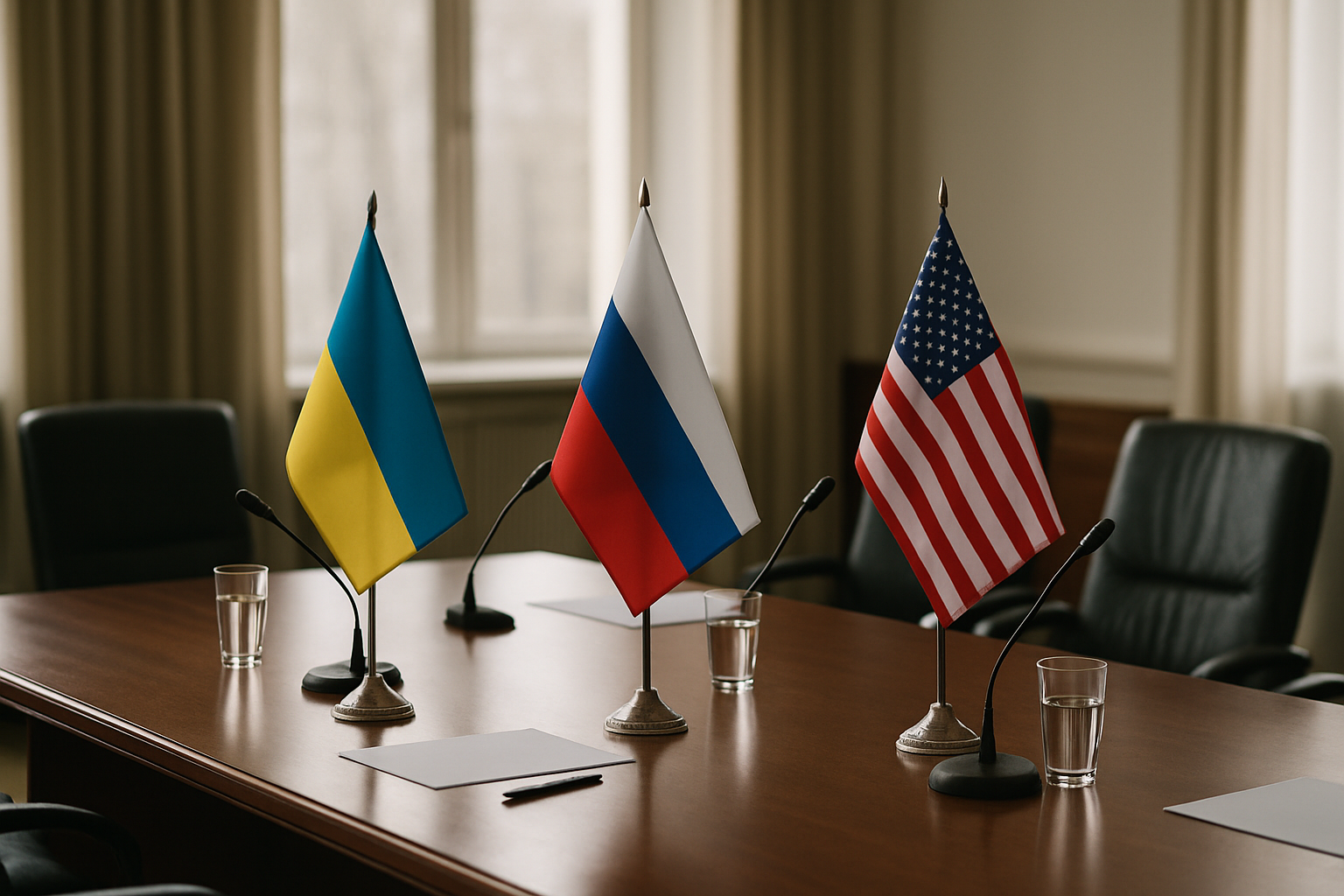
Ukrainian President Volodymyr Zelensky announced Tuesday that trilateral peace negotiations between Ukraine, Russia, and the United States, originally scheduled for this week, have been postponed until next week at the proposal of the American side, citing escalating tensions in the Middle East.
The postponement represents a significant setback for what had been building as the most promising diplomatic momentum since Russia's invasion began nearly four years ago. The talks were intended to build on breakthrough achievements from recent rounds in Abu Dhabi and Geneva, which had achieved historic prisoner exchanges and restored critical communication channels between the superpowers.
American Initiative Behind Delay
Speaking to journalists in Kyiv, Zelensky confirmed that the postponement came directly from Washington. "This was proposed by the American side, but we'll see what happens in the Middle East, to be honest," Zelensky stated, acknowledging the complex regional dynamics affecting diplomatic priorities.
According to multiple sources familiar with the negotiations, the talks had been scheduled to take place in Turkey this week as part of an evolving diplomatic framework that had progressed from initial meetings in Abu Dhabi to substantive negotiations in Geneva, with the ultimate goal of presidential-level engagement in Washington by June 2026.
"We were ready to travel to Turkey. They postponed this meeting. It was specifically the American side that postponed it, saying: 'Let's do it next week.' This is the information we have today," Zelensky explained during an online press briefing.
Previous Diplomatic Breakthroughs at Risk
The postponement threatens to derail momentum from what had been described as unprecedented diplomatic progress. In February, trilateral talks in Abu Dhabi achieved the first prisoner exchange in five months, with 314 personnel exchanged - 157 military personnel from each side, plus three Russian civilians from the Kursk region returned from Ukrainian custody.
More significantly, those talks resulted in the restoration of US-Russia military communications after a four-year suspension, with the Pentagon establishing deconfliction protocols covering operations globally, from Syria to the Arctic to Africa. This represented the most substantial US-Russia military agreement since the conflict began and provided the only remaining formal diplomatic channel between the nuclear superpowers.
The Geneva talks in February built on this foundation, with European "Big 5" observers - Germany, France, Italy, the UK, and Poland - participating for the first time in the trilateral format. While territorial disputes remained unresolved, US Special Envoy Steve Witkoff reported "significant progress" on ceasefire monitoring mechanisms.
Nuclear Crisis Context Adds Urgency
The postponement comes against the backdrop of an unprecedented nuclear governance crisis. The New START treaty between the US and Russia expired on February 5, 2026, marking the first time in over 50 years without nuclear arms control constraints between the superpowers, who control 80% of the world's nuclear weapons.
UN Secretary-General António Guterres has warned of a "grave turning point" with nuclear risks at their "highest in decades." The restored military communications from the Abu Dhabi process represent virtually the only remaining formal diplomatic channel between Washington and Moscow during this critical period.
Territorial Disputes Remain Core Challenge
Despite the diplomatic progress on humanitarian and military technical issues, the fundamental sticking point remains unchanged: the status of eastern Ukrainian territories currently under Russian control. Russia has consistently demanded territorial recognition and insists that any Putin-Zelensky meeting must occur in Moscow. Ukraine maintains its position on territorial integrity while seeking comprehensive long-term security guarantees.
Russian territorial gains have accelerated in recent months, with forces capturing 481 square kilometers in January 2026 compared to 260 square kilometers in December 2025 - an 85% increase representing some of the fastest territorial changes in months of conflict.
Civilian Toll Continues to Mount
The diplomatic delays occur as the humanitarian crisis deepens. President Zelensky has disclosed that 55,000 Ukrainian soldiers have been officially confirmed killed, with a "large number" still classified as missing in action. International estimates suggest actual military casualties could be two to three times higher when including undocumented losses.
Systematic targeting of civilian infrastructure continues, with what Ukrainian officials term "energy terrorism" leaving over 1,170 buildings in Kyiv without heating during sub-zero temperatures. Ukrainian nuclear plants have been forced to halt electricity production for the first time in the conflict following attacks on the power grid.
Recent attacks have demonstrated the continued targeting of civilians, including a drone strike in Bohodukhiv that killed four civilians, including three young children and their father - the second deadly attack on the same town within three days.
International Support Remains Robust
Despite the diplomatic setback, international support for Ukraine remains historically unprecedented. The European Union has approved a €90 billion loan package - the largest single-nation assistance program in EU history - though Slovakia, the Czech Republic, and Hungary refused participation, highlighting ongoing divisions within the bloc.
Additional support includes a €246 million air defense package from Sweden and Denmark featuring Tridon Mk2 systems, and 35 Patriot missiles from Germany. Over 17.8 million Ukrainians are currently accessing winter support programs as the country faces severe infrastructure damage from systematic attacks.
Middle East Crisis Diverts Attention
The postponement highlights how regional conflicts can derail promising diplomatic initiatives elsewhere. Ukraine is reportedly expanding military cooperation to Middle Eastern nations including the UAE, Qatar, Jordan, Bahrain, and Kuwait, sharing expertise in combating Iranian "Shahed" drone attacks - the same weapons systems that have been devastating Ukrainian infrastructure.
This represents a significant evolution for Ukraine, transitioning from being primarily an aid recipient to becoming a security provider, leveraging hard-won battlefield experience into strategic partnerships that could provide new sources of defense industry funding.
June Deadline Remains in Question
The postponement raises questions about the Trump administration's ambitious June 2026 timeline for a comprehensive peace agreement. The planned evolution from Abu Dhabi to Geneva to Washington, potentially culminating in presidential-level engagement, now faces uncertainty as American diplomatic resources are redirected to Middle East crises.
The delay allows continued military escalation while potentially strengthening Russia's bargaining position through ongoing territorial gains. Ukrainian officials have categorically rejected territorial concessions, with Zelensky stating that the Ukrainian people would reject any referendum "handing over territories" as a "failure story."
Framework Preservation Offers Hope
Despite the setback, diplomatic achievements from previous rounds remain intact. The prisoner exchange mechanisms, structured negotiation format, and restored US-Russia communications provide a foundation that can be reactivated when conditions permit. The UAE methodology of working groups by topic followed by joint position synchronization has proven effective for producing humanitarian results amid military operations.
European observers' participation in Geneva talks added institutional weight while maintaining the proven trilateral structure, demonstrating that the diplomatic framework can be expanded when resumed.
Global Implications of Delay
The postponement has broader implications beyond Ukraine-Russia relations. It demonstrates how regional conflicts in today's interconnected world can derail diplomatic initiatives elsewhere, potentially setting precedents for how international crises interact and compete for diplomatic attention and resources.
The stakes extend far beyond the immediate conflict. Success in eventual resumed talks could provide templates for 21st-century territorial dispute resolution, while failure might encourage military over diplomatic solutions to complex international challenges. The conflict affects European security architecture, international law enforcement credibility, and territorial sovereignty principles with implications extending decades beyond current events.
Looking Ahead
As the international community manages multiple simultaneous crises, the preservation of diplomatic momentum becomes crucial. Ukraine's pivot to becoming a security provider in the Middle East may create new leverage for eventual resumed negotiations, while the framework established through previous successful rounds provides a tested methodology for complex multilateral negotiations.
The coming weeks will be critical in determining whether the postponement represents a temporary delay or a more fundamental shift in diplomatic priorities. With Europe's most significant security challenge since the Cold War at a crossroads, the international community faces the challenge of maintaining progress on multiple fronts while preventing further escalation in what remains the continent's deadliest conflict since World War II.