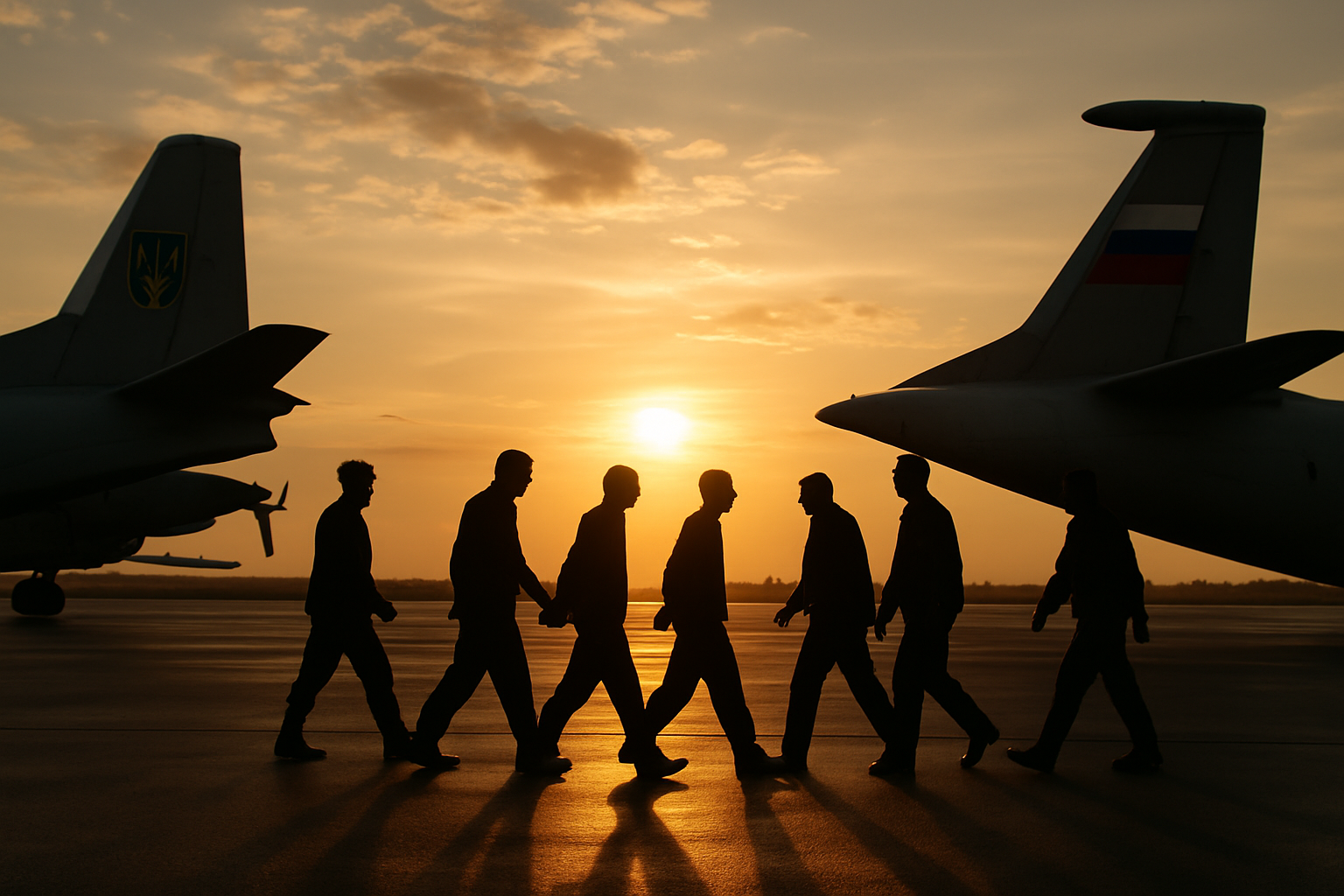
Ukraine and Russia have successfully conducted their first prisoner exchange in five months, with each side releasing 157 prisoners of war in a deal brokered during trilateral peace talks in Abu Dhabi involving the United States.
The historic exchange, confirmed by US Special Envoy Steve Witkoff, represents the 71st prisoner swap since Russia's full-scale invasion began in February 2022. The operation concluded Thursday evening as part of the second round of Ukraine-Russia-US negotiations in the United Arab Emirates capital.
Ukrainian Defense Minister Rustem Umerov described the Abu Dhabi talks as "substantial and productive," marking a significant diplomatic breakthrough despite ongoing military operations. The prisoner exchange served as a critical confidence-building measure during the most serious peace negotiations since the conflict began nearly four years ago.
Diplomatic Breakthrough Amid Military Escalation
The prisoner swap occurred against the backdrop of intensifying Russian attacks on Ukrainian energy infrastructure. Just days before the talks, Russia launched what Ukrainian energy company DTEK described as the "most powerful blow" of 2026, leaving over 1,170 buildings in Kyiv without heating during temperatures as low as minus-30°C.
These attacks broke an informal energy truce between Presidents Trump and Putin, demonstrating Russia's strategy of applying humanitarian pressure while simultaneously engaging in diplomatic negotiations. NATO Secretary-General Mark Rutte made a surprise visit to Kyiv, condemning the energy strikes as a "bad signal" before the peace talks.
"This is a concrete result that families have been waiting for - loved ones finally coming home."
— Steve Witkoff, US Special Envoy
The exchange included not only military personnel but also three Russian civilians from the Kursk region who had been held in Ukrainian custody. This addition highlights the complex humanitarian dimensions of the conflict and the need for comprehensive approaches to prisoner repatriation.
Abu Dhabi Framework Success
The UAE's role as neutral host proved crucial in facilitating concrete results. The talks followed a structured format with separate working groups addressing specific topics before joint position synchronization between delegations. This methodology, first established in January's negotiations, demonstrated its effectiveness in producing tangible humanitarian outcomes.
Russian delegation leader Igor Kostyukov, director of military intelligence, worked alongside Ukrainian and American counterparts to implement the exchange mechanism. The success of this operation provides momentum for continued negotiations, with future meetings planned to continue the UAE framework.
President Zelensky indicated that future talks would "most likely" take place in the United States, suggesting an evolution toward higher-level negotiations as diplomatic progress continues.
Restoration of Military Communications
In a parallel breakthrough, the Pentagon announced the restoration of high-level military-to-military communications between the United States and Russia after a suspension lasting more than four years since autumn 2021. General Alexus Grynkewich of US European Command confirmed the framework provides "means to increase transparency and reduce escalation."
The restored communications include deconfliction measures, incident prevention protocols, and advance notification systems for military activities. These mechanisms are designed to prevent unintended escalation while military operations continue, potentially affecting global security beyond Ukraine in regions where US and Russian forces operate in proximity, including Syria, the Arctic, and Africa.
Historical Context and Significance
The prisoner exchange represents a continuation of humanitarian efforts that have characterized the conflict despite its brutal military dimensions. Since the invasion began, Ukraine and Russia have conducted 71 such exchanges, providing rare moments of hope for families separated by war.
Recent memory searches reveal the complexity of these negotiations. Ukrainian President Zelensky disclosed in early February that 55,000 Ukrainian soldiers have been officially confirmed killed since the invasion began, with a "large number" still classified as missing in action. International researchers estimate actual military deaths could be 2-3 times higher when including missing personnel and undocumented casualties.
The timing coincides with other major diplomatic developments, including the expiration of the New START nuclear arms control treaty between the US and Russia on February 5, 2026 - the first time in over 50 years that no binding limits exist on their strategic nuclear arsenals.
Challenges Ahead
Despite the humanitarian success, fundamental territorial disagreements persist between the parties. The main sticking point remains the long-term fate of eastern Ukrainian territories currently under Russian control. Russia continues to insist that any direct talks between Presidents Putin and Zelensky must occur in Moscow, a condition Ukraine has not accepted.
Military operations continue alongside diplomatic efforts. Russian forces captured 481 square kilometers in January 2026 compared to 260 square kilometers in December 2025, showing accelerated territorial gains. Over 10,000 Russian drones and bombs were launched in January alone, with Russia shifting to what analysts describe as "logistics terror" - targeting transportation infrastructure and civilian facilities.
European divisions also complicate the diplomatic landscape. Germany opposes direct Putin talks due to what officials describe as "maximalist demands," while France and Italy continue to push for expanded diplomatic channels. This disagreement reflects broader European uncertainty about the most effective approach to ending the conflict.
Humanitarian Impact
The prisoner exchange provides immediate relief to 314 families who have endured months or years of separation and uncertainty. For Ukrainian families, the return of military personnel represents hope amid a conflict that has devastated communities across the country.
The timing during extreme winter conditions adds urgency to humanitarian concerns. Over 17.8 million Ukrainians are currently accessing winter support programs as the country faces continued attacks on critical infrastructure. Emergency warming centers have been activated across eight oblasts affected by recent Russian strikes.
International support continues to flow, with the European Union approving a historic €90 billion loan package for Ukrainian defense and reconstruction - the largest EU financial assistance package in history. Sweden and Denmark announced a €246 million air defense package, while Poland has provided emergency generators to help Ukrainian cities cope with power outages.
Looking Forward
The success of the prisoner exchange and restoration of US-Russia military communications represent significant diplomatic achievements amid one of the most serious international conflicts since World War II. These developments provide a tested framework for complex conflict resolution and demonstrate that sustained diplomatic engagement can produce concrete humanitarian results even during active military operations.
However, the fundamental challenges of territorial control, security guarantees, and political settlement remain unresolved. The parties have agreed to continue meetings "in the coming weeks," with the UAE framework providing a foundation for ongoing negotiations.
As European security architecture faces its greatest test in decades, the Abu Dhabi talks offer a rare opportunity for sustainable peace. The prisoner exchange serves as proof that diplomatic engagement can deliver immediate humanitarian benefits while building confidence for broader political resolution.
The international community continues to monitor whether this diplomatic momentum can translate into lasting solutions to end Europe's deadliest conflict since World War II. With winter humanitarian pressures mounting and military operations continuing, time remains critical for converting diplomatic breakthroughs into comprehensive peace.