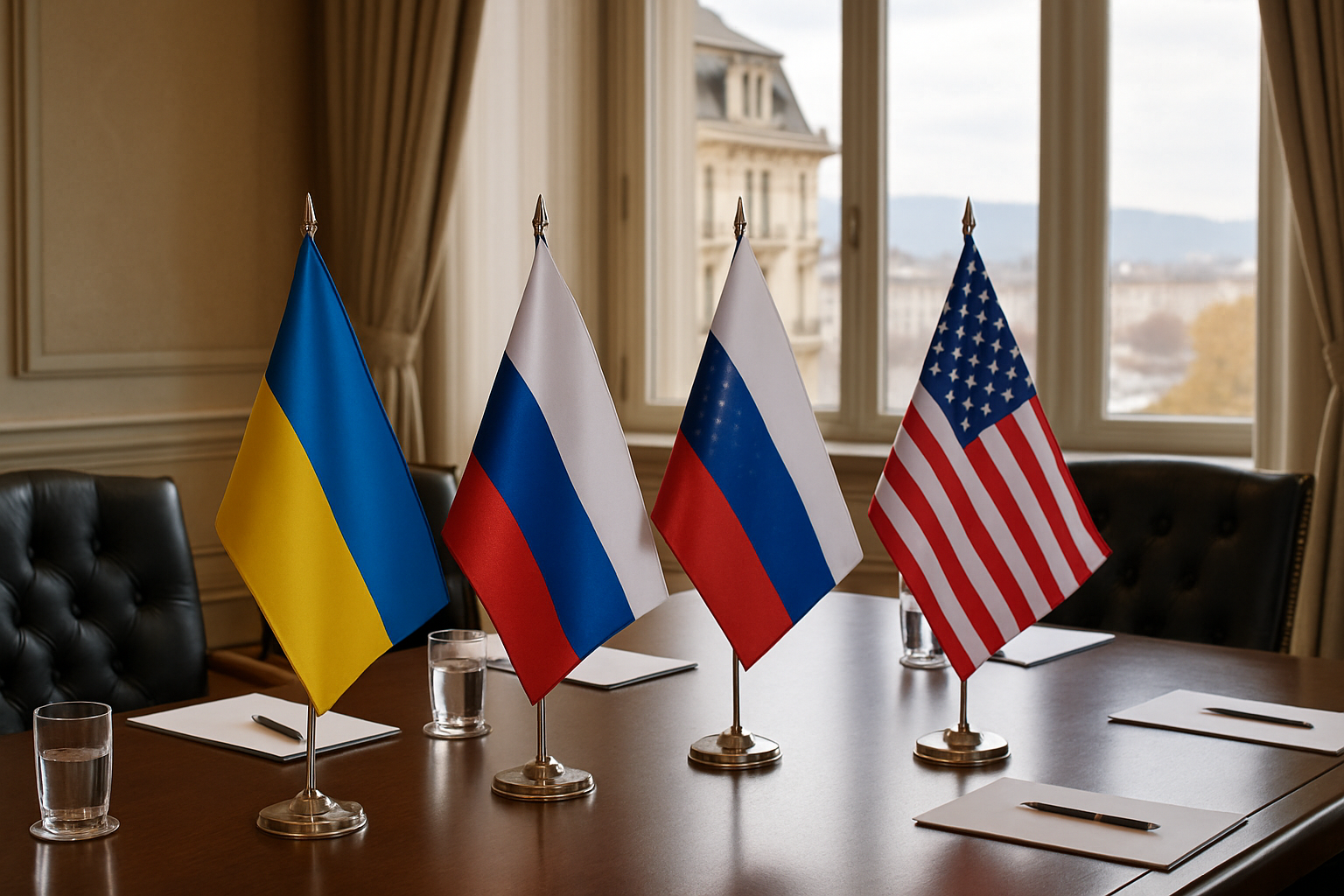
The next round of US-brokered trilateral peace negotiations between Ukraine and Russia is confirmed for February 17-18, 2026, in Geneva, Switzerland, marking a significant evolution from the Abu Dhabi framework that achieved historic diplomatic breakthroughs earlier this month.
Ukrainian presidential communications advisor Dmytro Lytvyn confirmed the dates, stating "Yes, as of today the Ukrainian delegation is preparing." The Geneva venue represents a strategic shift to neutral European territory following successful UAE-hosted talks that produced concrete humanitarian results amid Europe's deadliest conflict since World War II.
Key Delegation Leaders Confirmed
Russia will deploy veteran negotiator Vladimir Medinsky, Putin's chief adviser and head peace negotiator, according to Kremlin spokesman Dmitry Peskov. Medinsky previously led Russia's delegation to failed Istanbul talks in May 2025, where he was criticized for delivering "pseudo-history lessons" rather than pursuing substantive progress.
Ukraine's delegation will be headed by National Security Council Secretary Rustem Umerov, who described the previous Abu Dhabi talks as "substantial and productive." Umerov has emphasized the need for "serious and responsible" negotiations while maintaining Ukraine's territorial integrity positions.
The United States will continue its active mediation role through Special Envoy Steve Witkoff, whose direct engagement proved crucial in achieving the February breakthrough that restored US-Russia military communications after a four-year suspension.
Abu Dhabi Momentum Creates Foundation
The Geneva talks build upon unprecedented diplomatic achievements from the February 4-6 Abu Dhabi negotiations, which produced the first prisoner exchange in five months—314 personnel swapped including 157 military personnel from each side plus three Russian Kursk civilians returned from Ukrainian custody.
"The Ukrainian team remains the same and is formed taking into account military, political and security issues."
— Rustem Umerov, Ukrainian Defense Minister
More significantly, the Abu Dhabi framework restored high-level US-Russia military communications through the Pentagon and European Command, establishing deconfliction protocols and incident prevention mechanisms that had been suspended since autumn 2021.
This represents the most substantial military-to-military agreement between the nuclear superpowers since the Ukraine conflict began, providing transparency measures and escalation reduction protocols that extend beyond Ukraine to global US-Russia military interactions in Syria, the Arctic, and Africa.
Nuclear Governance Crisis Adds Urgency
The Geneva talks occur against an unprecedented nuclear backdrop following the February 5, 2026 expiration of the New START treaty—marking the first time in over 50 years without bilateral nuclear arms control between the United States and Russia.
UN Secretary-General António Guterres warned this creates a "grave turning point" with nuclear weapon use risks "higher than at any time in decades." Both nations now possess unconstrained arsenals: Russia approximately 4,380 warheads with 1,710 deployed, and the United States 3,708 warheads with 1,670 deployed, controlling over 80% of global nuclear weapons.
The military communications restoration provides the sole remaining formal channel between nuclear superpowers, making the Geneva diplomatic track crucial for preventing miscalculation amid ongoing territorial disputes.
Military Escalation Continues Despite Diplomacy
Russian military operations have intensified dramatically, capturing 481 square kilometers in January 2026 compared to 260 square kilometers in December 2025. Over 10,000 Russian drones and bombs were launched in January alone, representing a systematic escalation in both scope and frequency.
The "winter weapon" strategy targeting civilian energy infrastructure has reached unprecedented levels. Russia's February 3-4 attacks, described by DTEK as the "most powerful blow of 2026," left over 1,170 buildings in Kyiv without heating during minus-30°C temperatures, breaking an informal Trump-Putin agreement to avoid energy targets during negotiations.
Ukrainian nuclear power plants were forced to halt electricity production for the first time since the conflict began, creating cascading effects throughout the interconnected power grid and affecting millions of civilians during life-threatening winter conditions.
Systematic Civilian Targeting Escalates
Recent attacks have shown a disturbing pattern of deliberate civilian targeting. A February 11 Russian drone strike on Bohodukhiv, Kharkiv region, killed four civilians including three young children—two one-year-old boys and a two-year-old girl, along with their 34-year-old father. This marked the second deadly attack on the same town within three days.
The systematic targeting extends to energy infrastructure repair personnel, with 15 DTEK workers killed in recent strikes. This pattern represents clear violations of the Geneva Conventions' civilian protection provisions and demonstrates sophisticated calculation to maximize humanitarian pressure during diplomatic engagement.
European Support Remains Historic
Despite ongoing escalation, European Union support has reached unprecedented levels with Parliament's approval of a €90 billion loan package—the largest EU financial assistance package ever for a single nation. The package covers 2026-2027 defense and reconstruction needs, though Slovakia, Czech Republic, and Hungary refuse participation, highlighting persistent European divisions.
Sweden and Denmark announced a €246 million air defense package including advanced Tridon Mk2 systems. Poland has deployed fighter jets and provided emergency generators, while the World Bank allocated $40 million for energy restoration efforts.
President Zelensky disclosed that 55,000 Ukrainian soldiers have been officially confirmed killed since February 2022, with a "large number" still classified as missing in action. Over 17.8 million Ukrainians are currently accessing winter support programs due to infrastructure damage.
Territorial Disputes Remain Core Challenge
The fundamental sticking point persists: eastern Ukrainian territories under Russian control. Russia maintains demands for territorial recognition and insists that Putin-Zelensky talks must occur in Moscow. Ukraine continues to assert territorial integrity principles, rejecting any territorial concessions as violations of international law.
This represents the same impasse that has characterized negotiations since 2022, with accelerating Russian territorial gains adding urgency to diplomatic resolution efforts while potentially strengthening Moscow's bargaining position.
June Deadline Creates Pressure
The Trump administration has established a June 2026 deadline for comprehensive peace agreement, with Washington venue talks potentially involving presidential-level participation. This timeline creates significant pressure for innovative territorial compromise solutions that have eluded negotiators for nearly four years.
The evolution from Abu Dhabi to Geneva to potentially Washington suggests a deliberate escalation in diplomatic engagement levels, testing whether sustained high-level attention can produce breakthrough solutions where previous efforts have failed.
Strategic Implications for European Security
The Geneva talks represent the most significant diplomatic opportunity since the conflict began, with implications extending far beyond Ukraine. Success could end Europe's deadliest war since World War II and provide a template for 21st-century territorial dispute resolution.
Failure, however, could intensify military operations globally and undermine confidence in diplomatic solutions for territorial conflicts, with broader implications for international law enforcement and sovereignty principles in an era of great power competition.
The restoration of US-Russia military communications, achieved through the Abu Dhabi framework, provides essential deconfliction mechanisms that could prevent nuclear escalation while territorial negotiations continue. This represents perhaps the most crucial aspect of recent diplomatic progress given the unprecedented nuclear governance vacuum.
Coming Days Decisive
The February 17-18 Geneva negotiations will test whether the humanitarian breakthroughs achieved in Abu Dhabi can translate into substantive progress on territorial disputes. The combination of nuclear governance crisis, accelerating military operations, and historic international support creates a unique diplomatic moment.
Whether innovative compromise solutions can bridge decade-old territorial challenges or whether the talks represent another cycle in prolonged diplomatic engagement remains to be determined. The stakes for European security architecture, international law credibility, and global conflict prevention could not be higher.
As delegations prepare for Geneva, the international community watches to see if sustained diplomatic engagement can overcome the fundamental territorial disagreements that have defined this conflict, or if military escalation will ultimately determine the outcome of Europe's most consequential war since 1945.