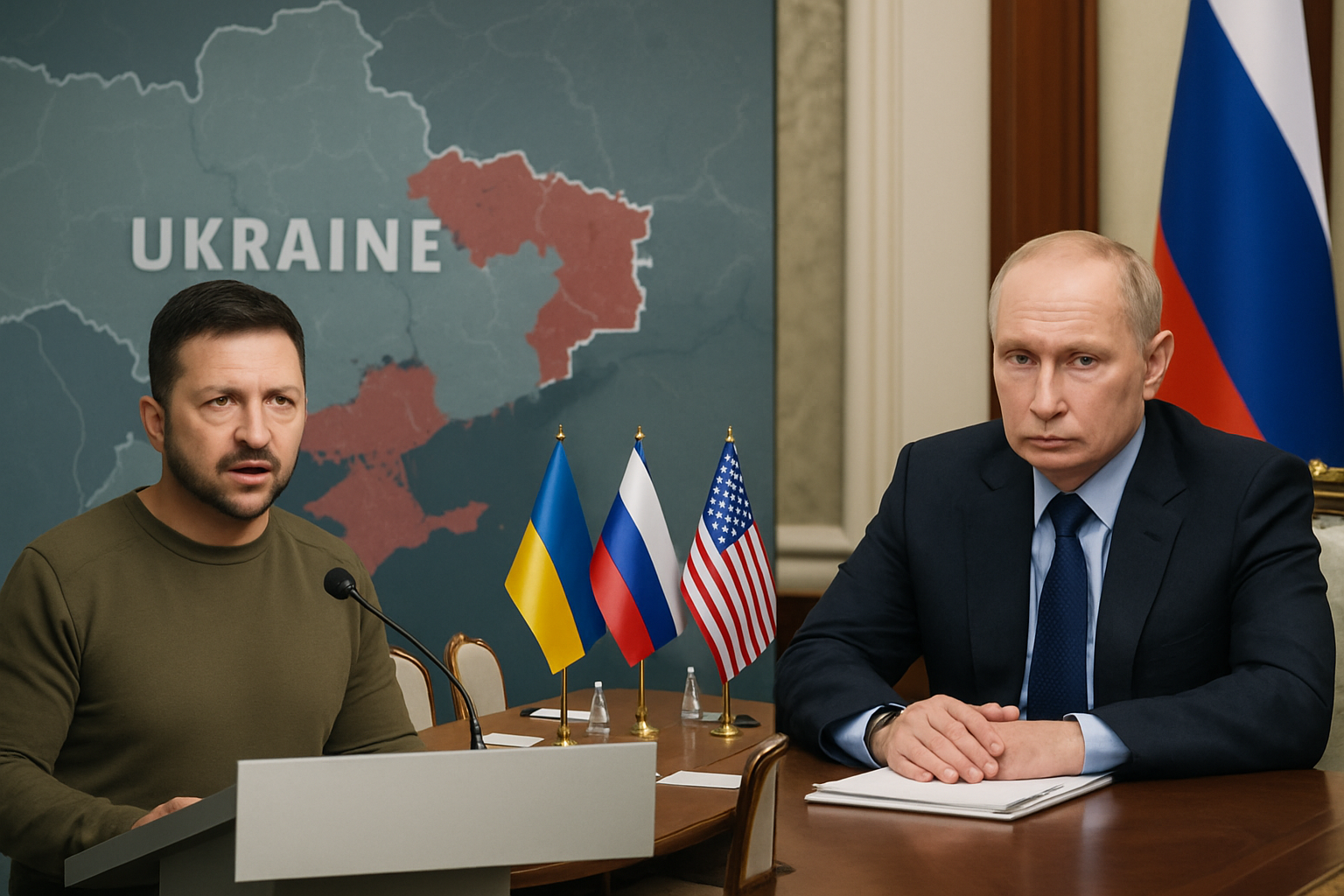
Ukraine's foreign minister announced President Volodymyr Zelensky's readiness to meet with Russian President Vladimir Putin in Turkey, marking a potential diplomatic breakthrough even as trilateral peace talks remain suspended and military operations intensify across multiple fronts.
The announcement was made by Foreign Minister Andrii Sybiha during the Antalya Diplomacy Forum, representing the most significant diplomatic opening in months despite ongoing challenges in broader international peace negotiations. The Turkish venue proposal comes as previous trilateral talks between Ukraine, Russia, and the United States have been indefinitely postponed due to the Iranian crisis consuming American foreign policy attention.
Diplomatic Framework Under Strain
The current diplomatic situation reflects a complex paradox of progress and stagnation. While Ukrainian leadership has expressed openness to direct talks with Putin in Turkey, the broader framework of international negotiations remains suspended. The February 2026 diplomatic breakthroughs - including a historic 314-prisoner exchange and the restoration of US-Russia military communications after a four-year suspension - have been preserved but remain stalled.
French diplomatic sources indicate that Russia has yet to formulate concrete initiatives regarding the Ukrainian crisis settlement. Russian Foreign Minister Sergei Lavrov stated that "for now, no concrete initiative has been formulated" concerning efforts to settle the Ukrainian crisis, highlighting the gap between diplomatic rhetoric and substantive action.
"Ukraine is ready for a meeting between Volodymyr Zelensky and Vladimir Putin in Turkey"
— Andrii Sybiha, Ukrainian Foreign Minister
Military Technological Evolution
The conflict has witnessed unprecedented military innovation, particularly in unmanned systems warfare. Estonian Ministry of Defense officials report that Ukraine has dramatically increased combat operations using unmanned ground systems, marking a significant tactical evolution in modern warfare.
Ukrainian forces have achieved remarkable success with electronic warfare systems, neutralizing more than 50% of enemy aerial targets according to Ground Forces reports. This technological superiority has been demonstrated through successful operations against sophisticated threats, including the first documented downing of a jet-powered drone traveling at over 400 kilometers per hour by private air defense units in the Kharkiv region.
The scope of drone warfare has expanded dramatically, with Ukrainian unmanned systems forces striking over 24,000 pieces of Russian military equipment in their first 10 months of operation since establishment. This represents a fundamental transformation in warfare tactics and Ukraine's evolution from aid recipient to security provider.
International Military Cooperation
Ukraine's strategic partnerships have expanded beyond traditional Western allies into Middle Eastern cooperation. The country has deployed over 200 military specialists to the UAE, Qatar, Jordan, Bahrain, and Kuwait, sharing expertise in combating Iranian Shahed drones - the same weapons systems being used against Ukrainian infrastructure.
Naval capabilities are set for significant enhancement, with Ukraine's Navy expected to operate five mine countermeasure vessels by June 2026. The Netherlands is currently training crews for the minehunter Zr. Ms. Makkum, which will be renamed Henichesk and transferred to Ukraine, representing substantial international military cooperation.
Aviation Modernization and EU Financial Support
President Zelensky announced that unblocking European financial packages could fund the expansion of Ukraine's combat aviation with Gripen aircraft. Discussions with King Carl XVI Gustaf of Sweden focus on beginning training of Ukrainian pilots on Swedish-made Gripen fighter jets as early as this year, potentially revolutionizing Ukraine's air capabilities.
The European Union's financial commitment remains historic, with Ukraine having received approximately $45 billion, representing 90% of expected funding backed by revenues from frozen Russian assets. This unprecedented financial support demonstrates sustained international commitment despite political divisions within Europe.
Sanctions and Economic Pressure
President Zelensky has imposed sanctions on 130 Russian military commanders and religious figures who justify Russian aggression, representing a comprehensive approach to accountability. These sanctions target those directly involved in missile attacks against Ukraine as well as religious leaders supporting the conflict.
The sanctions regime reflects broader international efforts to maintain economic pressure while diplomatic channels remain challenging. However, concerns have emerged about potential risks to weapons supplies due to regional conflicts, particularly the war in Iran, though European partners have indicated readiness to find alternative solutions.
Humanitarian and Infrastructure Challenges
The conflict continues to exact a severe humanitarian toll, with systematic targeting of civilian infrastructure remaining a persistent challenge. Russian forces have maintained attacks on energy facilities and residential areas, including strikes on Odessa that have caused casualties and damage to both residential buildings and port facilities.
The pattern of infrastructure targeting has forced Ukrainian nuclear plants to halt electricity production for the first time since the conflict began, highlighting the broader implications for European energy security. These attacks violate international humanitarian law and represent calculated pressure tactics during potential diplomatic engagement.
Nuclear and Strategic Considerations
The expiration of the New START treaty on February 5, 2026, marked the first time in over 50 years without US-Russia nuclear constraints. This development has created an unprecedented nuclear governance crisis, with both superpowers controlling 80% of global nuclear weapons without bilateral limitations.
UN Secretary-General António Guterres has described this as a "grave turning point," with nuclear risks at their "highest in decades." The restoration of military communications between the Pentagon and Russian General Staff represents the only remaining formal diplomatic channel between the nuclear superpowers.
Regional Security Architecture
The conflict's implications extend far beyond Ukraine's borders, affecting the entire European security architecture. The Munich Security Conference assessed that the "post-war order no longer exists," with France exploring nuclear deterrent expansion beyond national scope for the first time since the Cold War.
European unity faces challenges, with Hungary threatening to veto EU sanctions packages and financial support over pipeline disputes. Lithuania has warned that "the EU cannot become Budapest's hostage," highlighting internal divisions that complicate unified Western responses.
Looking Forward: Diplomatic Opportunities and Challenges
The Turkish proposal for direct talks between Zelensky and Putin represents a potential breakthrough in diplomatic engagement. Turkey's neutral status and successful mediation history provide advantages for sensitive territorial compromise discussions, building on previous framework successes achieved through structured negotiations.
However, fundamental sticking points remain unchanged. Russia continues to demand recognition of occupied eastern Ukrainian territories and insists on Moscow as the venue for Putin-Zelensky talks. Ukraine maintains its territorial integrity position while seeking long-term security guarantees from international partners.
The timeline for resumed negotiations depends heavily on the resolution of the Iranian crisis and broader Middle East stability. Military escalation continues with systematic civilian targeting while Ukraine expands international partnerships and maintains operational capabilities through technological innovation.
Strategic Implications for Global Security
The success or failure of eventual diplomatic breakthroughs carries implications far beyond Europe, affecting 21st-century territorial dispute resolution frameworks. The stakes include European security architecture redefinition, international law enforcement credibility, and territorial sovereignty principles that will influence global power competition for decades.
Ukraine's transformation from aid recipient to security provider, demonstrated through Middle Eastern partnerships and technological innovation, provides potential new leverage for future diplomatic conditions. The framework preservation from previous negotiations allows for reactivation when favorable conditions return.
As the conflict approaches its fourth anniversary, the international community watches closely for diplomatic innovation versus traditional limitations in resolving complex territorial disputes. The template established through this conflict will affect global conflict prevention mechanisms and the credibility of diplomatic solutions to territorial sovereignty challenges worldwide.
The coming phase remains uncertain, with military capabilities continuing to evolve while diplomatic channels maintain potential for reactivation. Whether innovative compromise can bridge fundamental positions or continued military escalation will determine European security trajectory depends on the resolution of competing international priorities and the development of creative solutions to territorial sovereignty challenges that have defined this conflict since its inception.