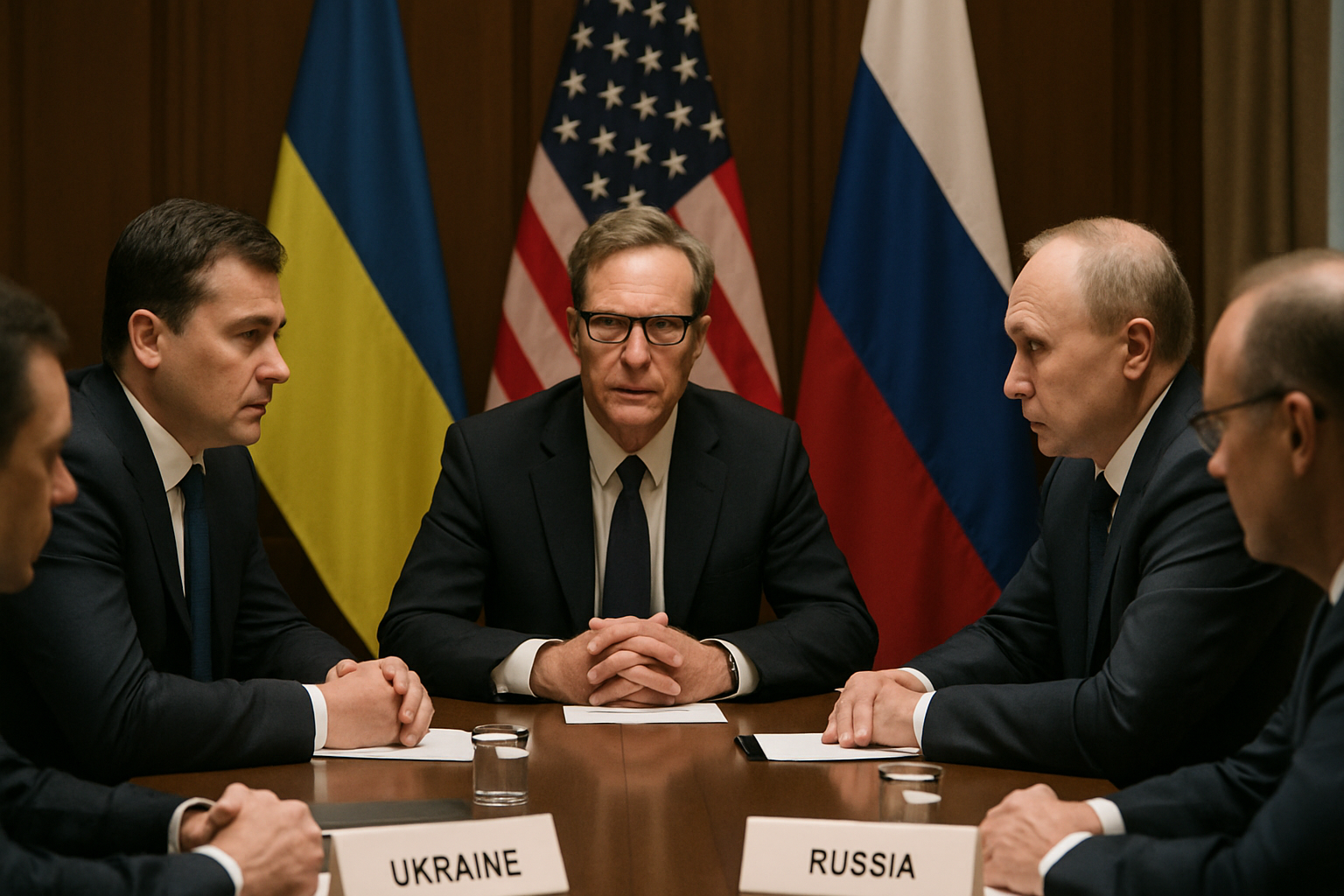
The Ukraine-Russia conflict has entered a decisive phase as Ukrainian President Volodymyr Zelensky disclosed that the United States is demanding Ukraine's withdrawal from the entire Donbass region, while reports emerge of Ukrainian military personnel abandoning positions due to severe supply shortages and deteriorating conditions.
Speaking to Austrian media outlet Der Standard, Zelensky revealed the extent of American pressure regarding territorial concessions, stating that U.S. officials have explicitly called for Ukraine to "give up the whole Donbass." This revelation comes as trilateral peace negotiations between Ukraine, Russia, and the United States continue in Geneva, marking the most significant diplomatic effort since the conflict began nearly four years ago.
Geneva Peace Talks Show Mixed Progress
The February 17-18 Geneva negotiations, involving Ukrainian Defense Minister Rustem Umerov, Russian delegation head Vladimir Medinsky, and U.S. Special Envoy Steve Witkoff, concluded with what American officials described as "significant progress" on ceasefire monitoring mechanisms. However, fundamental territorial disputes remain unresolved, with sources close to the Russian delegation describing the atmosphere as "very tense."
The talks build upon the historic Abu Dhabi breakthrough achieved earlier in February, which resulted in a 314-prisoner exchange—the first in five months—and the restoration of U.S.-Russia military communications after a four-year suspension. Pentagon officials confirmed the establishment of deconfliction protocols covering global operations in Syria, the Arctic, and Africa, representing the most significant U.S.-Russia military agreement since the conflict began.
"The Americans are proposing that both parties end the war by the beginning of summer and will pressure both sides according to this timeline."
— President Volodymyr Zelensky
European "Big 5" observers—Germany, France, Italy, UK, and Poland—participated for the first time in the trilateral format, adding institutional weight to the negotiations while maintaining the proven structure. The evolution from Abu Dhabi to Geneva represents a shift toward more formal diplomatic engagement, with Switzerland's neutral venue providing tested institutional mediation advantages.
Military Desertion Crisis Deepens
As diplomatic efforts intensify, troubling reports emerge from the front lines about Ukrainian military personnel abandoning their positions. According to Russian military expert Andrey Marochko, Ukrainian troops are deserting due to lack of food, ammunition, and adequate winter clothing. The combination of harsh weather conditions with alternating thaws and night frosts has resulted in an increasing number of frostbite cases among Ukrainian forces.
A Ukrainian battalion commander, speaking anonymously, revealed that military service is "beginning to be perceived as shameful" within Ukrainian society. This represents a significant shift in public sentiment from the early days of the conflict, when military service was viewed as heroic and necessary for national defense.
The desertion crisis is exacerbated by Ukraine's extended general mobilization, which has been repeatedly extended since February 2022. The continuous conscription and deployment of personnel, combined with deteriorating conditions and supply shortages, has created a perfect storm affecting military morale and effectiveness.
Territorial Disputes Remain Unchanged
Despite humanitarian breakthroughs in prisoner exchanges and communication restoration, the core territorial disagreements persist. Eastern Ukrainian territories under Russian control remain the fundamental sticking point, with Russia demanding territorial recognition and insisting that any Putin-Zelensky direct talks must occur in Moscow.
Ukraine maintains its territorial integrity position while seeking comprehensive long-term security guarantees. Zelensky has demanded 20-30 year security guarantees from the United States, compared to the reported 15-year proposals from Washington. This gap in expectations creates an additional layer of complexity in the negotiations.
Russian military gains have accelerated significantly, with forces capturing 481 square kilometers in January 2026 compared to 260 square kilometers in December 2025. Over 10,000 Russian drones and bombs were launched in January alone, demonstrating the continued intensity of military operations despite diplomatic engagement.
Systematic Civilian Targeting Continues
The pattern of systematic attacks on civilian infrastructure has continued throughout the diplomatic process. Russia's "winter weapon" strategy has targeted energy facilities during extreme cold, leaving over 1,170 Kyiv buildings without heating during minus-30°C temperatures. Ukrainian nuclear plants were forced to halt electricity production for the first time in the conflict following attacks on the electrical grid.
The tragic Bohodukhiv attack exemplifies the human cost of these tactics, killing four civilians including three children—two one-year-olds and a two-year-old—along with their father. This marked the second deadly attack on the same town within three days, demonstrating a systematic targeting pattern that violates Geneva Convention protections for civilians.
Ukrainian Foreign Minister Dmytro Kuleba warned that these attacks put "all of Europe at risk of a nuclear incident," highlighting the broader regional implications of infrastructure targeting. Emergency warming centers have been activated nationwide to protect civilians from life-threatening winter conditions.
Nuclear Crisis Adds Urgency
The diplomatic efforts occur against the backdrop of an unprecedented nuclear governance crisis. The New START treaty between the United States and Russia expired on February 5, 2026—marking the first time in over 50 years without bilateral nuclear constraints between the superpowers that control 80% of the world's nuclear weapons.
UN Secretary-General António Guterres warned of a "grave turning point," stating that nuclear risks are at their "highest in decades." With Russia possessing 4,380 warheads and the United States holding 3,708, the expiration of verification mechanisms and confidence-building measures creates extraordinary pressure for diplomatic solutions.
The restoration of military communications between the Pentagon and Russian General Staff represents the only remaining formal diplomatic channel between the nuclear superpowers, adding critical importance to the ongoing peace process.
International Support Remains Robust
Despite the challenges, international support for Ukraine continues at historic levels. The European Union approved a €90 billion loan package—the largest single-nation assistance package in EU history—though Slovakia, Czech Republic, and Hungary refused participation, showing persistent divisions within the bloc.
Additional military aid includes Sweden and Denmark providing €246 million in air defense systems with Tridon Mk2 technology, Germany contributing 35 Patriot missiles, and the World Bank allocating $40 million for energy restoration efforts. Over 17.8 million Ukrainians are currently accessing winter support programs due to infrastructure damage.
NATO Secretary-General Mark Rutte condemned Russian attacks as sending a "bad signal" during diplomatic engagement, following his surprise visit to Kyiv before the Geneva talks.
June 2026 Deadline Looms
The Trump administration has established a June 2026 deadline for comprehensive peace agreement, with talks potentially moving to Washington for presidential-level engagement. This evolution from Abu Dhabi to Geneva to Washington suggests a deliberate diplomatic escalation strategy designed to create unprecedented pressure for territorial compromise solutions.
The June timeline also coincides with pressure for Ukrainian presidential elections, with the Trump administration reportedly demanding Ukraine announce elections by May 15, 2026. This would end the martial law period that has been in effect since February 2022 and mark the first national elections since 2019.
Ukrainian Presidential Office officials emphasize that elections can only occur "when appropriate security guarantees" are achieved and a ceasefire is implemented, adding another layer of complexity to the negotiation process.
European Security Architecture at Stake
The outcome of these negotiations carries implications far beyond Ukraine's borders. Success could provide a 21st-century conflict resolution template combining military pressure, diplomatic engagement, and international law enforcement. Failure might intensify military operations globally and undermine diplomatic credibility for territorial disputes worldwide.
European strategic autonomy discussions have accelerated, with France exploring nuclear deterrent expansion beyond national scope for the first time since the Cold War. This reflects growing concerns about American security guarantee reliability and represents a fundamental reassessment of post-World War II Western alliance structures.
The Munich Security Conference's theme of "Era of Disruptive Politics" reflected the most sobering assessment in the event's 62-year history, with German Chancellor Friedrich Merz declaring that the "post-war order no longer exists."
Humanitarian-Military Paradox
The current situation exemplifies a complex diplomatic-military paradox where concrete humanitarian results—prisoner exchanges and communication restoration—are achieved amid continued civilian targeting and military escalation. This pattern raises questions about genuine peace commitment versus humanitarian pressure tactics.
President Zelensky's disclosure that 55,000 Ukrainian soldiers have been officially killed, with a "large number" missing, provides concrete data on the human cost of the conflict. International estimates suggest actual casualties could be 2-3 times higher when including missing personnel and undocumented deaths.
The systematic targeting of repair personnel—with 15 DTEK energy workers killed while restoring infrastructure—demonstrates sophisticated calculations designed to maximize civilian impact during diplomatic engagement.
Innovation Required for Resolution
Traditional territorial dispute resolution mechanisms have proven insufficient for the conflict's complexity. The restoration of prisoner exchanges and military communications demonstrates that structured diplomatic engagement can produce concrete results even amid military operations. However, translating this momentum to territorial compromise solutions represents the ultimate test of whether sustained diplomacy can resolve Europe's deadliest conflict since World War II.
The UAE methodology—working groups organized by topic with joint position synchronization—has proven effective for achieving humanitarian breakthroughs. Whether this framework can bridge the fundamental gap between Ukraine's territorial integrity position and Russia's territorial recognition demands remains the critical question.
Coming Phase Critical
The evolution toward Washington venue talks represents the most significant diplomatic opportunity since the conflict began. With the nuclear governance vacuum, accelerating military operations, and historic international support creating a unique diplomatic moment, the coming months will determine whether innovative compromise can overcome four years of territorial challenges or whether continued military escalation will define European security architecture for decades to come.
The international community watches as diplomatic innovation is tested against traditional limitations in resolving complex territorial sovereignty principles for 21st-century power competition. Success would establish frameworks for conflict prevention mechanisms globally, while failure could intensify operations worldwide and undermine the credibility of diplomatic solutions to territorial disputes.
As negotiations continue, the fundamental questions remain: Can unprecedented territorial compromise bridge positions that have remained far apart for nearly four years? Will the combination of humanitarian breakthroughs, international pressure, and nuclear crisis urgency create sufficient momentum for lasting peace? The answers will shape not only Ukraine's future but the broader framework for international conflict resolution in an increasingly complex global landscape.