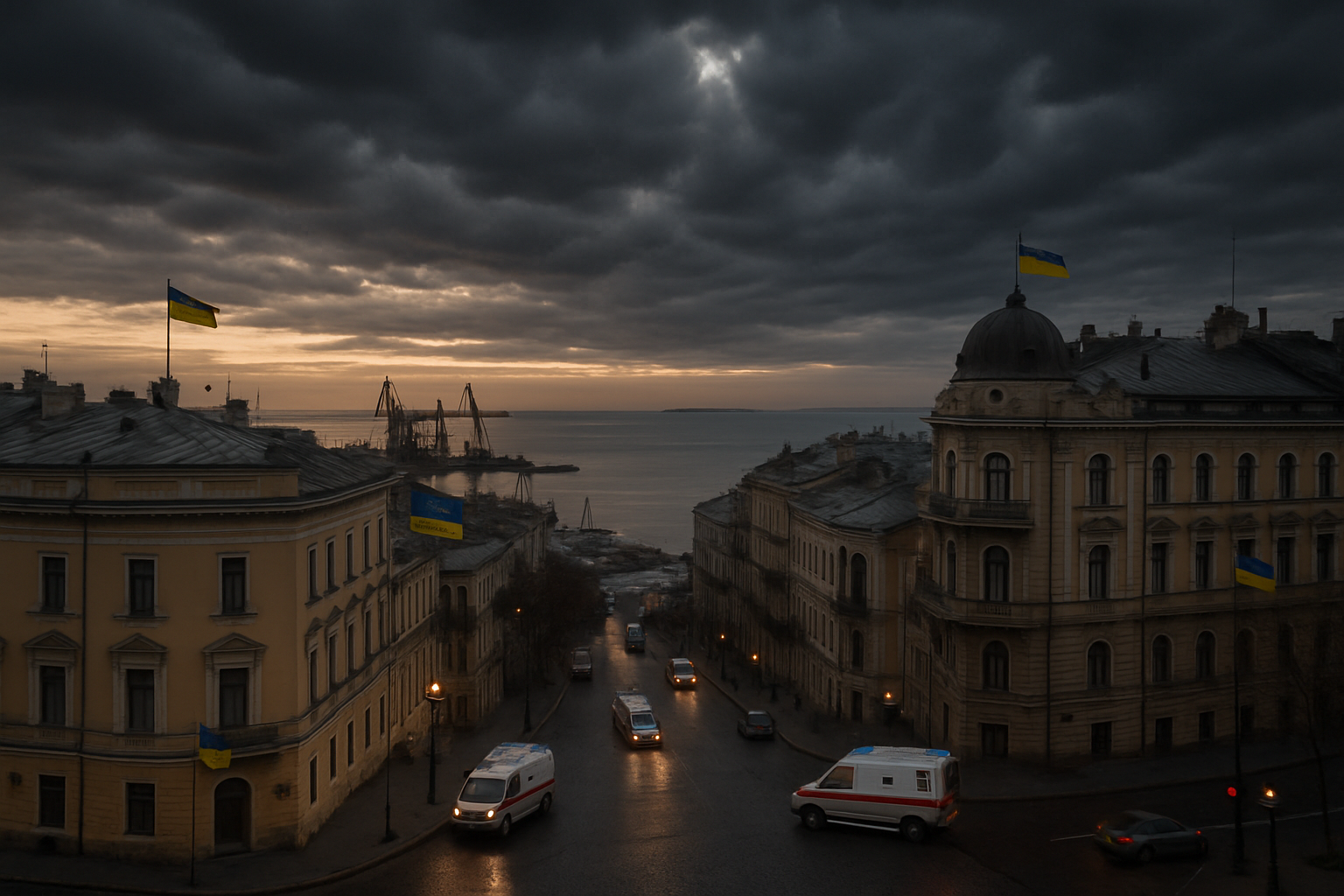
Russian forces launched renewed drone attacks on the strategic port city of Odesa while diplomatic efforts continue through Ukraine-Russia-US trilateral peace talks, demonstrating the complex dynamics between military operations and peace negotiations on day 1,446 of the conflict.
The latest developments underscore the persistent challenges facing negotiators as military action continues across multiple fronts despite breakthrough achievements in prisoner exchanges and restoration of US-Russia military communications during recent Abu Dhabi talks.
Odesa Under Attack as Military Operations Persist
Russian drone strikes targeted infrastructure and residential areas in Odesa, with Governor Oleh Kiper describing the assault as "massive" according to Swedish media reports. The attacks damaged critical gas pipeline infrastructure and sparked fires throughout the city, marking another escalation in Russia's systematic targeting of Ukrainian civilian infrastructure.
One person was confirmed killed in the Odesa drone attack, with significant damage recorded to residential buildings and essential services. The strikes represent a continuation of Russia's strategy of targeting civilian infrastructure during extreme winter conditions, which Ukrainian officials describe as "energy terrorism."
Ukrainian Military Gains in Zaporizhzhia Sector
Despite ongoing attacks, Ukrainian forces achieved tactical successes with soldiers from the 17th Army Corps capturing 11 Russian servicemen near the village of Pavlivka in the Zaporizhzhia sector. This operation demonstrates continued Ukrainian military effectiveness despite facing sustained Russian pressure across multiple front lines.
In separate operations in the Pokrovsk area of Donetsk region, Ukrainian defenders successfully destroyed a Russian 2S9 Nona-S self-propelled artillery unit using drone strikes. The artillery system was reportedly being positioned by Russian paratroopers to support assault operations toward Hryshyne, highlighting the ongoing tactical battles across the eastern front.
Historic Peace Talk Achievements Amid Continued Fighting
The military escalation occurs against the backdrop of significant diplomatic progress achieved during the recent Abu Dhabi trilateral peace talks between Ukraine, Russia, and the United States. The negotiations, described by Ukrainian Defense Minister Rustem Umerov as "substantial and productive," produced concrete humanitarian results despite ongoing military operations.
The breakthrough prisoner exchange involved 314 individuals - 157 military personnel from each side plus three Russian civilians from the Kursk region returned from Ukrainian custody. This marked the 71st such exchange since the February 2022 invasion began and the first swap in five months, serving as a critical confidence-building measure.
"The talks achieved substantial and productive discussions on methods for implementing ceasefire and monitoring cessation of hostilities."
— Rustem Umerov, Ukrainian Defense Minister
Restored US-Russia Military Communications
Perhaps equally significant, the Pentagon announced restoration of high-level US-Russia military communications after a four-year suspension since autumn 2021. The agreement includes deconfliction measures, incident prevention protocols, and advance notification systems designed to reduce escalation risks while military operations continue.
General Alexus Grynkewich from US European Command confirmed the framework provides "means to increase transparency and reduce escalation" through direct channels between European Command and Russian General Staff counterparts. This represents the most significant US-Russia military agreement since the Ukraine conflict began.
Winter Crisis Deepens Infrastructure Challenges
The attacks on Odesa occurred as Ukraine continues to face severe winter conditions, with temperatures dropping to minus-30°C in some regions. Earlier Russian strikes left over 1,170 buildings in Kyiv without heating during extreme cold, demonstrating Russia's continued use of energy infrastructure as a strategic target.
Ukrainian nuclear power plants were forced to halt electricity production for the first time during the conflict following attacks on electrical distribution networks. IAEA Director General Rafael Grossi confirmed the unprecedented shutdown, while Ukrainian officials warned the targeting puts "all of Europe at risk of nuclear incident."
International Support Continues
The European Union approved its 20th sanctions package against Russia, including a complete ban on maritime services for Russian crude oil exports. The package adds 43 additional vessels to the shadow fleet blacklist and activates new anti-circumvention mechanisms targeting digital control machinery exports to high-risk countries.
Sweden and Denmark announced a €246 million air defense package including advanced Tridon Mk2 systems, while the World Bank allocated $40 million for Ukrainian energy system restoration. The EU's historic €90 billion loan package for Ukraine defense and reconstruction represents the largest financial assistance package in EU history.
Diplomatic Framework Evolution
Future peace negotiations are expected to continue the UAE framework established in Abu Dhabi, with President Zelensky indicating talks will "most likely" occur in the United States. This suggests potential evolution toward higher-level diplomatic engagement, possibly involving direct presidential participation.
The June 2026 deadline established by the United States for reaching a comprehensive peace agreement adds urgency to the diplomatic process. American officials have indicated they will "pressure both sides according to this timeline," representing unprecedented US involvement in conflict resolution efforts.
Territorial Disputes Remain Central Challenge
Despite humanitarian progress through prisoner exchanges and communication restoration, fundamental disagreements over eastern Ukrainian territories under Russian control remain the primary obstacle to comprehensive peace. Russian forces captured 481 square kilometers in January 2026 compared to 260 square kilometers in December 2025, showing accelerated territorial gains.
Over 10,000 Russian drones and bombs were launched in January 2026 alone, indicating the scale of ongoing military pressure. Russia maintains that direct Putin-Zelensky talks must occur in Moscow, while Ukrainian leadership insists on neutral venues, preferably in the United States.
Strategic Implications and International Response
The simultaneous occurrence of military escalation and diplomatic breakthroughs reflects the complex nature of modern conflict resolution. While concrete humanitarian results demonstrate that sustained diplomatic engagement can produce tangible benefits, continued attacks on civilian infrastructure highlight the challenges of achieving lasting ceasefire implementation.
NATO Secretary-General Mark Rutte's recent surprise visit to Kyiv condemned energy infrastructure attacks as sending a "bad signal" during negotiations, emphasizing international concern about Russia's dual-track approach of diplomacy coupled with civilian targeting.
The conflict's evolution toward day 1,446 shows both the resilience of diplomatic channels and the persistent nature of territorial disputes that have defined this war since its inception. Success in upcoming Washington-based talks could end Europe's deadliest conflict since World War II, while failure might intensify military operations with global consequences for international law and territorial sovereignty principles.
As winter conditions continue to affect millions of Ukrainians, the international community faces the challenge of supporting both immediate humanitarian needs and long-term reconstruction efforts while maintaining pressure for diplomatic solutions to end nearly four years of devastating conflict.