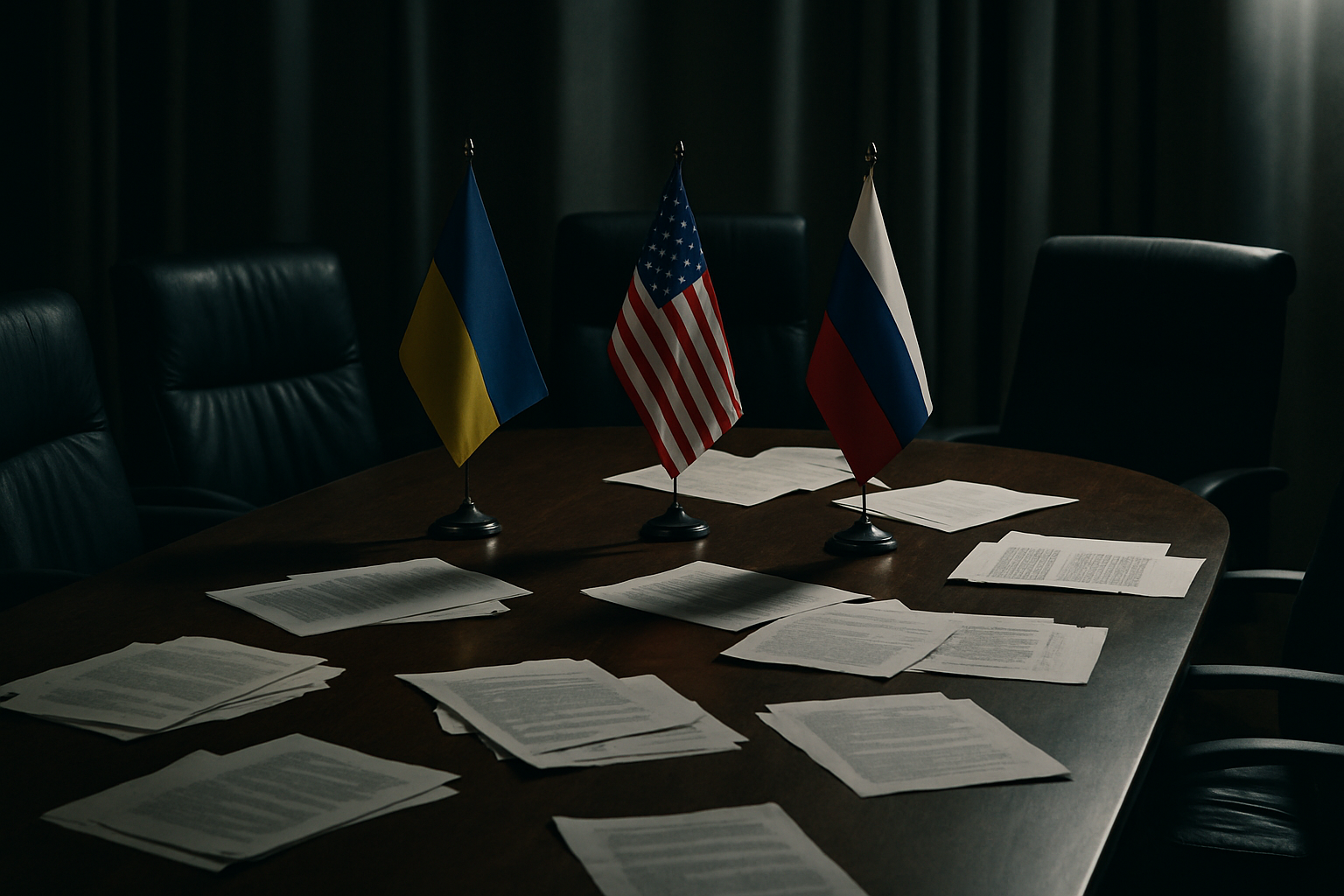
Ukrainian President Volodymyr Zelensky has disclosed that the United States is conditioning security guarantees on Ukraine's withdrawal from unoccupied parts of the Donbas region, creating a new diplomatic crisis as trilateral peace negotiations remain indefinitely suspended due to the escalating Iran situation.
Speaking to Reuters in an exclusive interview, Zelensky revealed the controversial American position linking security assurances to territorial concessions, stating that such a withdrawal would "compromise the security of Ukraine and Europe." The revelation comes as the most significant diplomatic breakthrough since Russia's 2022 invasion has stalled due to competing international crises.
Historic Diplomatic Momentum Derailed
The suspension of Ukraine-Russia-US trilateral negotiations represents a devastating blow to unprecedented diplomatic progress achieved in early 2026. February's breakthrough in Abu Dhabi delivered the largest prisoner exchange in five months—314 military personnel—and restored US-Russia military communications after a four-year suspension.
Geneva talks on February 17-18 further advanced the process, with US Special Envoy Steve Witkoff reporting "significant progress" on ceasefire monitoring mechanisms. For the first time, European "Big 5" observers from Germany, France, Italy, the UK, and Poland participated in the trilateral format, adding crucial institutional weight to the negotiations.
"Due to the situation around Iran, there are still no necessary signals for a trilateral meeting"
— President Volodymyr Zelensky
However, the Iran crisis has now suspended what many considered the most promising path to ending Europe's deadliest conflict since World War II. The Trump administration's June 2026 deadline for a comprehensive peace agreement, with potential presidential-level engagement in Washington, now faces uncertainty amid competing Middle East priorities.
Territorial Integrity vs Security Guarantees
The fundamental sticking point remains unchanged: eastern Ukrainian territories under Russian control. Moscow demands territorial recognition and insists any Putin-Zelensky summit must occur on Russian soil. Ukraine maintains its territorial integrity position while seeking long-term security guarantees from Western partners.
Russian forces have accelerated territorial gains, capturing 481 square kilometers in January 2026 versus 260 square kilometers in December 2025—an 85% increase representing the fastest monthly advance in recent periods. This military momentum potentially strengthens Moscow's bargaining position as diplomatic talks remain frozen.
Zelensky has categorically rejected territorial concessions, previously stating that the Ukrainian people would reject any referendum "handing over territories" as a "failure story." The president has criticized Trump administration pressure on Ukraine rather than Russia, arguing it's "not fair that Trump keeps calling on Ukraine, not Russia, to make concessions."
Ukraine's Strategic Pivot to Middle East
As traditional diplomatic channels remain blocked, Ukraine has pursued an innovative strategic pivot, deploying military experts to UAE, Qatar, Jordan, Bahrain, and Kuwait to combat Iranian Shahed drone attacks—the same weapons devastating Ukrainian infrastructure. This evolution from aid recipient to security provider demonstrates Ukraine's attempt to leverage battlefield experience into new strategic partnerships.
The UK has revealed four operational MRO (Maintenance, Repair, Operations) facilities in Ukraine servicing Western-supplied equipment, with a fifth facility planned. This represents the first public acknowledgment of extensive military infrastructure supporting Ukraine's defense capabilities.
Nuclear Crisis Context
The diplomatic deadlock unfolds against an unprecedented nuclear governance crisis. The New START treaty between the US and Russia expired on February 5, 2026, marking the first time in over 50 years without bilateral nuclear constraints between the superpowers. Both nations control approximately 80% of global nuclear weapons, with Russia possessing 4,380 warheads and the US holding 3,708.
UN Secretary-General António Guterres has described this as a "grave turning point," warning that nuclear risks are now at their "highest levels in decades." The restored US-Russia military communications represent the only remaining formal diplomatic channel between the nuclear superpowers.
Human Cost and International Support
The human toll continues mounting as diplomatic solutions remain elusive. Zelensky has disclosed that 55,000 Ukrainian soldiers have been officially killed, with a "large number" missing in action. International estimates suggest actual casualties may be two to three times higher when including undocumented deaths.
Systematic civilian targeting persists, with energy "terrorism" leaving over 1,170 Kyiv buildings without adequate heating during sub-zero temperatures. Ukrainian nuclear plants have been forced to halt electricity production for the first time in the conflict. The pattern of infrastructure attacks during extreme winter conditions represents clear violations of Geneva Conventions protecting civilian populations.
Despite diplomatic uncertainties, international support remains unprecedented. The European Union has approved a historic €90 billion loan package—the largest single-nation assistance program ever—though Slovakia, Czech Republic, and Hungary have refused participation, exposing persistent European divisions.
Massive Military Support Continues
Sweden and Denmark have committed €246 million for advanced Tridon air defense systems, while Germany has delivered 35 Patriot missiles. Over 17.8 million Ukrainians continue accessing winter support programs, demonstrating the massive humanitarian scale of the crisis.
Latvia's transfer of CVR(T) reconnaissance vehicles and other military support from Baltic and Nordic countries shows sustained regional commitment to Ukrainian defense capabilities despite diplomatic setbacks.
Fraudulent Recruitment and Global Implications
The conflict's global reach extends beyond traditional geopolitical boundaries. Zimbabwe has reported that 15 of its citizens were killed after fraudulent recruitment into the Russia-Ukraine war, highlighting systematic efforts to recruit personnel from African countries into the four-year conflict.
A Russian deserter who fled to Latvia seeking political asylum represents growing internal Russian opposition to the war. The individual, initially motivated by "patriotic considerations" in 2023, changed his position and deserted from the front lines after two years of conflict.
Finland's Warning on Negotiations
Finnish President Alexander Stubb has expressed concerns that US-led negotiations between Russia and Ukraine have reached an impasse and may have come to an end. This assessment from a key European leader underscores growing pessimism about diplomatic solutions despite earlier breakthroughs.
Framework Preservation for Future Talks
Despite the suspension, diplomatic achievements remain intact. The prisoner exchange mechanisms, Pentagon-Moscow deconfliction protocols covering Syria, Arctic, and Africa operations, and structured negotiation formats can be reactivated when the Iranian crisis permits.
The UAE methodology—working groups by topic and joint position synchronization—has proven effective for achieving concrete humanitarian results amid ongoing military operations. This framework represents the most substantial US-Russia military agreement since the conflict began and provides a foundation for future diplomatic engagement.
Strategic Stakes and Global Implications
The suspension of peace talks carries implications far beyond Ukraine's borders. Success could have provided a template for 21st-century territorial dispute resolution and ended Europe's deadliest war since World War II. Failure allows continued military escalation with global implications for territorial sovereignty principles and international law enforcement.
European security architecture faces fundamental redefinition. The Munich Security Conference's theme "Era of Disruptive Politics" reflects the most sobering assessment in the event's 62-year history, with German officials declaring that the "post-war order no longer exists."
French discussions about expanding nuclear deterrence beyond national scope mark the first such conversations since the Cold War, highlighting how the conflict is reshaping European strategic thinking and defense cooperation frameworks.
Coming Phase Uncertain
The timeline for renewed negotiations depends entirely on resolution of the Iran situation, demonstrating how interconnected regional conflicts affect European security challenges in today's multipolar environment. Ukraine's strategic pivot to Middle Eastern partnerships while maintaining operational capabilities shows adaptation to changing geopolitical realities.
Military escalation continues with systematic civilian targeting while Ukraine expands international partnerships as a security provider. The success or failure of eventual resumed talks will carry global implications for whether diplomatic innovation or continued military approaches determine European security redefinition for the coming decades.
As President Zelensky noted regarding Middle East cooperation, "Ukraine proposes mutually beneficial partnerships: we can strengthen those who can strengthen us." This philosophy may define Ukraine's approach to building alternative diplomatic and security relationships while traditional peace processes remain suspended due to competing international crises.