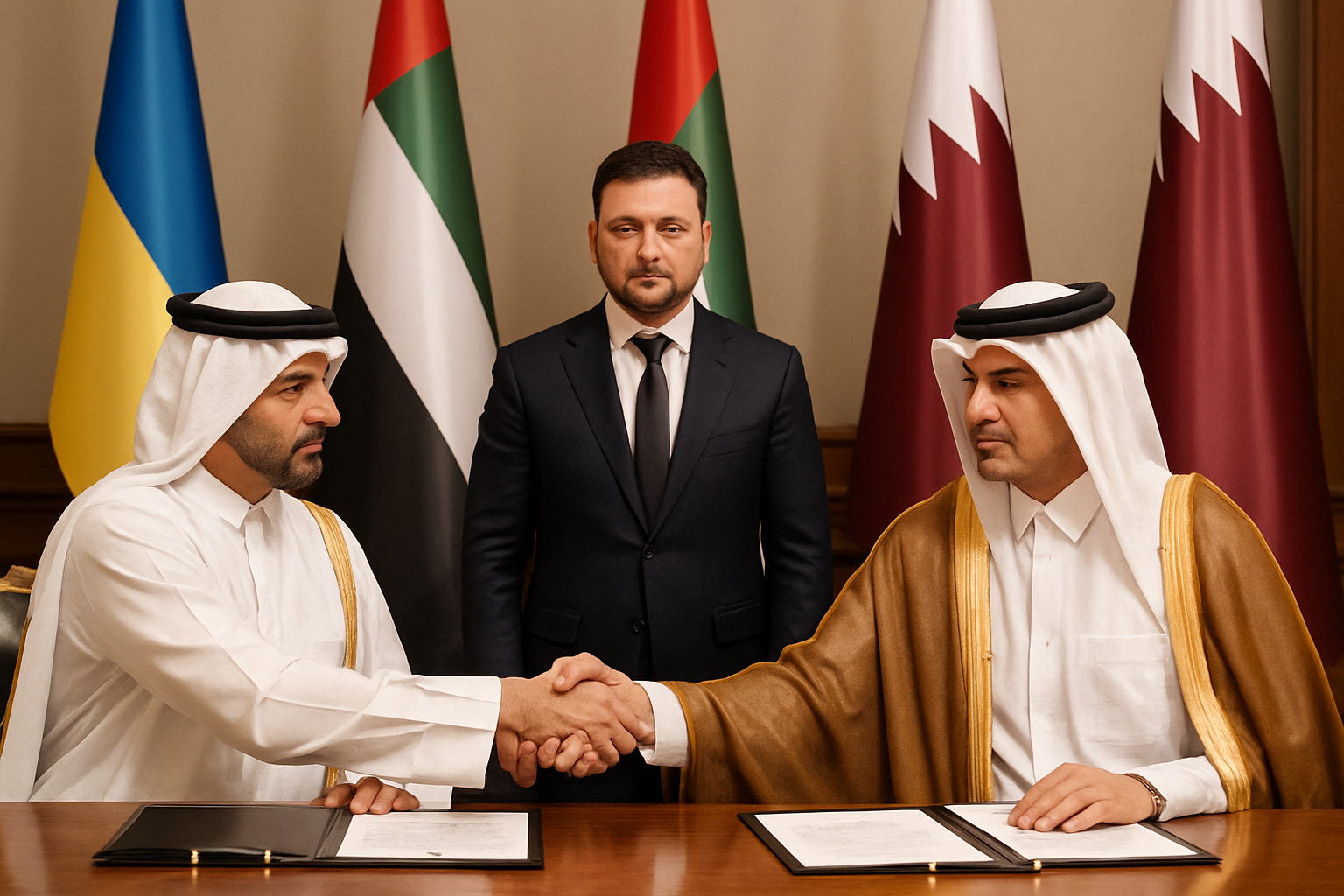
Ukrainian President Volodymyr Zelensky concluded historic air defense cooperation agreements with the United Arab Emirates and Qatar on Saturday, cementing Ukraine's transformation from aid recipient to global security provider while trilateral peace talks with Russia remain indefinitely suspended due to the Iran crisis.
The agreements, which span a decade-long timeline, establish comprehensive defense partnerships focused on countering Iranian Shahed drone attacks that have devastated both Ukrainian infrastructure and Gulf state facilities. Zelensky confirmed the completion of deals with Qatar following similar agreements with Saudi Arabia and the UAE during his unprecedented Gulf tour.
Strategic Evolution: From Recipient to Provider
"We are talking about 10-year cooperation. We have already signed an agreement in this regard with Saudi Arabia, we have just signed a similar agreement with Qatar, also for 10 years, and we will sign another one with the Emirates," Zelensky stated during a press briefing. The agreements include provisions for joint production chains and the exchange of expertise in countering missile and unmanned aerial systems.
This marks a fundamental shift in Ukraine's international positioning. Having endured years of Russian drone attacks using Iranian-supplied Shahed weapons, Ukraine now leverages its hard-earned battlefield experience to assist Gulf nations facing the same threat. Ukrainian military specialists have been deployed to UAE, Qatar, Jordan, Bahrain, and Kuwait, sharing critical knowledge on intercepting and neutralizing drone swarms.
Suspended Peace Talks Cast Shadow
The agreements come against the backdrop of indefinitely suspended trilateral peace negotiations between Ukraine, Russia, and the United States. The talks, which had achieved significant momentum in February 2026 including a historic 314-prisoner exchange and the restoration of US-Russia military communications after a four-year suspension, were postponed due to the Iran crisis diverting American attention to the Middle East.
"Due to the situation around Iran, there are still no necessary signals for a trilateral meeting," Zelensky explained. The suspension represents a major diplomatic setback, as the negotiations had shown promise for resolving Europe's deadliest conflict since World War II.
The February breakthrough had included significant progress on ceasefire monitoring with European "Big 5" observers participating for the first time. However, fundamental territorial disputes remain unchanged, with Russia demanding recognition of occupied eastern Ukrainian territories while Ukraine maintains its territorial integrity position.
Military Expertise in High Demand
Ukraine's pivot to security provider status reflects the country's unique experience in combating the same weapons now targeting Gulf infrastructure. The Iranian-supplied Shahed drones that have killed thousands of Ukrainian civilians and destroyed critical energy facilities are identical to those striking UAE, Qatar, and Saudi facilities as part of Iran's regional military campaign.
Qatar's defense ministry confirmed the agreement "includes the exchange of expertise in countering missiles and unmanned aerial systems." The partnership extends beyond mere consultation, with Ukrainian specialists establishing operational presence across five Middle Eastern countries to provide hands-on training and tactical guidance.
The United Kingdom has revealed four operational maintenance, repair, and overhaul (MRO) facilities in Ukraine servicing Western-supplied equipment, with a fifth facility planned. This represents the first public acknowledgment of extensive military infrastructure enabling rapid equipment repair without overseas transport.
Nuclear Governance Crisis Context
The agreements unfold amid an unprecedented nuclear governance crisis following the expiration of the New START treaty on February 5, 2026 – the first time in over 50 years without US-Russia nuclear constraints. Both nations control 80% of global nuclear weapons, prompting UN Secretary-General António Guterres to warn of nuclear risks at their "highest in decades."
The restored military communications between Washington and Moscow represent the only remaining formal diplomatic channel between the superpowers, making the suspension of broader peace talks particularly significant for global security architecture.
International Support Amid Divisions
Despite the diplomatic setbacks, Ukraine continues receiving unprecedented international support. The European Union's €90 billion loan package represents the largest single-nation assistance program in history, though Slovakia, Czech Republic, and Hungary have refused participation, highlighting persistent European divisions.
Germany has delivered 35 Patriot missiles as part of sustained military assistance, while Sweden and Denmark committed €246 million for air defense systems. Over 17.8 million Ukrainians continue accessing winter support programs as energy infrastructure remains under systematic Russian attack.
Regional Implications
The Gulf partnerships come as the region faces unprecedented Iranian military pressure. Revolutionary Guard forces have declared "no red lines remain" in their regional campaign, systematically targeting energy infrastructure across Qatar, UAE, Saudi Arabia, and Kuwait. The coordination represents Iran's most aggressive regional military posture since the 1980s.
Ukrainian expertise proves particularly valuable given the identical nature of threats. The same Shahed drones devastating Ukrainian cities are now striking Gulf energy facilities, creating natural synergy for defense cooperation. Qatar's Ras Laffan facility, responsible for 20% of global LNG exports, has faced repeated Iranian attacks, highlighting the strategic importance of enhanced air defense capabilities.
Territorial Sovereignty Principles
The agreements underscore broader questions of territorial sovereignty and international law enforcement in the 21st century. Ukraine's categorical rejection of territorial concessions – with Zelensky stating Ukrainian people would reject "handing over territories" as a "failure story" – establishes precedents for how democracies respond to territorial aggression.
The military situation continues deteriorating, with Russian territorial gains accelerating to 481 square kilometers in January versus 260 square kilometers in December 2025 – an 85% increase. Systematic civilian targeting has left over 1,170 Kyiv buildings without adequate heating during subzero temperatures, representing documented violations of Geneva Conventions.
Framework Preservation
Despite the suspension, diplomatic achievements remain intact for future reactivation. The prisoner exchange mechanisms, Pentagon-Moscow deconfliction protocols covering operations in Syria, Arctic, and Africa, and structured negotiation formats can be restored when the Iranian crisis permits. The UAE methodology has proven effective for achieving humanitarian results even amid fundamental disagreements.
The June 2026 deadline set by the Trump administration for Washington-venue negotiations remains technically active, though Middle East priorities have created uncertainty about the timeline. The evolution from Abu Dhabi to Geneva to potentially Washington represents the most substantial diplomatic track since the invasion began.
Global Strategic Implications
Ukraine's transformation into a security provider while maintaining defense against Russian aggression demonstrates the interconnected nature of regional conflicts in the multipolar security environment. The success or failure of eventual resumed peace talks carries global implications for 21st-century territorial dispute resolution templates.
The stakes include European security architecture redefinition, international law enforcement credibility, and territorial sovereignty principles with decades-long implications. Whether diplomatic innovation can overcome military escalation will determine fundamental principles governing international relations for the coming generation.
As Ukrainian forces continue striking Russian targets in occupied Crimea, Donetsk, and Zaporizhzhia while expanding Middle Eastern partnerships, the nation exemplifies how modern conflicts transcend traditional geographic boundaries. The coming phase remains uncertain, with the timeline for resumed negotiations dependent on resolving the Iran crisis that has derailed the most promising European peace initiative since the Cold War.