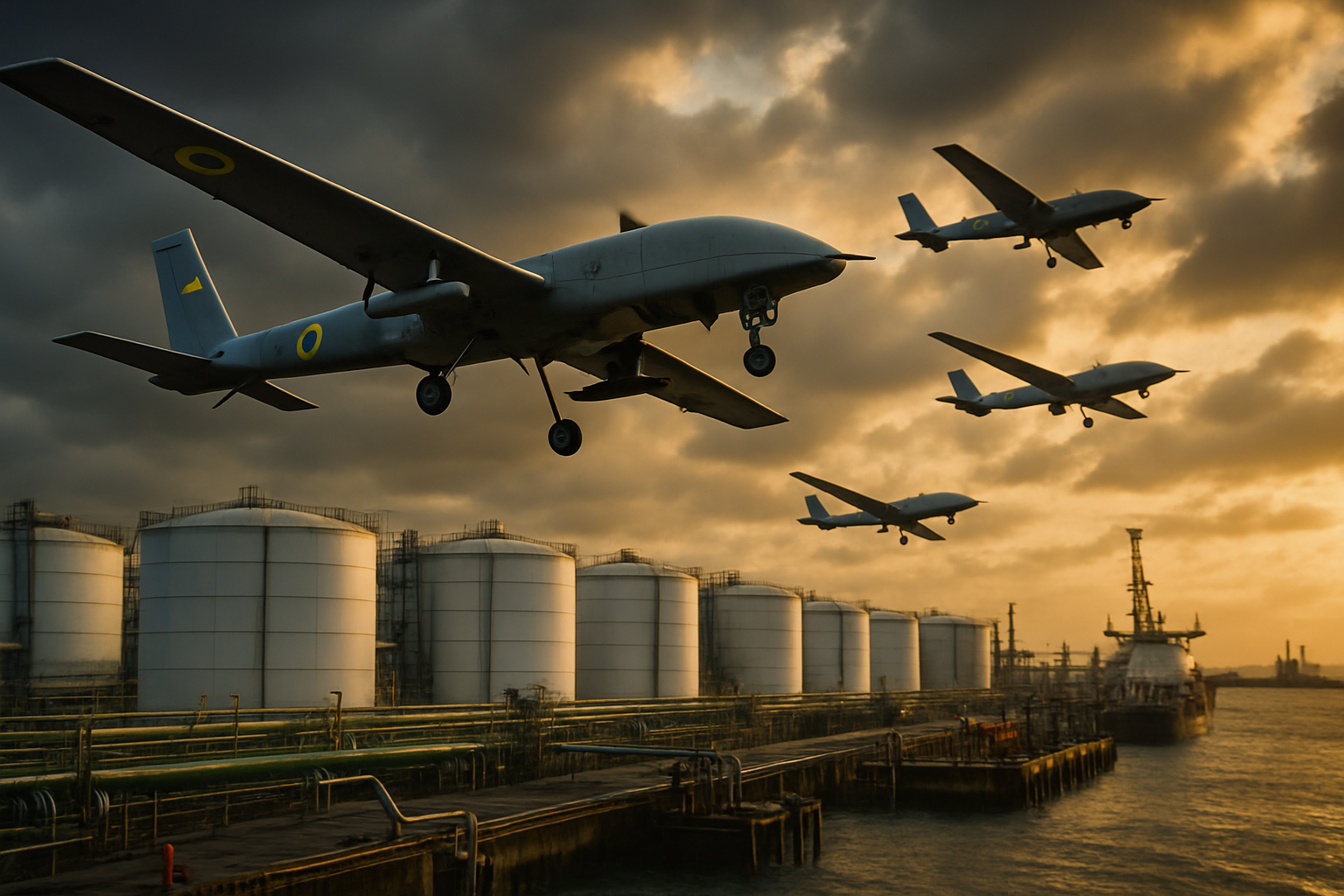
Ukrainian forces have conducted a series of devastating drone strikes against strategic Russian targets, including critical Baltic Sea export facilities and military installations in occupied Crimea, as part of an intensified campaign to disrupt Moscow's war-supporting infrastructure and revenue streams.
The multi-pronged assault, confirmed by both Ukrainian and Russian officials, represents one of the most significant escalations in Ukraine's deep-strike capabilities since the conflict began, demonstrating remarkable operational reach extending over 1,000 kilometers from Ukrainian territory.
Baltic Sea Operations Target Energy Infrastructure
Ukrainian drones struck Russia's strategically vital Ust-Luga oil export terminal in the Leningrad region for the third time within a week, according to regional Governor Drozdenko. The facility, which handles approximately 700,000 barrels of oil per day and represents one of Russia's largest Baltic Sea petroleum export outlets, suffered significant damage and fires despite Russian air defense efforts.
The Ust-Luga terminal, operated by Transneft, shipped 32.9 million metric tons of oil products in 2023 alone, making it a crucial component of Russia's energy export infrastructure. Estonian experts assess that direct attacks on Russian export facilities create more effective economic pressure than international sanctions, creating significant budget shortfalls for Moscow's war financing.
"There is damage to the port of Ust-Luga. There were no casualties,"
— Russian Regional Governor, as reported by regional authorities
The successful penetration of Russian air defenses comes despite claims by the Russian Defense Ministry that it intercepted 36 drones during the operation, highlighting the sophisticated nature of Ukrainian operational planning and execution.
Crimean Military Assets Destroyed
In a separate but coordinated operation during the night of March 28-29, Ukrainian forces targeted a multiple rocket launcher base in occupied Crimea, destroying three BM-30 Smerch/Tornado-S systems along with a transport-loading vehicle and several fuel tanks. Romanian media reported the precision strikes, which represent a significant blow to Russian military capabilities in the strategically important peninsula.
The targeted Tornado multiple launch rocket systems are among Russia's most advanced artillery platforms, capable of striking targets at ranges exceeding 120 kilometers. Their destruction not only eliminates immediate military capabilities but also removes assets worth millions of dollars from Russian inventories.
Video evidence released by Ukrainian forces shows the moment of impact, with secondary explosions indicating successful targeting of ammunition and fuel storage areas collocated with the launcher systems.
Systematic Campaign Against War Economy
These latest strikes are part of a systematic Ukrainian campaign targeting Russian energy infrastructure throughout the conflict. Previous successful operations have included attacks on oil depots, refineries, and energy distribution networks across Russian territory, with the strategic objective of disrupting both military logistics and the economic foundations supporting Moscow's war effort.
According to previous assessments by European intelligence services, Ukrainian operations have successfully disrupted Russian energy exports by approximately 40%, stranding dozens of shadow fleet tankers in the Gulf of Finland and forcing Moscow to seek more expensive, less efficient export routes.
International Context and Diplomatic Backdrop
The escalation in Ukrainian operations occurs against the backdrop of indefinitely suspended peace negotiations between Ukraine, Russia, and the United States. The trilateral talks, which achieved historic breakthroughs in February 2026 including a 314-prisoner exchange and restoration of US-Russia military communications, remain stalled due to the Iran crisis consuming American foreign policy attention.
Despite diplomatic setbacks, Ukraine has evolved from an aid recipient to a security provider, with Ukrainian military experts deployed to five Middle Eastern countries—UAE, Qatar, Jordan, Bahrain, and Kuwait—sharing battlefield experience in combating Iranian Shahed drones, the same weapons systems being used against Ukrainian infrastructure.
Russian officials reported that this week alone, Russia launched over 3,000 drones, 1,450 guided bombs, and 40 missiles against Ukrainian targets, according to President Volodymyr Zelensky, highlighting the continued intensity of the conflict despite ongoing diplomatic efforts.
Strategic Implications and Regional Security
The proximity of the Ust-Luga strikes to the Finnish border carries significant NATO considerations, demonstrating Ukraine's remarkable operational capabilities and sophisticated intelligence gathering systems. The repeated successful penetration of Russian air defenses raises questions about Moscow's defensive capabilities and the vulnerability of critical infrastructure across Russian territory.
Energy warfare has become a central component of the conflict, with both sides targeting critical infrastructure but employing different approaches. While Ukraine focuses on export facilities and military-industrial targets, Russia has systematically attacked civilian infrastructure, leaving over 1.17 million buildings in Kyiv alone without adequate heating during winter conditions.
Economic Impact and War Financing
The targeting of energy export facilities like Ust-Luga creates lasting economic pressure on Russia's ability to fund sustained military operations. Each day of disrupted exports represents millions of dollars in lost revenue that would otherwise support Moscow's war machine.
International observers note that Ukraine's enhanced deep-strike capabilities, developed through international military cooperation and technology sharing, represent a maturation of strategic operations beyond tactical disruption toward comprehensive economic pressure campaigns designed to affect Russia's long-term military sustainability.
Looking Ahead
As the conflict approaches its fifth year in 2026, Ukraine's demonstration of enhanced operational capabilities at remarkable distances from its territory signals a new phase of strategic competition. The success of these operations is likely to encourage continued escalation in Ukraine's energy warfare campaign against Russian economic infrastructure.
The framework for diplomatic engagement remains intact, with mechanisms for prisoner exchanges and military communications potentially reactivatable when geopolitical conditions permit. However, fundamental territorial disputes over eastern Ukrainian territories under Russian control remain unresolved, with Russia demanding recognition of occupied territories while Ukraine maintains its territorial integrity position.
The strategic implications extend far beyond the immediate Ukraine-Russia conflict, providing a template for 21st-century energy warfare and demonstrating how modern conflicts transcend geographic boundaries to require new forms of international cooperation and security arrangements. Success or failure in eventual resumed diplomatic efforts will carry global implications for territorial sovereignty principles and conflict resolution mechanisms for decades to come.