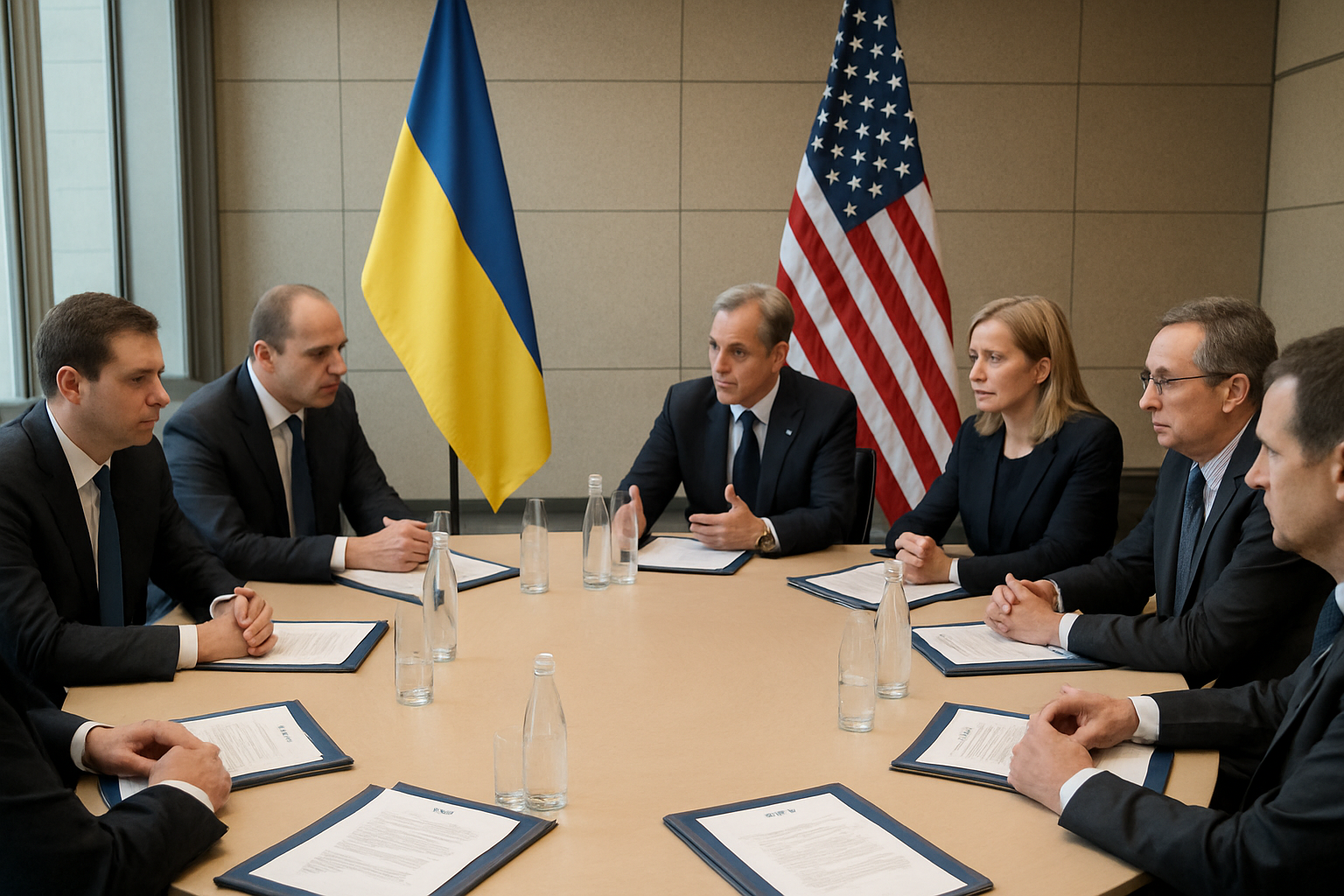
Ukraine's Secretary of the National Security and Defense Council, Rustem Umerov, engaged in critical bilateral meetings with United States officials in Geneva, Switzerland, focusing on economic support measures and ongoing security challenges as the Ukraine-Russia war enters its fifth year.
The high-level diplomatic engagement represents a continuation of the momentum established during the groundbreaking Geneva peace talks held February 17-18, which marked the first time European "Big 5" observers from Germany, France, Italy, the UK, and Poland participated in the trilateral format between Ukraine, Russia, and the United States.
Economic Recovery Takes Center Stage
According to multiple international sources, the bilateral discussions between Ukrainian and American delegations have officially begun in Geneva, with economic support and humanitarian issues forming the core agenda. The talks come at a critical juncture as Ukraine faces unprecedented reconstruction challenges estimated at $831 billion—one of the largest post-conflict rebuilding needs since World War II.
The European Union has already committed to historic support levels, approving a €90 billion loan package—the largest single-nation assistance package in EU history. However, the commitment has exposed deep divisions within Europe, with Slovakia, Czech Republic, and Hungary refusing to participate in financing the initiative.
"The Ukrainian and US delegations are discussing economic support, humanitarian issues and preparations for trilateral negotiations with Russia slated for early March."
— Kyiv Post reporting
Diplomatic Breakthrough Amid Military Escalation
The current Geneva meetings build upon the extraordinary diplomatic achievements of February 2026, including the historic 314-prisoner exchange—the first such swap in five months—and the restoration of US-Russia military communications after a four-year suspension. These concrete humanitarian results demonstrate that sustained diplomatic engagement can produce tangible outcomes even amid continued military operations.
However, the diplomatic progress exists against a backdrop of accelerating military escalation. Russian territorial gains have dramatically increased to 481 square kilometers in January 2026 compared to 260 square kilometers in December 2025—an 85% acceleration representing the fastest territorial expansion in months.
Humanitarian Crisis Deepens
The human cost of the conflict continues to mount at staggering levels. President Zelensky has disclosed that 55,000 Ukrainian soldiers have been officially killed, with a "large number" missing in action. International estimates suggest the actual casualty figures may be two to three times higher than officially reported.
The systematic targeting of civilian infrastructure has created a humanitarian emergency of unprecedented scale. Russia's "energy terrorism" strategy has left over 1,170 Kyiv buildings without heating during temperatures plunging to minus-30°C, forcing Ukrainian nuclear plants to halt electricity production for the first time since the conflict began.
Nuclear Governance Crisis Adds Urgency
The diplomatic efforts occur within the context of an unprecedented nuclear governance crisis. The New START treaty between the United States and Russia expired on February 5, 2026—marking the first time in over 50 years that the two nuclear superpowers operate without bilateral nuclear constraints. Combined, Russia and the US control 80% of the world's nuclear weapons, with Russia possessing 4,380 warheads and the US maintaining 3,708.
UN Secretary-General António Guterres has warned of a "grave turning point," stating that nuclear risks are at their "highest in decades." The restoration of US-Russia military communications through the diplomatic process now represents the only remaining formal channel between the nuclear superpowers.
International Support Network Expands
Despite internal European divisions, international support for Ukraine continues to reach historic levels. Nordic and Baltic countries have committed €12.5 billion in defense support plus €918 million for energy resilience. Sweden and Denmark have announced a €246 million air defense package featuring Tridon Mk2 systems, while Germany has provided 35 Patriot missiles.
The scope of humanitarian assistance has also expanded dramatically, with over 17.8 million Ukrainians now accessing winter support programs—a testament to both the scale of the crisis and the international community's commitment to addressing civilian suffering.
Territorial Disputes Remain Unchanged
The fundamental sticking point in all diplomatic initiatives remains the status of eastern Ukrainian territories currently under Russian control. Russia demands territorial recognition and insists that any Putin-Zelensky talks must occur in Moscow. Ukraine maintains its position on territorial integrity while seeking comprehensive security guarantees spanning 20-30 years, compared to reported US proposals for 15-year commitments.
This territorial disagreement represents the core challenge that has prevented breakthrough agreements despite significant humanitarian progress in prisoner exchanges and military communications restoration.
June 2026 Deadline Approaches
The Trump administration has established a comprehensive peace timeline with a June 2026 deadline, featuring a Washington venue that suggests potential presidential-level engagement. This evolution from Abu Dhabi to Geneva to Washington represents a deliberate diplomatic escalation strategy, with each venue offering unique advantages.
The June deadline creates unprecedented pressure for innovative territorial compromise solutions while fundamental positions remain far apart. Success could end Europe's deadliest war since World War II and provide a 21st-century conflict resolution template. Failure may intensify military operations globally and undermine diplomatic credibility for territorial disputes worldwide.
Strategic Implications for European Security
The ongoing diplomatic efforts carry implications far beyond Ukraine's borders. The Munich Security Conference in February, themed "Era of Disruptive Politics," delivered the most sobering assessment in its 62-year history. German Chancellor Friedrich Merz declared that "the post-war order no longer exists," reflecting the fundamental changes to international security architecture.
European strategic autonomy discussions have accelerated to unprecedented levels, with France exploring nuclear deterrent expansion beyond national scope for the first time since the Cold War. These developments underscore how the Ukraine conflict has catalyzed broader transformations in European security thinking.
"This is a historic moment that will determine the trajectory of European security for decades to come. The stakes could not be higher."
— European diplomatic source
Looking Ahead: Critical Phase Approaches
As the conflict approaches its fourth anniversary on February 24, 2026, the international community faces a decisive moment. The combination of unprecedented nuclear crisis, historic international support, continued military escalation, and diplomatic breakthrough potential creates a unique window for resolution.
The success or failure of these diplomatic efforts will serve as a template for 21st-century conflict resolution, affecting global conflict prevention mechanisms, European integration trajectory, and international sovereignty enforcement for decades to come.
The coming months will test whether diplomatic innovation can overcome military escalation in Europe's deadliest conflict since World War II, with implications extending far beyond the immediate participants to shape international relations and security architecture for the foreseeable future.