Three toddlers and a man were killed in a Russian drone strike on a residential building in Bohodukhiv, Kharkiv region, as reports emerged that Ukraine is planning to hold presidential elections alongside a peace referendum following pressure from the Trump administration to conclude negotiations by mid-May 2026.
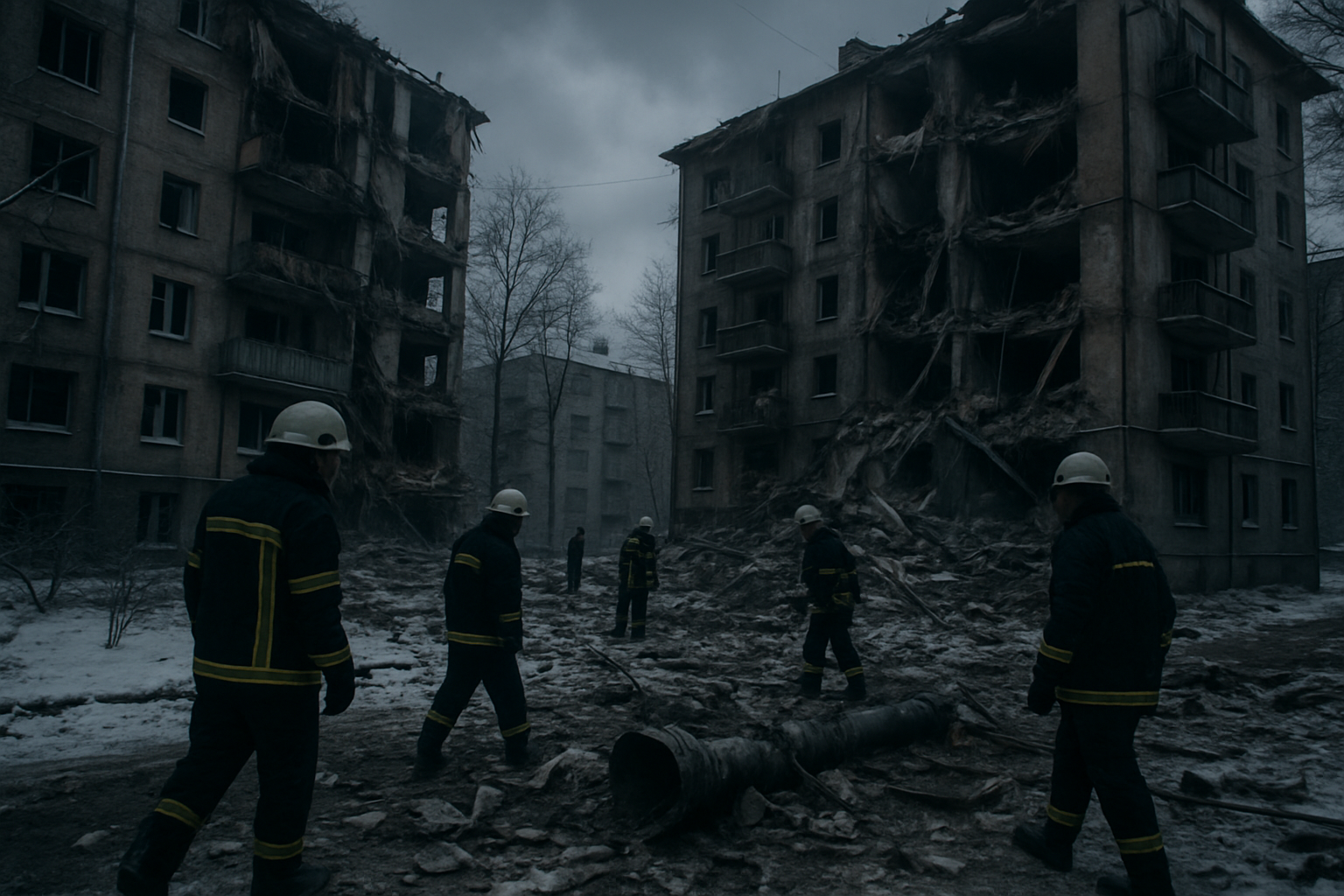
The attack on Tuesday night in the border town of Bohodukhiv killed two one-year-old boys, a two-year-old girl, and a 34-year-old man, according to Kharkiv regional governor Oleh Synehoubov. A 74-year-old woman was wounded and is receiving medical treatment. The residential building was completely destroyed, with rescue workers retrieving bodies from the rubble in the early hours of Wednesday.
Pattern of Civilian Targeting
This marks the second deadly attack on Bohodukhiv within just three days. On Monday, a Russian strike killed a woman and a 10-year-old child in the same town, demonstrating a systematic pattern of targeting civilian residential areas housing families with children. The attacks represent clear violations of international humanitarian law and continue Russia's strategy of targeting civilian infrastructure during the harsh winter months.
The incidents occurred approximately 60 kilometers west of Kharkiv city, near the Russian border, highlighting the vulnerability of communities in the region that have endured nearly four years of conflict since Russia's February 2022 invasion.
"Two small boys of 1 year old and a small girl of 2 years old died in this attack which hit a residential pavilion in Bohodukhiv."
— Oleh Synehoubov, Kharkiv Regional Governor
Presidential Elections and Peace Referendum Plans
As the tragic civilian casualties mounted, multiple sources confirmed that Ukraine has begun planning presidential elections alongside a referendum on a potential peace agreement with Russia. According to reports from the Financial Times, cited by Bulgarian, Greek, Norwegian, and Polish media, President Volodymyr Zelensky is expected to announce these plans on February 24, marking the fourth anniversary of Russia's invasion.
The election planning comes after the Trump administration reportedly pressured Kyiv to organize both votes before May 15, 2026, threatening that Ukraine would lose proposed US security guarantees if this timeline is not met. This represents a significant shift from the wartime martial law that has been in place since the invasion began, with no national elections held since Zelensky's 2019 presidential victory.
Ukrainian and European officials cited in multiple reports indicate that the White House has intensified pressure on Kyiv to complete peace negotiations by spring, with the combined election and referendum serving as a way for Ukrainians to democratically validate any potential peace agreement with Russia.
Diplomatic Context and Abu Dhabi Breakthrough
The election planning follows significant diplomatic progress achieved during trilateral talks in Abu Dhabi involving Ukraine, Russia, and the United States. These February negotiations resulted in a historic prisoner exchange of 314 individuals - the first such swap in five months - and the restoration of US-Russia military communications after a four-year suspension.
Ukrainian Defense Minister Rustem Umerov described the Abu Dhabi talks as "substantial and productive," with detailed discussions on ceasefire monitoring and implementation mechanisms. The breakthrough included 157 military personnel exchanged by each side, plus three Russian civilians returned from Ukrainian custody.
However, the fundamental sticking point remains the eastern Ukrainian territories currently under Russian control. Despite the diplomatic progress, Russian forces have accelerated territorial gains, capturing 481 square kilometers in January 2026 compared to 260 square kilometers in December 2025, according to Institute for Study of War assessments.
Continued Military Escalation
The civilian casualties in Bohodukhiv are part of a broader pattern of Russian attacks that have intensified during the winter months. Over 10,000 Russian drones and bombs were launched in January 2026 alone, with attacks systematically targeting energy infrastructure and civilian facilities during harsh winter conditions with temperatures dropping to minus-30°C.
Recent attacks left more than 1,170 buildings in Kyiv without heating during extreme cold, forcing the activation of emergency warming centers across multiple regions. Ukrainian officials describe this as Russia's "winter weapon" strategy, deliberately targeting civilian infrastructure to maximize humanitarian pressure during peace negotiations.
In other recent incidents, Russian attacks killed civilians across multiple regions: one person was killed and two wounded in ongoing strikes on Zaporizhzhia, six people were wounded in Kherson region over 24 hours, and one person was killed with another injured in attacks on three communities in Sumy region.
International Response and Support
NATO Secretary-General Mark Rutte recently made a surprise visit to Kyiv, condemning the attacks as sending a "bad signal" before diplomatic negotiations. The international community has maintained strong support for Ukraine through military and financial assistance, including the European Union's historic €90 billion loan package - the largest EU aid package ever provided.
Recent support measures include a €246 million air defense package from Sweden and Denmark, featuring advanced Tridon Mk2 systems, and Poland's deployment of fighter jets along the border. Over 17.8 million Ukrainians are currently accessing winter support programs as the humanitarian crisis deepens.
Casualty Toll and Human Cost
The conflict's human toll continues to mount, with President Zelensky recently disclosing that 55,000 Ukrainian soldiers have been officially confirmed killed since the invasion began, with a "large number" still classified as missing in action. International researchers estimate actual military casualties could be two to three times higher when including missing personnel and undocumented deaths.
The systematic targeting of civilians, including children, healthcare facilities, and energy infrastructure, has drawn widespread international condemnation. The attacks on Bohodukhiv, killing three toddlers in their home, represent the latest tragedy in what has become Europe's deadliest conflict since World War II.
Nuclear Context and Global Implications
These developments occur against the backdrop of the New START nuclear arms control treaty's expiration on February 5, 2026, marking the first time in over 50 years without nuclear weapons constraints between the United States and Russia. The treaty's lapse has created additional uncertainty in global security architecture while diplomatic efforts continue.
The restoration of US-Russia military communications during the Abu Dhabi talks represents the most significant breakthrough in superpower relations since the conflict began, including deconfliction measures and incident prevention protocols designed to prevent unintended escalation.
Looking Ahead: May 2026 Timeline
The proposed May 2026 timeline for Ukrainian elections and a peace referendum represents an unprecedented political transition during an active conflict. The success of such democratic processes would require significant security guarantees and international oversight, particularly given continued Russian attacks on civilian targets.
The international community continues to watch whether sustained diplomatic engagement can produce concrete territorial compromises or if the conflict will intensify further. The combination of military pressure, diplomatic initiatives, and democratic processes represents a complex test of 21st-century conflict resolution mechanisms.
As rescue workers continued clearing rubble in Bohodukhiv, the contrast between diplomatic hope and civilian tragedy underscores the urgent need for a sustainable resolution to a conflict that has already claimed tens of thousands of lives and displaced millions of people across Europe.