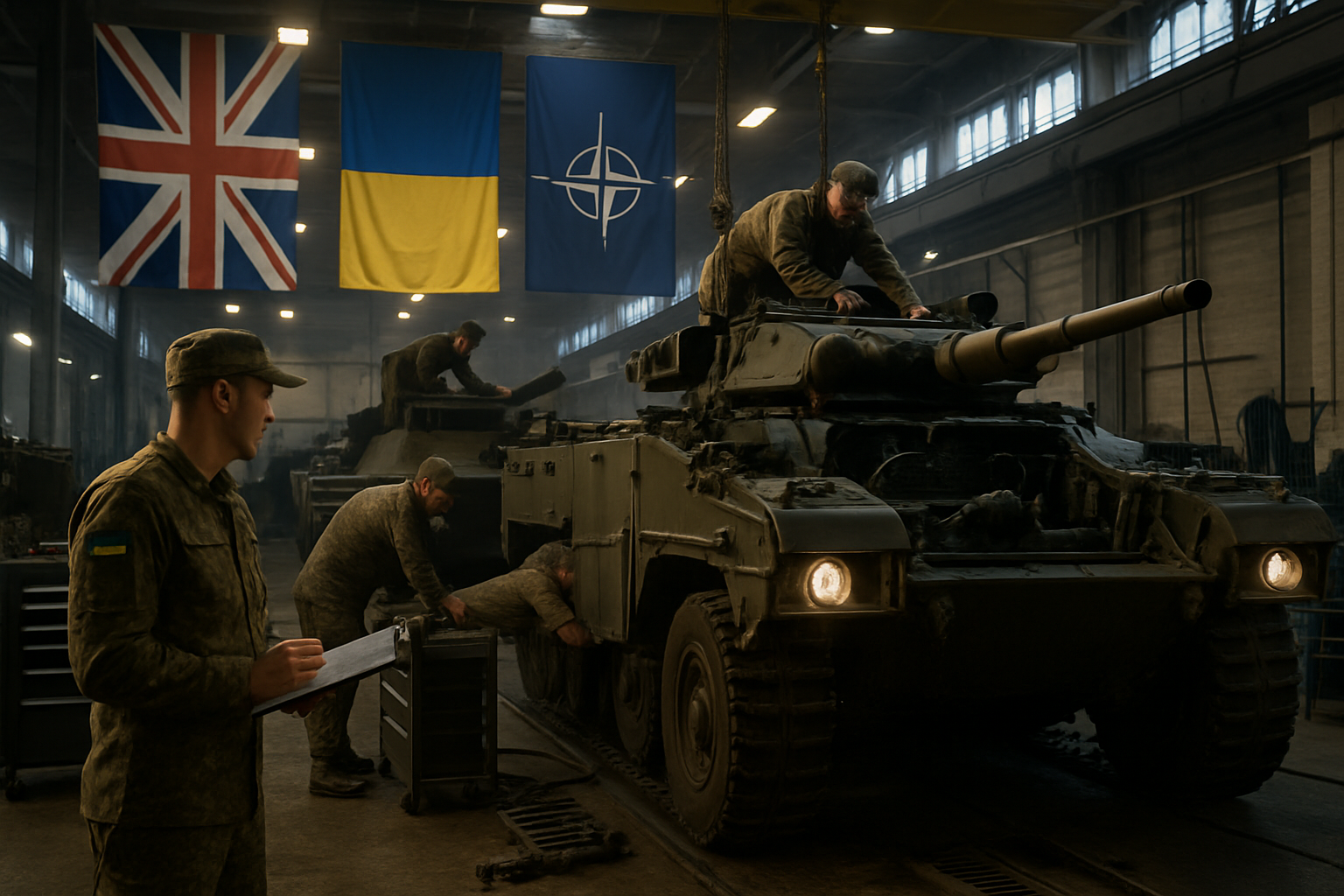
The United Kingdom has revealed the existence of four maintenance, repair and overhaul (MRO) facilities operating in Ukraine to service Western-supplied military equipment, marking a significant escalation in international military support as the conflict enters its fifth year with Russia launching nearly 1,750 strike drones in the past week alone.
The announcement comes amid a complex diplomatic and military landscape, with Ukrainian President Volodymyr Zelensky calling on Western partners to expand air-defense deliveries and tighten sanctions as Russian forces have intensified systematic attacks across multiple regions. The revelation of UK maintenance facilities represents the first public acknowledgment of such operations on Ukrainian soil.
UK Military Support Infrastructure Revealed
According to official sources, the UK government has confirmed four operational maintenance, repair, and overhaul facilities designed specifically to service and restore armored vehicles and artillery systems supplied by Western partners. A fifth facility is reportedly in the planning stages, indicating an expansion of this critical support infrastructure.
These facilities represent a significant investment in Ukraine's long-term military capabilities, allowing for rapid repair and return to service of sophisticated Western equipment that has proven crucial in Ukraine's defense efforts. The MRO facilities address a critical logistical challenge that has hampered military operations throughout the conflict.
Massive Russian Offensive Operations
The facility revelations come as Ukraine faces an unprecedented barrage from Russian forces. Over the past week alone, Russia has launched nearly 1,750 strike drones, 1,530 guided aerial bombs, and 39 missiles of various types against Ukrainian targets, according to President Zelensky's latest disclosure.
Russian attacks have targeted critical infrastructure and civilian areas across multiple regions. In Kharkiv, a Russian strike on a residential building killed 10 people and wounded 15 others, while additional attacks in the Sumy region resulted in one civilian death and seven injuries from over 100 shellings in a single day.
"The Russians cannot regain the positions they previously held, not only in Kupiansk itself but also in the surrounding area"
— Ukrainian Military Source
The systematic targeting has extended to railway infrastructure, with a Russian drone hitting the locomotive of a Kyiv-Sumy passenger train, demonstrating the expanding scope of attacks on civilian transportation networks.
International Military Support and Naval Developments
Beyond the UK facilities, international support continues to evolve across multiple fronts. Ukrainian Defense Forces have successfully struck several Russian military targets, including air defense systems and landing craft in temporarily occupied Crimea and territories in the Donetsk and Zaporizhzhia regions.
Naval operations remain a critical component of the conflict, with Ukraine's Navy revealing that Russia still maintains the main force of the Black Sea Fleet, including five surface and two submarine missile carriers in the Black Sea, representing a continued threat to Ukrainian operations and international shipping.
Dutch Prime Minister Rob Jetten's visit to Ukraine on Sunday, meeting with President Zelensky in Kyiv, highlights ongoing EU diplomatic engagement amid the Ukraine-Hungary oil dispute, demonstrating the complex web of international relationships affected by the conflict.
Tactical Developments and Territory Control
Ukrainian forces have demonstrated continued operational capabilities with successful strikes on Russian positions across occupied territories. Recent operations targeted Russian command posts, air defense systems, and strategic infrastructure, indicating sustained long-range strike capabilities despite defensive pressures.
In emergency response operations, Russian forces struck firefighters while they were dealing with the aftermath of an attack in the village of Velyka Babka in the Chuhuiv district of the Kharkiv region, representing a disturbing escalation in targeting emergency services personnel.
The conflict's impact extends beyond military operations, with systematic attacks on civilian infrastructure creating humanitarian challenges. Emergency services continue operating under extreme conditions, with first responders facing direct targeting during rescue operations.
Diplomatic Context and International Response
The revelation of UK maintenance facilities occurs within a broader context of international diplomatic efforts. Ukraine has urged the Venice Biennale to exclude Russia after organizers announced they would allow Russian participation for the first time since 2022, highlighting ongoing cultural and diplomatic battles parallel to military operations.
Iran's involvement in the conflict continues to draw international attention, with Zelensky highlighting the complicity between the Kremlin and Iran, particularly regarding military collaboration that extends beyond Ukraine to conflicts in the Middle East region.
The timing of facility revelations suggests a strategic communication approach, balancing operational security requirements with the need to demonstrate sustained international commitment to Ukraine's defense capabilities.
Infrastructure and Logistics Challenges
The establishment of maintenance facilities addresses critical logistical challenges that have hampered Western military aid effectiveness. Complex Western weapon systems require specialized maintenance capabilities that traditional Ukrainian military infrastructure was not designed to support.
These facilities enable rapid turnaround of damaged or malfunctioning equipment, reducing the need to transport materiel out of country for repairs and significantly improving operational readiness rates for Ukrainian forces employing Western-supplied systems.
The facilities also represent a long-term commitment to Ukraine's military modernization, providing infrastructure that will remain valuable beyond the current conflict for ongoing defense cooperation and capability development.
Regional Security Implications
The UK's facility disclosure reflects broader shifts in European security architecture, with NATO allies increasingly willing to establish forward support infrastructure in conflict zones. This represents an evolution from traditional arms supply models toward more comprehensive military support frameworks.
Regional impacts extend beyond Ukraine, with neighboring countries adapting their security postures in response to the sustained conflict. The maintenance facilities represent a template for future military cooperation that could be applied to other security partnerships.
Energy security remains a critical concern, with continued attacks on Ukrainian energy infrastructure affecting regional stability and European energy markets, demonstrating the conflict's far-reaching economic implications.
Looking Forward: Strategic Implications
The revelation of UK maintenance facilities marks a significant milestone in international military support for Ukraine, representing a commitment to sustained operational capability rather than limited equipment transfers. This infrastructure investment suggests confidence in Ukraine's long-term defensive capabilities and territorial integrity.
As the conflict continues into its fifth year, the establishment of such facilities indicates a strategic shift toward permanent support infrastructure rather than temporary aid measures. This approach acknowledges the extended timeline required for conflict resolution while ensuring Ukrainian forces maintain operational effectiveness with Western-supplied equipment.
The facilities' existence also demonstrates the evolution of international law and military cooperation norms, with NATO allies establishing increasingly sophisticated support networks within active conflict zones while maintaining careful distinctions between support roles and direct combat involvement.