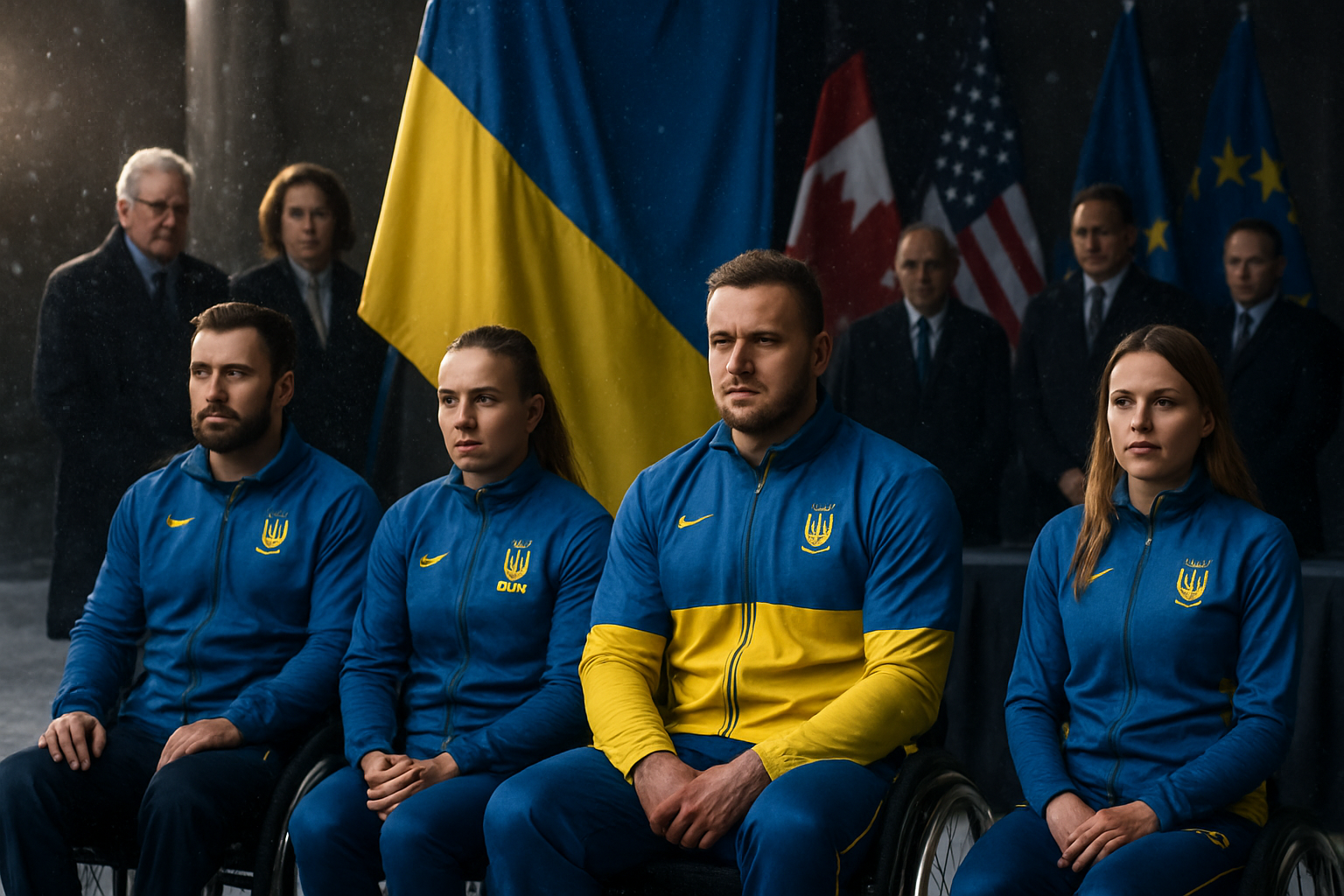
Ukraine's Paralympic Committee announced it will boycott the opening ceremony of the 2026 Milano Cortina Winter Paralympics on March 6 in protest of the International Paralympic Committee's decision to allow Russian and Belarusian athletes to compete under their national flags, marking a significant sporting protest amid ongoing diplomatic efforts to end the nearly four-year conflict.
The boycott announcement comes as peace negotiations continue to show both progress and setbacks, with recent Geneva talks achieving concrete advances in ceasefire monitoring mechanisms while fundamental territorial disputes remain unresolved. The complex diplomatic landscape reflects the broader challenges facing international efforts to resolve Europe's deadliest conflict since World War II.
Paralympic Boycott Highlights International Sports Divisions
The Ukrainian Paralympic Committee's decision to boycott the opening ceremony represents a direct challenge to the International Paralympic Committee's (IPC) allocation of 10 combined slots to Russian and Belarusian athletes. According to sources from Bolivia's La Razón and Cyprus Mail, the Ukrainian committee stated it was "outraged by the cynical decision" to grant these slots while the conflict continues.
"The Ukrainian Paralympic team and the National Paralympic Committee of Ukraine boycott the opening ceremony of the 14th Winter Paralympic Games and demand that the Ukrainian flag not be used in the opening ceremony," the organization declared in an official statement.
Estonian media reported that Ukrainian athletes competing at the ongoing Milano Cortina Winter Olympics have expressed their "revulsion at having to compete alongside competitors from aggressor states." The International Paralympic Committee declined to comment on the Ukrainian decision, stating only that it is "in negotiations with Ukrainian leaders."
"Russia, which has been excluded from much international competition due to the war, says it is wrong to mix sport and politics while targeting disabled athletes is offensive."
— Russian Position, Cyprus Mail
Geneva Peace Talks Show Mixed Results
The most recent round of Ukraine-Russia-US trilateral negotiations concluded February 18 with what US Special Envoy Steve Witkoff described as "significant progress" on ceasefire monitoring mechanisms, though territorial disputes remain the primary obstacle to a comprehensive agreement.
The talks, held at the InterContinental Hotel Geneva, marked an evolution from the successful Abu Dhabi framework that achieved a historic 314-prisoner exchange in February—the first such swap in five months. This diplomatic breakthrough also restored US-Russia military communications after a four-year suspension, establishing deconfliction protocols that extend globally to operations in Syria, the Arctic, and Africa.
European observers participated for the first time, with the "Big 5" nations—Germany, France, Italy, the United Kingdom, and Poland—joining as observers, adding institutional weight to the trilateral structure while maintaining the proven negotiation format.
Territorial Disputes Remain Central Challenge
Despite humanitarian breakthroughs, the fundamental sticking point remains unchanged: eastern Ukrainian territories currently under Russian control. Russian forces have accelerated territorial gains, capturing 481 square kilometers in January 2026 compared to 260 square kilometers in December 2025, demonstrating a significant acceleration in military operations.
Russia continues to demand territorial recognition and insists that any Putin-Zelensky summit must occur in Moscow. Ukraine maintains its position on territorial integrity while seeking comprehensive long-term security guarantees. President Zelensky has categorically rejected any peace agreement requiring unilateral withdrawal from the Donbas region, stating that the Ukrainian people would reject a referendum "handing over territories."
French media reported Zelensky's assessment of Russian intentions: "We have lost too much of our population and our territories to just stop and cede them," he stated in a BBC interview, emphasizing Ukraine's continued capacity for resistance.
Military Escalation Amid Diplomatic Efforts
The diplomatic paradox continues with major military escalations occurring alongside negotiation efforts. Hours before the Geneva talks began, Russia launched one of its largest attacks of 2026—29 ballistic missiles and 396 drones targeting Ukrainian cities and energy infrastructure. Ukrainian air defenses intercepted 25 missiles and 367 drones, but significant damage occurred in Odesa and central Ukraine.
This pattern of escalation before diplomatic meetings has become consistent, with attacks designed to strengthen Russia's bargaining position through humanitarian pressure. The systematic targeting of civilian infrastructure during extreme winter conditions has left over 1,170 buildings in Kyiv without heating during temperatures reaching minus-30°C.
Médecins Sans Frontières (MSF) reported on the humanitarian impact, with their Italian assessment noting that "at -20 degrees and without electricity, life is impossible," denouncing the use of "cold as a weapon."
Nuclear Crisis Adds Urgency
The diplomatic efforts occur against the backdrop of an unprecedented nuclear governance crisis. The New START treaty between the US and Russia expired February 5, 2026—the first time in over 50 years without bilateral nuclear constraints between the superpowers. Both nations control approximately 80% of global nuclear weapons, with Russia possessing 4,380 warheads and the US holding 3,708.
UN Secretary-General António Guterres has described this as a "grave turning point," warning that nuclear risks are at their "highest in decades." The restoration of US-Russia military communications represents the only remaining major diplomatic channel between the nuclear superpowers.
International Support and Divisions
International support for Ukraine has reached historic levels, with the EU approving a €90 billion loan package—the largest single-nation assistance package in EU history. However, divisions persist, with Slovakia, Czech Republic, and Hungary refusing to participate in the financing, demonstrating continued European splits on Ukraine policy.
Poland formally withdrew from the Ottawa Convention on landmines, citing the growing Russian threat. Poland's deputy defense minister confirmed the country will use both anti-personnel and anti-tank landmines to defend its eastern border, reflecting the broader regional security concerns.
Additional support includes Sweden and Denmark's €246 million air defense package featuring Tridon systems, and Germany's provision of 35 Patriot missiles. NATO Secretary-General Mark Rutte made a surprise Kyiv visit, condemning Russian attacks as sending a "bad signal" during diplomatic engagement.
Humanitarian Impact and War Crimes Allegations
The systematic targeting of civilian infrastructure during life-threatening winter conditions represents what Ukrainian officials term "energy terrorism." Recent attacks forced Ukrainian nuclear plants to halt electricity production for the first time in the conflict, prompting warnings from the International Atomic Energy Agency about risks to nuclear safety.
President Zelensky has disclosed that 55,000 Ukrainian soldiers have been officially confirmed killed since the conflict began, with a "large number" still classified as missing in action. International researchers estimate actual military casualties could be 2-3 times higher when including missing personnel and undocumented deaths.
Civilian casualties continue to mount, with systematic targeting of families evident in attacks like the Bohodukhiv drone strike that killed four civilians, including three children aged one and two years old, along with their 34-year-old father. This marked the second deadly attack on the same town within three days.
Political Pressures and Democratic Transitions
The Trump administration has reportedly been pressuring Ukraine to announce presidential elections by May 15, 2026, which would end the martial law period in effect since February 2022. Ukrainian officials have emphasized that elections can only occur "when appropriate security guarantees" are achieved and a ceasefire is in place.
This pressure for democratic transition during active conflict represents unprecedented complexity in modern conflict resolution. Success would require coordination between ceasefire implementation, territorial dispute resolution, security guarantee enforcement, and international oversight of the electoral process.
June Deadline Creates Diplomatic Pressure
The Trump administration has established a June 2026 deadline for a comprehensive peace agreement, with talks potentially moving to Washington for presidential-level engagement. This timeline creates unprecedented pressure for innovative territorial dispute resolution, as the evolution from Abu Dhabi to Geneva to Washington suggests deliberate diplomatic escalation.
The success or failure of this diplomatic framework will have implications far beyond Ukraine, potentially serving as a template for 21st-century conflict resolution or, conversely, undermining confidence in diplomatic solutions to territorial disputes globally.
Looking Forward: Stakes and Implications
The current developments represent the most significant diplomatic opportunity since the conflict began, with concrete humanitarian breakthroughs demonstrating that sustained engagement can produce results even amid military operations. However, the fundamental positions remain far apart, with Ukraine insisting on territorial integrity and Russia demanding territorial recognition.
The stakes extend far beyond Ukraine's borders, affecting European security architecture, international law enforcement, and territorial sovereignty principles that will shape power competition for decades to come. Success could end Europe's deadliest war since World War II and provide a template for resolving complex territorial disputes in an era of renewed great power competition.
As the Paralympic boycott demonstrates, the conflict's impact extends into every sphere of international relations, from sports to diplomacy to nuclear governance. The coming months will test whether innovative diplomatic solutions can overcome four years of military escalation and deeply entrenched positions, or whether the pattern of parallel progress and escalation will continue indefinitely.
The international community watches as Ukraine, Russia, and their partners navigate between military pressure and diplomatic engagement, with the outcome likely to define not only the future of European security but also the credibility of international institutions and democratic values in addressing territorial conflicts in the 21st century.