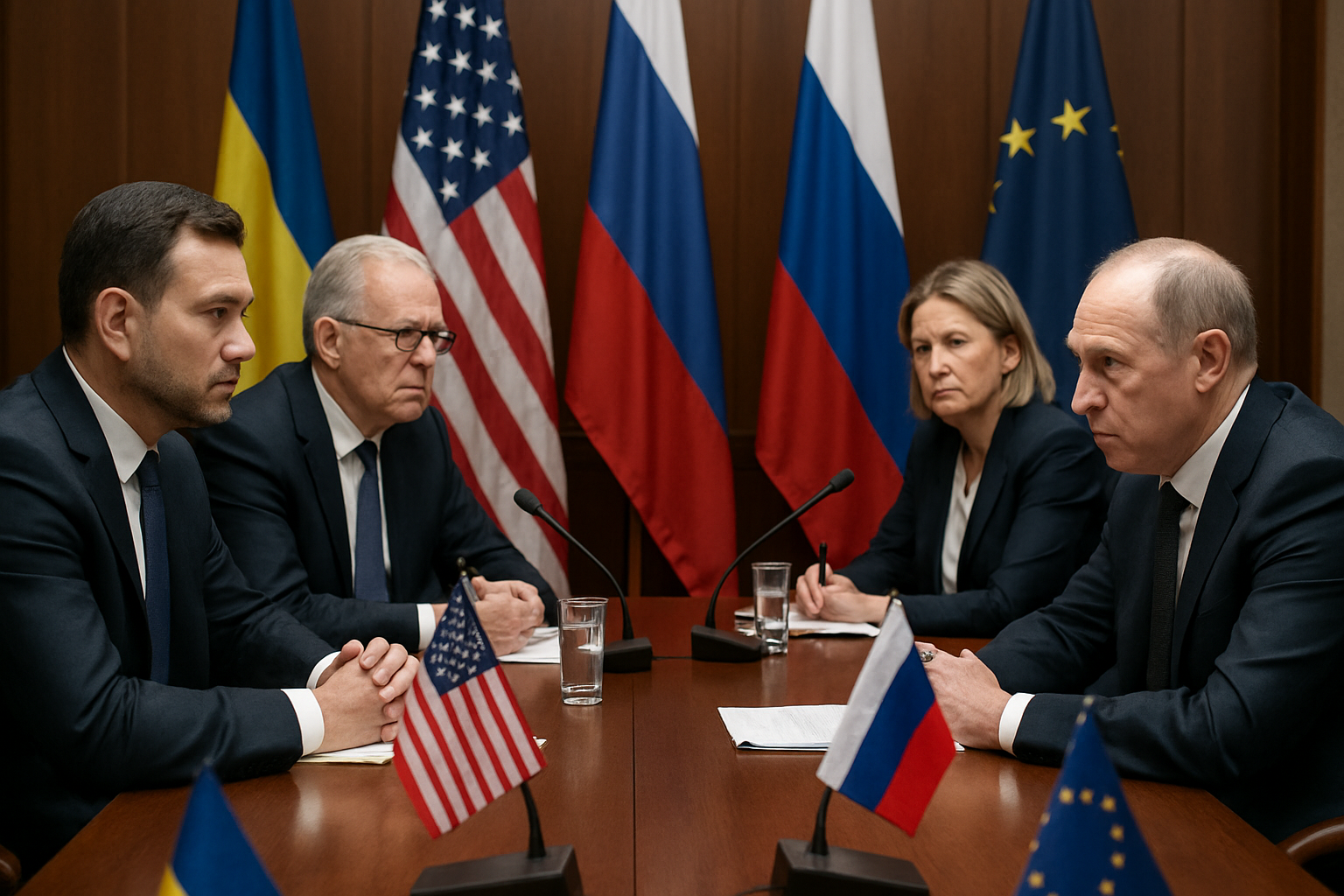
Ukrainian President Volodymyr Zelensky announced the indefinite postponement of trilateral peace negotiations between Ukraine, Russia, and the United States due to the escalating Iran crisis, while simultaneously revealing Ukraine's expansion into Middle Eastern military cooperation and dealing with continued Russian territorial gains and diplomatic tensions with Hungary.
The announcement represents a significant setback to diplomatic momentum that had been building since February's breakthrough agreements, including a historic 314-prisoner exchange and the restoration of US-Russia military communications after a four-year suspension. The postponement comes as Ukraine pivots from aid recipient to security provider in the Middle East, offering military expertise to combat the same Iranian drones that have devastated Ukrainian infrastructure.
Peace Talks Suspended Due to Iran Crisis
President Zelensky confirmed that planned trilateral negotiations were postponed "at proposal of American side" due to the deteriorating Middle East situation. "Due to situation around Iran, there are still no necessary signals for trilateral meeting," Zelensky stated, while emphasizing that talks will resume "as soon as security situation and general political context allow."
The suspension affects what had been characterized as the most significant diplomatic opportunity since the conflict began in February 2022. Previous Geneva talks in February achieved "significant progress" on ceasefire monitoring mechanisms, building on the Abu Dhabi framework that produced concrete humanitarian results including prisoner exchanges and military communications restoration.
"The Americans are proposing parties end war by beginning of summer, will pressure both sides according to timeline."
— President Volodymyr Zelensky, on previous peace negotiations
The Trump administration had established a June 2026 deadline with a potential Washington venue for presidential-level engagement, representing a deliberate escalation from Abu Dhabi to Geneva to Washington. However, the Iranian crisis has created uncertainty around this timeline as American diplomatic resources are redirected to the Middle East.
Ukraine Expands Military Cooperation to Middle East
In a strategic pivot that demonstrates Ukraine's evolution from aid recipient to security provider, President Zelensky announced that Ukrainian military experts will be deployed to Middle Eastern nations including the UAE, Qatar, Jordan, Bahrain, and Kuwait. The mission focuses on combating Iranian "Shahed" drone attacks—the same weapons systems that have systematically targeted Ukrainian civilian infrastructure throughout the conflict.
This development represents a significant strategic realignment, with Ukraine leveraging its hard-earned battlefield experience against Iranian weaponry to build new strategic partnerships. The cooperation addresses a shared threat, as Iranian drones that have left over 1,170 Kyiv buildings without heating during sub-zero temperatures are now being used against Ukraine's potential Middle Eastern partners.
Ukrainian officials have also announced securing 150 Swedish Gripen fighter jets and 100 French Rafale jets, significantly strengthening air defense capabilities. These acquisitions come as Ukraine has become the largest drone production sector domestically, with 450 companies engaged in production and 10 European export centers operational by 2026.
Continued Military Escalation Despite Diplomatic Efforts
Despite the diplomatic breakthrough momentum, Russian territorial gains have accelerated dramatically, with forces capturing 481 square kilometers in January 2026 compared to 260 square kilometers in December 2025—an 85% increase representing the fastest territorial expansion in months. Over 10,000 Russian drones and bombs have been launched since January 2026 alone.
The systematic "energy terrorism" strategy continues to devastate Ukrainian civilian infrastructure. Russian attacks have forced Ukrainian nuclear plants to halt electricity production for the first time in the conflict, while over 1,170 Kyiv buildings remain without heating during life-threatening winter conditions. President Zelensky has disclosed that 55,000 Ukrainian soldiers have been officially confirmed killed, with a "large number" still missing in action. International estimates suggest actual casualties could be 2-3 times higher.

Recent attacks have demonstrated the continued targeting of civilian populations, with incidents in Kharkiv killing five people and injuring civilians in Dnipropetrovsk. The pattern of systematic civilian infrastructure targeting violates Geneva Conventions protections and represents calculated humanitarian pressure during extreme winter conditions.
Historic International Support Amid European Divisions
International support for Ukraine has reached unprecedented levels, with the European Union approving a historic €90 billion loan package—the largest single-nation assistance package in EU history. However, this support reveals significant European divisions, as Slovakia, Czech Republic, and Hungary have refused participation in the financing mechanism.
The divisions have deepened over the Druzhba oil pipeline crisis, with Hungarian Prime Minister Viktor Orbán threatening to veto both the EU loan package and the 20th sanctions package against Russia. Lithuania's Foreign Minister warned that "the EU cannot become Budapest's hostage," as the crisis accelerates discussions about enhanced cooperation mechanisms to bypass unanimity requirements.
Additional international support includes Sweden-Denmark's €246 million air defense package featuring Tridon systems, Germany's provision of 35 Patriot missiles, and ongoing World Bank energy restoration funding. Over 17.8 million Ukrainians are currently accessing winter support programs, demonstrating the massive humanitarian response required.
Nuclear Governance Crisis Adds Urgency
The diplomatic suspension occurs against the backdrop of an unprecedented nuclear governance crisis. The New START treaty between the United States and Russia expired on February 5, 2026, marking the first time in over 50 years without bilateral nuclear constraints between the superpowers. Both nations control approximately 80% of global nuclear weapons—Russia possessing 4,380 warheads and the US holding 3,708.
UN Secretary-General António Guterres has characterized this as a "grave turning point," warning that nuclear risks are at their "highest in decades." The restoration of US-Russia military communications through the Abu Dhabi framework represents the only remaining formal diplomatic channel between the nuclear superpowers, making the suspension of peace talks particularly concerning from a strategic stability perspective.
"Due to situation around Iran, there are still no necessary signals for trilateral meeting, but talks will resume as soon as security situation and general political context allow."
— President Volodymyr Zelensky, March 2026
Territorial Disputes Remain Fundamental Sticking Point
The core territorial disagreements that have prevented breakthrough progress remain unchanged. Eastern Ukrainian territories under Russian control continue to represent the fundamental obstacle to any comprehensive peace agreement. Russia demands territorial recognition and insists that any Putin-Zelensky talks must occur in Moscow, while Ukraine maintains its territorial integrity position and seeks long-term security guarantees.
President Zelensky has categorically rejected territorial concessions, stating that the Ukrainian people would reject any referendum "handing over territories" as a "failure story." The acceleration of Russian territorial gains potentially strengthens Moscow's bargaining position, while historic international support maintains Ukrainian leverage in future negotiations.
European Security Architecture at Crossroads
The postponement of peace talks occurs as European security architecture faces its most significant test since the Cold War. The Munich Security Conference theme of "Era of Disruptive Politics" reflects the most sobering 62-year assessment, with German Chancellor Friedrich Merz declaring that the "post-war order no longer exists."
European strategic autonomy discussions have reached unprecedented levels, with France exploring nuclear deterrent expansion beyond national scope for the first time since the Cold War ended. The Hungarian pipeline crisis and sanctions veto threats expose the deepest EU divisions since the conflict began, testing democratic solidarity against authoritarian pressure.
Strategic Stakes and Global Implications
The suspension of what had been characterized as the most significant diplomatic opportunity since the invasion began carries profound implications for international conflict resolution mechanisms. Success in eventual resumed talks could provide a 21st-century template for territorial dispute resolution and end Europe's deadliest war since World War II.
However, failure or prolonged suspension may intensify military operations globally and undermine diplomatic credibility for resolving territorial disputes worldwide. The stakes extend beyond Ukraine-Russia to include European security architecture redefinition, international law enforcement credibility, and territorial sovereignty principles that will shape power competition frameworks for decades.
The Iranian crisis demonstrates how regional conflicts can derail promising diplomatic initiatives, highlighting the interconnected nature of security challenges in an increasingly multipolar world. Ukraine's pivot to Middle Eastern military cooperation while core territorial sovereignty challenges await resolution illustrates the complex strategic calculations required in modern conflict management.
Framework for Future Negotiations Remains Intact
Despite the postponement, the diplomatic achievements of recent months remain significant. The UAE methodology that produced concrete humanitarian results—including prisoner exchanges, communications restoration, and structured negotiation formats—provides a proven framework that can be reactivated when conditions permit.
The Pentagon-Moscow deconfliction protocols established through the Abu Dhabi talks cover global operations including Syria, Arctic, and Africa, representing the most substantial US-Russia military agreement since the conflict began. This communications channel remains the only formal diplomatic mechanism between the superpowers amid the nuclear governance vacuum.
The evolution from Abu Dhabi technical talks to Geneva political negotiations with European observers had suggested a path toward eventual Washington presidential-level engagement. While Iranian crisis priorities have interrupted this progression, the framework demonstrates that sustained diplomatic innovation can produce concrete results even amid military escalation.
Looking Ahead: Uncertainty and Opportunity
The international community now faces the challenge of managing multiple simultaneous crises while preserving momentum for Europe's most significant security challenge since the Cold War. The postponement allows continued Russian territorial gains, potentially altering the strategic balance when talks eventually resume.
However, Ukraine's expanding role as a security provider in the Middle East may create new leverage and partnerships that strengthen its position in future negotiations. The Iranian crisis that suspended talks also presents opportunities for Ukraine to demonstrate its strategic value beyond Europe, potentially enhancing its international standing.
As diplomatic efforts await more favorable conditions, the fundamental question remains whether territorial compromise innovation can bridge positions that remain far apart, or whether continued military escalation will determine the conflict's trajectory. The template being developed through these negotiations affects not only European security but global conflict prevention mechanisms for 21st-century challenges.