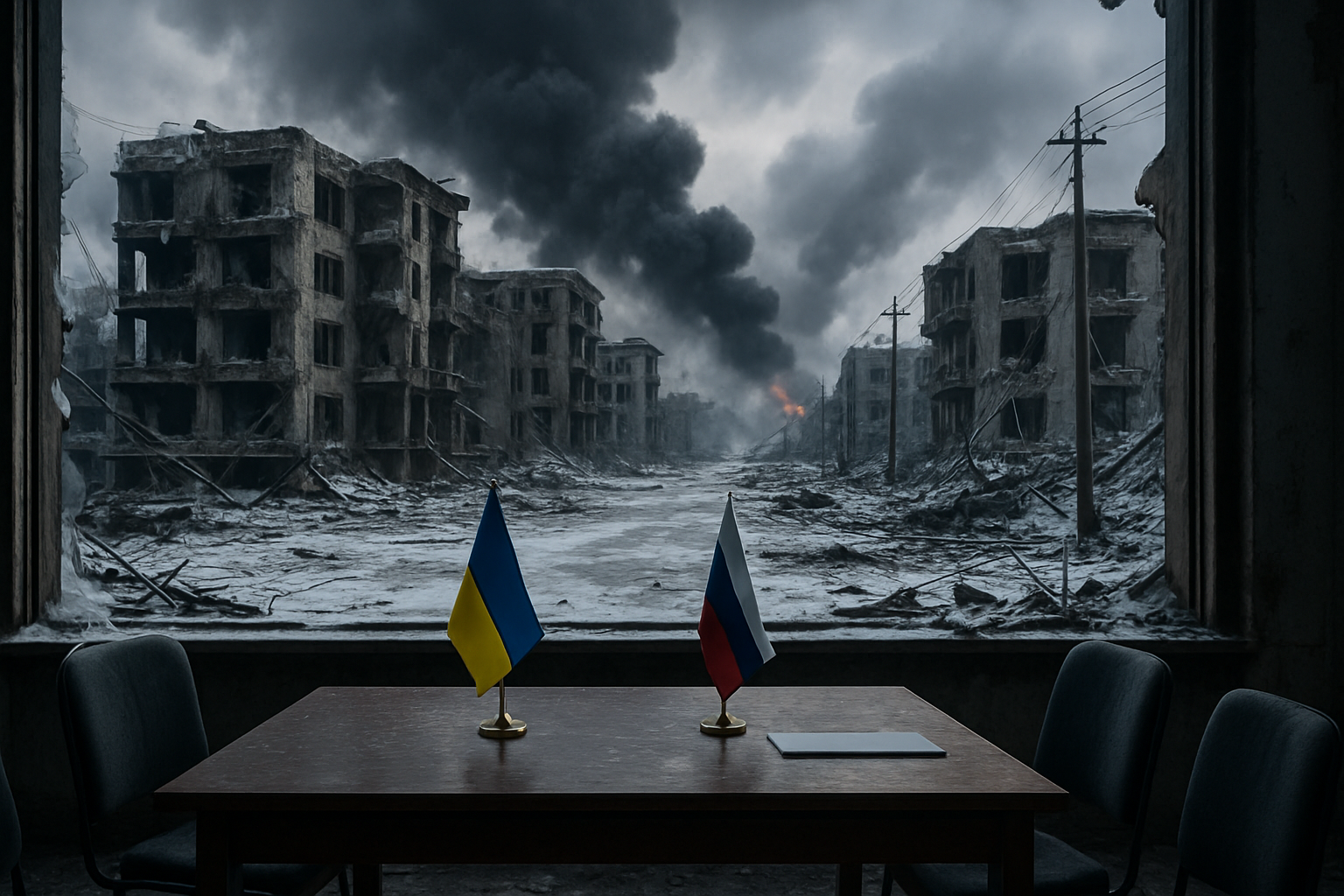
As the Ukraine-Russia conflict approaches its fourth anniversary on February 24, Ukrainian President Volodymyr Zelensky has declared that World War III has already begun, while Russia launched one of its largest coordinated attacks of 2026 targeting critical infrastructure across multiple regions.
Speaking to BBC in a stark interview, Zelensky warned that Russian President Vladimir Putin "has already started" the third world war, emphasizing that the conflict's implications extend far beyond Ukraine's borders. "I mean that Putin has already started it," Zelensky stated, calling for increased military support from allies to bring the war to an end.
Massive Russian Assault Precedes Anniversary
Russia launched approximately 300 drones and 50 missiles in a coordinated overnight assault on Sunday, February 22, targeting energy infrastructure across Ukraine just two days before the fourth anniversary of the full-scale invasion. Ukrainian air defenses successfully intercepted 33 missiles and 274 drones by 10:00 AM, but significant damage was recorded across multiple regions.
The attack left 16,000 consumers in Mykolaiv without power after Shahed-type drones damaged energy infrastructure. In Kyiv Oblast, rescue operations in Putrivka village saved eight people, including a child, from rubble, though one person died during transport and five were hospitalized.
"Moscow continues to invest in strikes more than in diplomacy."
— President Volodymyr Zelensky
Systematic Energy Terrorism Campaign
The latest attacks continue Russia's systematic "energy terrorism" campaign, which has left over 1,170 Kyiv buildings without heating during temperatures as low as minus-30°C. Ukrainian nuclear plants were previously forced to halt electricity production for the first time in the conflict following Russian attacks on electrical distribution networks.
According to President Zelensky, Russia launched approximately 50 missiles and 300 drones overnight, with the main target being Ukraine's energy sector. "Ordinary residential buildings were also damaged, and there is damage to the railway," Zelensky reported via social media.
Diplomatic Breakthrough Amid Military Escalation
Despite the ongoing attacks, significant diplomatic progress has been made through Geneva peace talks held February 17-18, which achieved "significant progress" on ceasefire monitoring mechanisms according to US Special Envoy Steve Witkoff. The talks built on unprecedented momentum from Abu Dhabi negotiations that secured a historic 314-prisoner exchange and restored US-Russia military communications after a four-year suspension.
The diplomatic efforts represent the most significant opportunity for peace since the conflict began, with European "Big 5" observers (Germany, France, Italy, UK, and Poland) participating for the first time in the trilateral format alongside Ukrainian Defense Minister Rustem Umerov and Russian delegation head Vladimir Medinsky.
Nuclear Crisis Adds Urgency
The diplomatic push comes amid an unprecedented nuclear governance crisis. The New START treaty between the US and Russia expired on February 5, 2026, marking the first time in over 50 years without nuclear constraints between the superpowers who control 80% of the world's nuclear weapons.
UN Secretary-General António Guterres has called this a "grave turning point," warning that nuclear risks are at their "highest in decades." The restoration of military communications between the Pentagon and Russian General Staff represents the only remaining major diplomatic channel between the nuclear superpowers.
Staggering Human Cost
President Zelensky recently disclosed that 55,000 Ukrainian soldiers have been officially killed since the February 2022 invasion, with a "large number" still missing in action. International estimates suggest actual casualties could be 2-3 times higher when including undocumented deaths and missing personnel.
The systematic targeting of civilians continues to violate international humanitarian law. A drone strike in Bohodukhiv killed four civilians, including three children (two one-year-olds and one two-year-old) plus their father, marking the second deadly attack on the same town within three days.
International Support Reaches Historic Levels
The international community has responded with unprecedented support for Ukraine. The European Union approved a €90 billion loan package, the largest single-nation assistance package in EU history, though Slovakia, Czech Republic, and Hungary refused to participate. Additional support includes:
- Sweden-Denmark: €246 million air defense package with Tridon Mk2 systems
- Germany: 35 Patriot missiles
- World Bank: $40 million for energy restoration
- Over 17.8 million Ukrainians accessing winter support programs
Territorial Disputes Remain Unchanged
Despite humanitarian breakthroughs in prisoner exchanges and communications restoration, the fundamental territorial disputes remain unresolved. Russian forces have accelerated territorial gains, capturing 481 square kilometers in January 2026 compared to 260 square kilometers in December 2025.
Eastern Ukrainian territories under Russian control remain the core disagreement, with Russia demanding territorial recognition while Ukraine maintains its territorial integrity position. President Zelensky has categorically rejected any territorial concessions, stating that the Ukrainian people would view "handing over territories" as a "failure story."
June 2026 Peace Deadline
The Trump administration has established a June 2026 deadline for comprehensive peace negotiations, with Washington potentially serving as the venue for presidential-level engagement. The evolution from Abu Dhabi to Geneva to Washington suggests a deliberate diplomatic escalation strategy.
However, the fundamental positions remain far apart. Russia demands territorial recognition and insists that Putin-Zelensky talks must occur only in Moscow, while Ukraine seeks 20-30 year security guarantees and maintains its territorial integrity stance.
Global Implications
The stakes extend far beyond Europe, affecting conflict prevention mechanisms, international law enforcement, and territorial sovereignty principles that will shape 21st-century power competition. Success could end Europe's deadliest war since World War II and provide a template for modern conflict resolution. Failure may intensify military operations globally and undermine diplomatic credibility for territorial disputes worldwide.
As the conflict approaches its fourth anniversary, the international community faces a critical test of whether diplomatic innovation can overcome military escalation in what has become a defining moment for European security architecture and global stability.