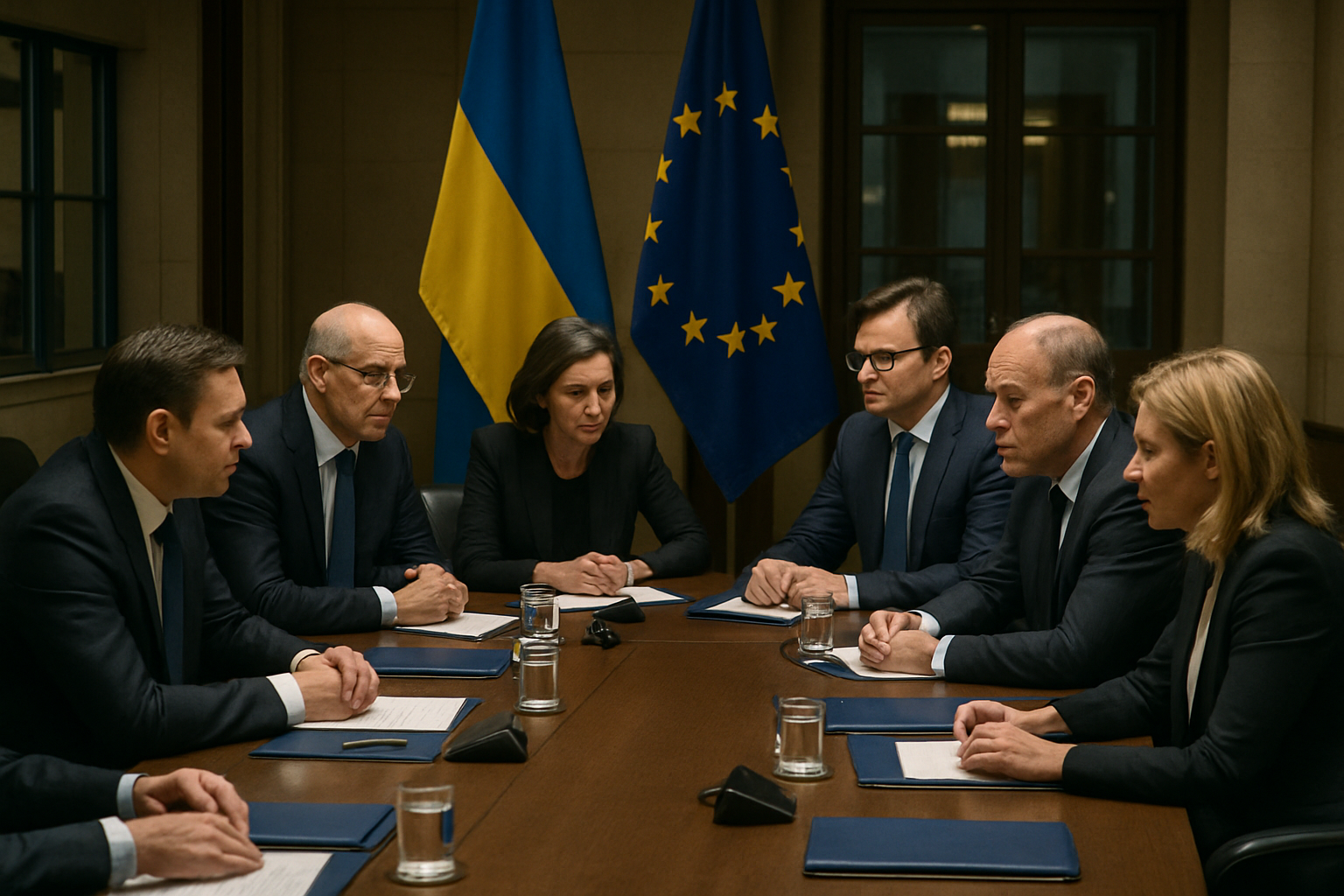
As Ukraine prepares to mark four years since Russia's full-scale invasion on February 24, 2022, the European Union faces a diplomatic crisis that threatens to undermine its unified response to Moscow's aggression. Hungary has blocked the EU's ambitious 20th sanctions package against Russia, creating divisions within the bloc just as diplomatic efforts to end the conflict are gaining momentum.
The sanctions package, which would be the most comprehensive to date, includes a complete ban on maritime services for Russian crude oil exports, targeting insurance, maintenance, port access, and technical support. The package would also blacklist an additional 43 vessels from Russia's so-called "shadow fleet" - sophisticated tankers using false documentation to circumvent existing restrictions.
Hungary's Energy Ultimatum
Hungarian Prime Minister Viktor Orbán announced a decisive blockade over the weekend, declaring that Budapest would maintain its veto on the sanctions package until Ukraine restores Russian oil transit through the Soviet-era Druzhba pipeline. The pipeline has been offline since late January, with Ukraine claiming it was damaged by Russian drone attacks requiring repairs, while Hungary and Slovakia maintain that Kyiv is deliberately manipulating the supply as "political blackmail."
Hungarian Foreign Minister Péter Szijjártó escalated the dispute by also threatening to block a separate €90 billion EU loan package for Ukraine - the largest single-nation assistance package in EU history. "Once oil shipments resume, normal relations will be restored," Orbán declared, establishing a clear quid pro quo that has sent shockwaves through European capitals.
"We continuerons d'augmenter la pression sur la Russie" (We will continue to increase the pressure on Russia)
— Emmanuel Macron, French President
Slovak Support for Hungary's Position
Slovakia has joined Hungary in the energy dispute, with Prime Minister Robert Fico issuing his own ultimatum threatening to cut emergency electricity supplies to Ukraine unless oil transit resumes. Slovakia declared an oil emergency and released 250,000 tons from strategic reserves - representing one month of operational capacity for the Slovnaft refinery. The country has also suspended diesel exports to Ukraine, prioritizing domestic supply during the crisis.
The dispute affects Hungary and Slovakia as the only two EU member states still dependent on Russian oil imports under special exemptions to sanctions. Both countries have maintained their pro-Moscow positions despite the ongoing conflict, complicating European unity efforts.
Diplomatic Progress Amid Military Escalation
The sanctions standoff comes at a critical moment as diplomatic efforts to end the four-year conflict are showing unprecedented progress. Recent trilateral talks in Geneva between Ukraine, Russia, and the United States achieved significant breakthroughs, including the restoration of US-Russia military communications after a four-year suspension and a historic prisoner exchange of 314 individuals - the first such swap in five months.
President Volodymyr Zelensky has warned that Russian leader Vladimir Putin has "already started" World War Three, telling the BBC that "the question is how much territory he (Putin) will be able to seize and how to stop him." Ukrainian officials disclosed that 55,000 soldiers have been officially killed in the conflict, with a "large number" still missing.

Winter Warfare and Humanitarian Crisis
Russia's systematic targeting of Ukrainian energy infrastructure continues to create a humanitarian crisis during the harsh winter. More than 1,170 buildings in Kyiv remain without heating during temperatures reaching minus-30°C. Ukrainian nuclear plants have been forced to halt electricity production for the first time during the conflict following attacks on electrical distribution networks.
The International Atomic Energy Agency (IAEA) Director Rafael Grossi confirmed the unprecedented nature of the nuclear plant shutdowns, while Ukrainian officials warn that such attacks put "all of Europe at risk of nuclear incident." Over 17.8 million Ukrainians are currently accessing winter support programs as the country struggles to maintain basic services.
EU Unity Under Strain
The Hungarian and Slovak blockade exposes deep fractures within the EU's response to the conflict. While the European Parliament approved the €90 billion Ukraine loan package with an overwhelming vote of 458 in favor, 140 against, and 44 abstentions, the requirement for unanimity on sanctions gives individual member states effective veto power over collective action.
German Foreign Minister Johann Wadephul has criticized Hungary's position, while French President Emmanuel Macron called on the EU to "advance" in adopting the sanctions package despite Hungarian objections. The crisis demonstrates the ongoing challenge of maintaining European solidarity when national energy interests conflict with collective security commitments.
Nuclear Governance Vacuum
The sanctions crisis unfolds against the backdrop of an unprecedented nuclear governance crisis. The New START treaty between the United States and Russia expired on February 5, 2026, marking the first time in over 50 years that the two nuclear superpowers operate without bilateral constraints on their arsenals. Together, Russia and the US control approximately 80% of the world's nuclear weapons.
UN Secretary-General António Guterres has described the situation as a "grave turning point," warning that nuclear risks are at their "highest in decades." The restoration of US-Russia military communications through the Geneva talks represents the only remaining major diplomatic channel between the superpowers.
Looking Toward June 2026
Despite the current impasse, diplomatic momentum continues to build toward a comprehensive peace agreement. The Trump administration has established a June 2026 deadline for ending the conflict, with talks potentially moving to Washington for the highest level of engagement. The evolution from Abu Dhabi to Geneva to Washington suggests a deliberate diplomatic escalation designed to create unprecedented pressure for territorial compromise.
However, fundamental disagreements persist over eastern Ukrainian territories currently under Russian control. Russia demands territorial recognition and insists that any Putin-Zelensky meeting must occur in Moscow, while Ukraine maintains its territorial integrity position and seeks long-term security guarantees from Western allies.
Fourth Anniversary Reflections
As Ukraine prepares to mark the fourth anniversary of Russia's full-scale invasion on February 24, the conflict has become Europe's deadliest war since World War II. Russian territorial gains have accelerated in recent months, with Moscow capturing 481 square kilometers in January 2026 compared to 260 square kilometers in December 2025 - an 85% increase representing the fastest pace of territorial acquisition in months.
The systematic targeting of civilian infrastructure continues to violate Geneva Convention protections for non-combatants. Recent attacks in Bohodukhiv killed four civilians, including three children aged one and two years old, along with their 34-year-old father - marking the second deadly attack on the same town within three days.
Strategic Stakes and Global Implications
The resolution of the current EU sanctions crisis will have implications far beyond European borders. Success in maintaining unified pressure on Russia while addressing legitimate energy security concerns could provide a template for managing similar challenges in other international crises. Failure could signal sanctions fatigue and Western response fragmentation, potentially emboldening authoritarian challenges to the international order.
The stakes extend to fundamental questions about European integration, the balance between national sovereignty and collective action, and the credibility of multilateral institutions in addressing 21st-century security challenges. As European leaders gather to address the crisis, the coming days will test whether diplomatic innovation can bridge fundamental divisions or whether the conflict will continue to fracture Western unity.
"Russia wants to impose on the world a different way of life and change the lives people have chosen for themselves."
— Volodymyr Zelensky, Ukrainian President
The fourth anniversary of the Ukraine war arrives at a moment of both unprecedented diplomatic opportunity and deepening European divisions. Whether the EU can overcome internal disagreements to maintain pressure on Russia while supporting Ukraine's defense will determine not only the trajectory of this conflict but the future of European security architecture for decades to come.