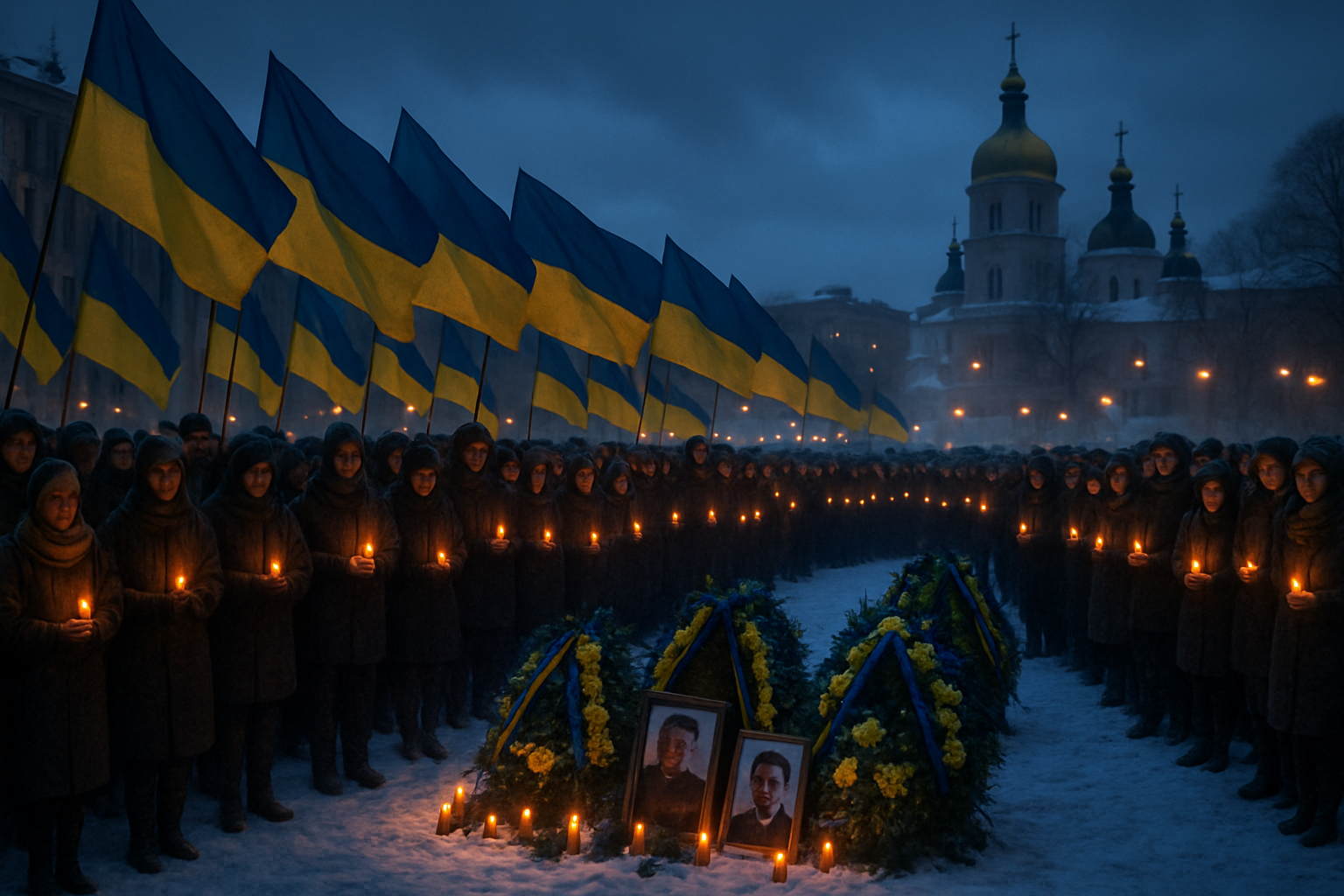
Ukraine marked the fourth anniversary of Russia's full-scale invasion on February 24, 2026, with President Volodymyr Zelensky warning that World War III has already begun while global allies pledge historic levels of support to the war-torn nation.
The somber milestone came as Ukraine continues to face devastating attacks from Moscow, with Russian forces launching one of 2026's largest coordinated assaults just days before the anniversary. Using approximately 300 drones and 50 missiles, Russia targeted Ukrainian energy infrastructure, leaving 16,000 consumers in Mykolaiv without power and causing civilian casualties in Kyiv Oblast.
President Zelensky, speaking from the Presidential Palace in Kyiv, delivered a stark assessment of the global situation in a BBC interview, declaring that Russian President Vladimir Putin "has already started" World War III. His warning came as commemoration events took place worldwide, from Sydney's St. Mary's Cathedral Square to vigils across European capitals.
Staggering Human Cost After Four Years
The war's toll has been devastating. Zelensky officially disclosed that 55,000 Ukrainian soldiers have been killed since the invasion began, with a "large number" still missing in action. International estimates suggest actual military casualties could be 2-3 times higher when including undocumented deaths and missing personnel.
Civilian casualties continue to mount, with recent attacks highlighting Russia's systematic targeting of non-combatants. A particularly tragic strike on Bohodukhiv killed four civilians, including three children aged two years old and two one-year-old boys, along with their 34-year-old father. This marked the second deadly attack on the same town within three days.
"Ukraine will not betray the sacrifices made by its people in four years of war just to make peace with Russia."
— President Volodymyr Zelensky
The systematic nature of Russian attacks extends beyond military targets. Over 1,170 buildings in Kyiv remain without heating during sub-zero temperatures, part of what Ukrainian officials describe as an "energy terrorism" strategy that violates the Geneva Conventions.
Historic International Support
Despite the ongoing devastation, Ukraine has received unprecedented international backing. The European Union approved a historic €90 billion loan package—the largest single-nation assistance program in EU history—though Slovakia, Czech Republic, and Hungary refused to participate, exposing divisions within the bloc.
Canada's Prime Minister Mark Carney announced an additional $2 billion in aid during anniversary commemorations, while Estonia pledged €11 million specifically for Ukrainian air defense systems and ammunition. Sweden and Denmark jointly committed €246 million for advanced Tridon air defense systems, and Germany provided 35 Patriot missiles to bolster Ukraine's defensive capabilities.
The scale of humanitarian support has been equally impressive, with over 17.8 million Ukrainians accessing winter support programs amid Russia's deliberate targeting of civilian infrastructure during extreme cold conditions.
Nuclear Crisis and Diplomatic Breakthrough
The anniversary occurred against an unprecedented backdrop of nuclear uncertainty. The New START treaty between the United States and Russia expired on February 5, 2026—marking the first time in over 50 years without nuclear arms control constraints between the superpowers. Both nations control 80% of the world's nuclear weapons, prompting UN Secretary-General António Guterres to describe the situation as a "grave turning point" with nuclear risks at their "highest in decades."
However, diplomatic efforts have shown surprising progress. Trilateral peace talks in Abu Dhabi achieved a breakthrough with a 314-prisoner exchange—the first in five months—and restored US-Russia military communications after a four-year suspension. The Pentagon confirmed the establishment of deconfliction protocols covering global operations from Syria to the Arctic.
Ukrainian Defense Minister Rustem Umerov described the talks as "substantial and productive," though fundamental disagreements over territorial control in eastern Ukraine remain unresolved. Russia continues to demand recognition of its territorial gains, while Ukraine maintains its position on territorial integrity backed by long-term security guarantees.
European Unity Faces Test
The anniversary highlighted growing tensions within the European response. Hungarian Prime Minister Viktor Orbán threatened to veto the EU's 20th sanctions package against Russia over disputes regarding the Druzhba oil pipeline, creating the deepest divisions since the conflict began.
The pipeline crisis exposed vulnerabilities in European energy security, with Slovakia declaring an oil emergency and releasing 250,000 tons of strategic reserves. Hungary and Slovakia remain the only EU countries still dependent on Russian oil under special sanctions exemptions.
European Council President António Costa issued an unprecedented letter demanding Budapest honor previous commitments, but the crisis threatens to signal weakening European resolve to Moscow at a critical diplomatic moment.
Global Commemorations and Continued Resistance
Around the world, Ukrainian communities and supporters held vigils and commemorative events. In Greece, Ukrainians and Greek citizens demonstrated in central Athens demanding an immediate end to the war. In Ireland, surveys revealed that uncertainty about the future and language barriers remain primary concerns for the 84,000 Ukrainians currently living there.
Pope Leo XIV responded to desperate pleas from Ukrainian bishops by sending medical supplies and electric heaters as Ukraine endures its fourth brutal winter of war. The Vatican emphasized the particular toll on children, with UNICEF warning that the conflict has disrupted young lives at critical developmental stages.
Bulgarian Prime Minister Andrey Guyrov captured the broader significance of Ukraine's struggle, stating that Ukraine fights "not only for its own freedom" but "for the freedom of Europe, of Bulgaria, and for a world where the rule of law is stronger than the right of force."
Military Situation and Future Prospects
Russian territorial gains have accelerated dramatically, with forces capturing 481 square kilometers in January 2026 compared to 260 square kilometers in December 2025—an 85% increase representing the fastest advancement in months. Over 10,000 Russian drones and bombs were launched in January alone.
The Trump administration has established a June 2026 deadline for comprehensive peace negotiations, with talks potentially moving to Washington for presidential-level engagement. This evolution from Abu Dhabi to Geneva to Washington suggests a deliberate diplomatic escalation aimed at breakthrough solutions.
However, President Zelensky has made clear that Ukraine will not compromise on core principles. He categorically rejected territorial concessions in the Donbas region, stating that the Ukrainian people would reject any referendum "handing over territories" as a "failure story."
A Defining Moment for International Order
As Ukraine enters its fifth year of full-scale conflict, the stakes extend far beyond the immediate battlefield. The war has become a test of international law enforcement, territorial sovereignty principles, and democratic resilience against authoritarian pressure.
Success in achieving a just peace could provide a template for 21st-century conflict resolution and reinforce the post-World War II international order. Failure, however, could embolden further aggression globally and undermine diplomatic solutions to territorial disputes worldwide.
Lithuanian President Gitanas Nausėda, while acknowledging that Ukraine's goal of EU membership by 2027 is "not realistic theoretically," emphasized that membership remains crucial as motivation for the war-suffering nation. The European integration process continues alongside military support, representing a long-term commitment to Ukraine's future.
As commemorative candles flickered in memorial services from Kyiv to Riga, from Bucharest to Dublin, they illuminated not just the tremendous sacrifices already made, but the resolve to continue supporting Ukraine's fight for freedom and territorial integrity in what has become Europe's deadliest conflict since World War II.