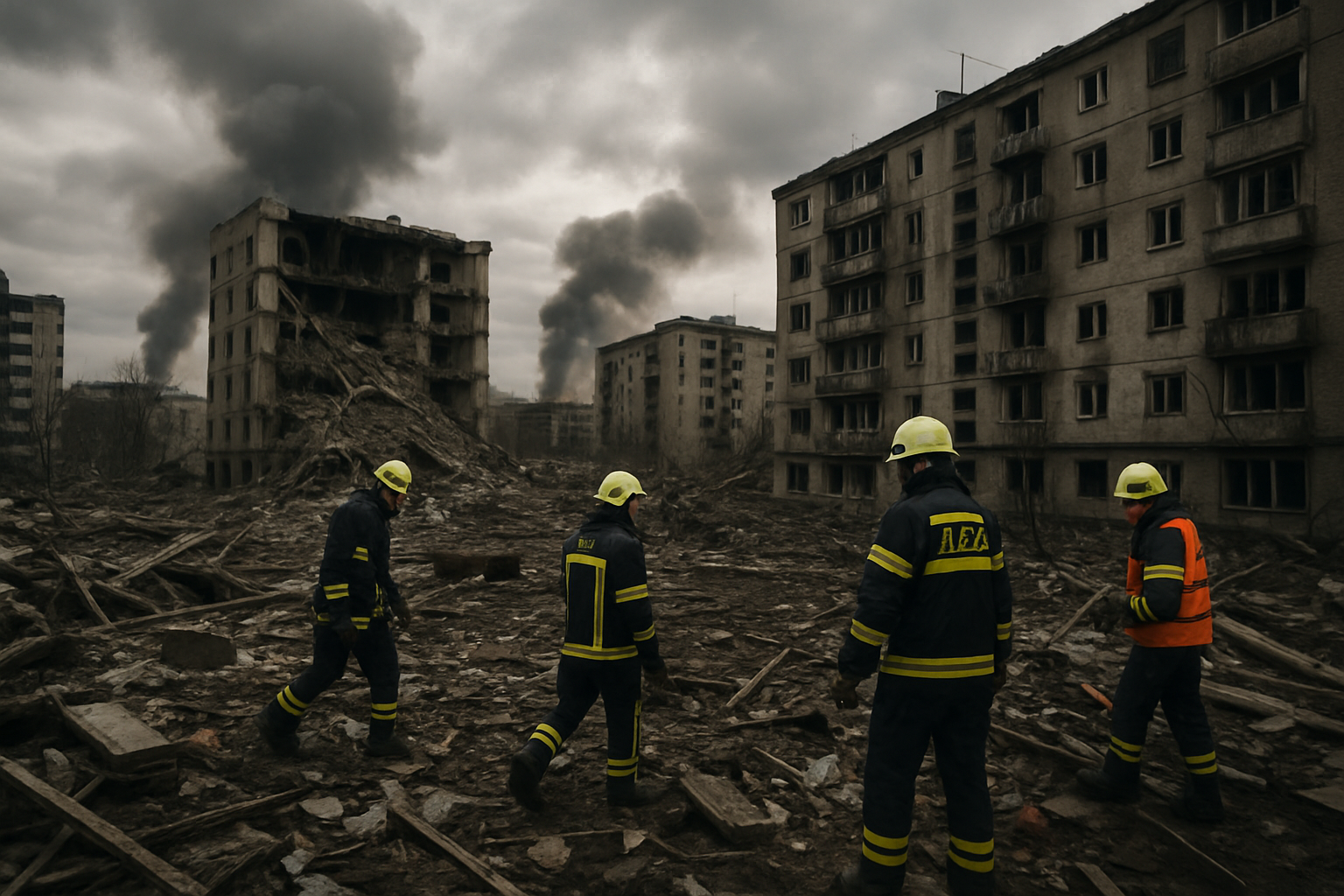
A Russian drone strike on a civilian enterprise in Ukraine's northeastern city of Kharkiv killed two people and wounded seven others on Wednesday morning, as diplomatic efforts to end the nearly three-year conflict remain stalled indefinitely due to the escalating Iran crisis.
The attack on Kharkiv, Ukraine's second-largest city, represents the latest in a systematic pattern of strikes targeting civilian infrastructure that has intensified as the war enters its fifth year. Ukrainian officials reported the drone hit what authorities described as a "civilian enterprise," with rescue operations ongoing at the site.
Diplomatic Momentum Derailed
The latest casualties come as President Volodymyr Zelensky announced that crucial trilateral peace negotiations between Ukraine, Russia, and the United States have been postponed indefinitely due to the Middle East Iran situation. The talks, which had been scheduled to continue the momentum from February's historic breakthrough, now face an uncertain timeline.
"Due to the situation around Iran, there are still no necessary signals for trilateral meeting," Zelensky stated, adding that talks will resume "as soon as the security situation and general political context allow."
The postponement threatens to derail unprecedented diplomatic progress achieved through the Abu Dhabi framework, which secured a historic 314-prisoner exchange in February – the first such exchange in five months – and restored US-Russia military communications after a four-year suspension.
UK Military Support Revealed
In a significant escalation of international involvement, the United Kingdom publicly acknowledged for the first time the existence of four operational maintenance, repair, and overhaul (MRO) facilities within Ukraine servicing Western-supplied armored vehicles and artillery systems, with a fifth facility planned.
This marks the first public acknowledgment of such operations on Ukrainian soil, representing a major evolution in international military support beyond traditional arms supplies. The facilities enable rapid repair turnaround for Western equipment without the need to transport materiel out of the country for maintenance.
"This represents a long-term commitment to Ukrainian military modernization that extends far beyond the current conflict,"
— Defense Analysis Expert
Escalating Military Operations
The conflict has seen a dramatic acceleration in Russian territorial gains, with Moscow capturing 481 square kilometers in January 2026 compared to 260 square kilometers in December 2025 – an 85% increase marking the fastest territorial expansion in months.
Over the past week alone, Russia launched nearly 1,750 strike drones, 1,530 guided aerial bombs, and 39 missiles across Ukraine, according to President Zelensky. The systematic targeting of civilian infrastructure continues to violate international humanitarian law, with particular focus on energy systems during harsh winter conditions.
Ukrainian forces have maintained their operational capabilities despite defensive pressures, conducting successful strikes on multiple Russian targets in occupied Crimea, Donetsk, and Zaporizhzhia regions. These operations have targeted air defense systems, landing craft, and command posts.
Humanitarian Crisis Deepens
The human cost of the conflict continues to mount, with Zelensky having previously disclosed that 55,000 Ukrainian soldiers have been officially killed, with a "large number" missing. International estimates suggest actual casualties may be 2-3 times higher.
Civilian casualties remain a daily occurrence, with systematic attacks on infrastructure, emergency services, and residential areas documented across multiple regions. The pattern of targeting emergency responders during rescue operations represents a clear violation of the Geneva Conventions.
Over 17.8 million Ukrainians are currently accessing winter support programs, highlighting the massive scale of the humanitarian challenge as energy infrastructure remains under constant attack.
Nuclear Governance Crisis
The conflict unfolds against the backdrop of an unprecedented nuclear governance crisis. The New START treaty between the US and Russia expired on February 5, 2026, marking the first time in over 50 years that the two nuclear superpowers lack formal constraints on their arsenals.
Both nations control approximately 80% of the world's nuclear weapons, creating what UN Secretary-General António Guterres has described as a "grave turning point" with nuclear risks at their "highest in decades."
Ukraine's Strategic Pivot
Demonstrating remarkable adaptability, Ukraine is expanding its role from aid recipient to security provider, with military experts deploying to Middle Eastern nations including the UAE, Qatar, Jordan, Bahrain, and Kuwait. This cooperation focuses on combating Iranian "Shahed" drone attacks – the same weapons systems that have devastated Ukrainian infrastructure.
This strategic pivot leverages Ukraine's battlefield experience into new partnerships while potentially creating additional leverage in future negotiations.
International Support Continues
Despite the diplomatic setback, international support for Ukraine remains robust. The European Union's historic €90 billion loan package – the largest single-nation assistance package in EU history – continues to provide crucial support, though Hungary, Slovakia, and the Czech Republic have refused participation.
Additional commitments include Sweden and Denmark's €246 million air defense package featuring Tridon systems, Germany's provision of 35 Patriot missiles, and continued World Bank funding for energy restoration efforts.
Territorial Disputes Remain Core Challenge
The fundamental sticking point in peace negotiations remains unchanged: control of eastern Ukrainian territories currently held by Russian forces. Russia continues to demand territorial recognition and insists that any Putin-Zelensky talks must occur in Moscow, while Ukraine maintains its position on territorial integrity and seeks long-term security guarantees.
The acceleration of Russian territorial gains potentially strengthens Moscow's bargaining position for future negotiations, while Ukraine's expanded international partnerships may provide additional leverage.
Regional Conflicts' Global Impact
The postponement of Ukraine peace talks due to the Iran crisis demonstrates how regional conflicts can derail promising diplomatic initiatives in an interconnected world. The international community finds itself managing multiple simultaneous crises while attempting to preserve momentum on Europe's most significant security challenge since the Cold War.
The stakes extend far beyond Ukraine's borders, encompassing European security architecture, international law enforcement, and territorial sovereignty principles that will shape 21st-century power competition for decades to come.
Looking Ahead
While the diplomatic framework established through the Abu Dhabi breakthrough remains intact – including prisoner exchange mechanisms and US-Russia military communications – the timeline for renewed negotiations remains uncertain. The June 2026 deadline previously established by the Trump administration for potential Washington venue talks now faces questions due to Middle East priorities.
The conflict continues to serve as a template for future territorial disputes and conflict resolution approaches, with success or failure having implications that extend far beyond Europe's boundaries. As military operations continue and civilian casualties mount, the international community faces the challenge of maintaining focus on diplomatic solutions while managing multiple global crises simultaneously.
The war's evolution from a regional European conflict to a defining challenge of international law and territorial sovereignty ensures that its resolution – or prolongation – will have lasting consequences for global security architecture and conflict prevention mechanisms in the decades ahead.