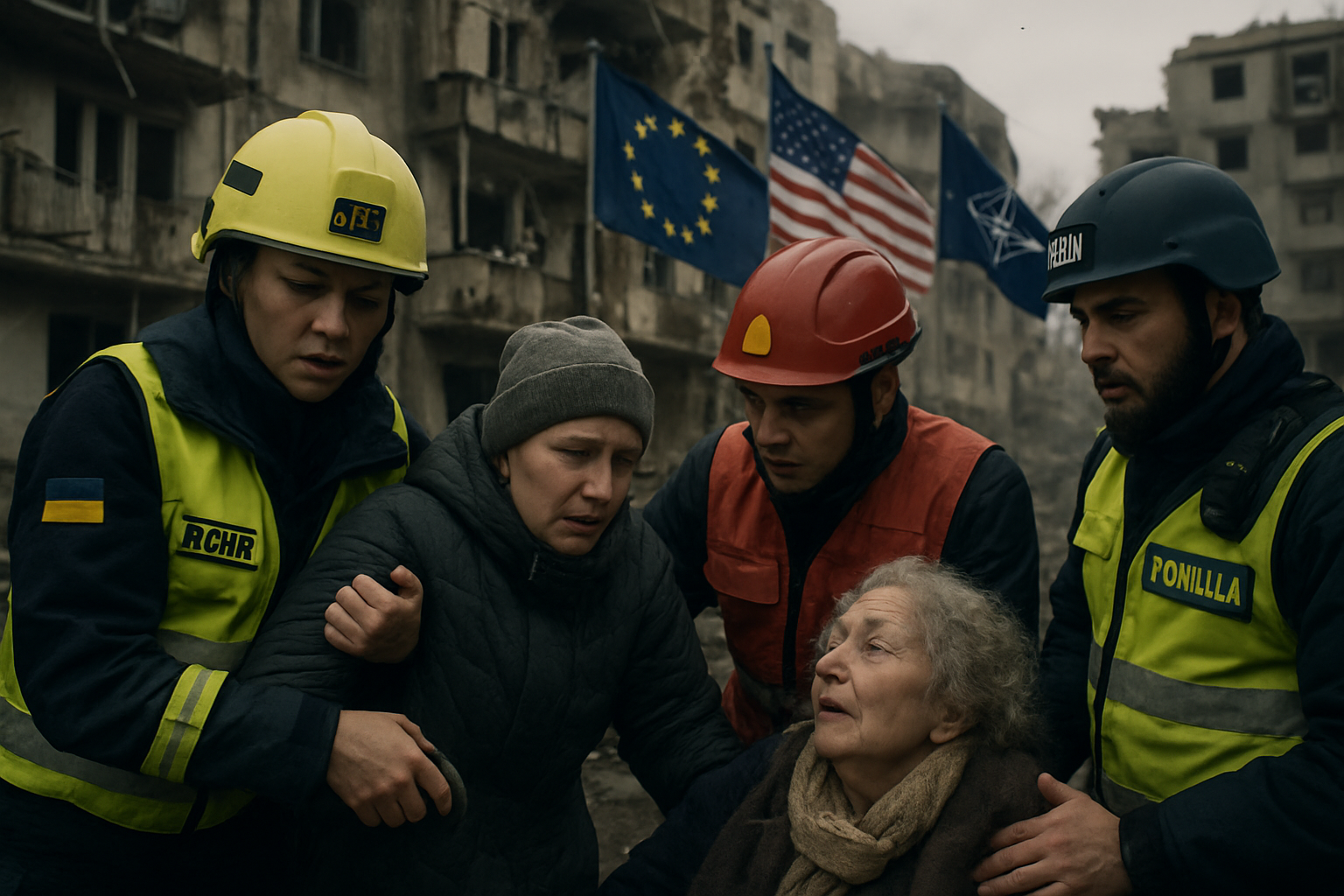
Ukraine-Russia peace negotiations have been indefinitely suspended due to the escalating Iran crisis, President Volodymyr Zelensky confirmed on March 14, as Russian forces launched devastating attacks across Ukrainian territories that killed multiple civilians and wounded dozens more.
The suspension of trilateral talks involving Ukraine, Russia, and the United States represents a major diplomatic setback after February's historic breakthrough that achieved a 314-prisoner exchange and restored military communications between Washington and Moscow after a four-year suspension.
Deadly Russian Strikes Continue Civilian Targeting
Russian forces intensified their attacks across Ukraine on March 14, with strikes reported in multiple regions causing significant civilian casualties. In Zaporizhzhia, Russian airstrikes killed at least one person and wounded 19 others, including several children, according to Ukrainian officials. The casualty toll later rose to 18 wounded, including two teenagers.
In the Kyiv region, a combined Russian missile and drone attack killed at least four people and wounded 15 in what Ukrainian President Zelensky described as targeting of energy infrastructure. The Obukhiv district was particularly hard hit, with schools, kindergartens, and vocational institutions damaged in the assault.
The Sumy region also came under attack, with Russian forces striking civilian infrastructure and injuring three civilians, according to the Sumy Regional Military Administration. Meanwhile, an explosion in Cherkasy on Saturday evening left one person dead, with police investigating the circumstances.
"Due to situation around Iran, there are still no necessary signals for trilateral meeting, but will resume as soon as security situation allows."
— President Volodymyr Zelensky
Peace Talks Indefinitely Postponed
The suspension of peace negotiations marks a significant blow to diplomatic momentum that had been building since February. The trilateral talks between Ukraine, Russia, and the United States had achieved unprecedented progress, including the largest prisoner exchange in five months and the restoration of military communication channels between Washington and Moscow.
The negotiations, which evolved from initial talks in Abu Dhabi to Geneva and were expected to culminate in Washington with potential presidential-level involvement, have now been derailed by the expanding Middle East conflict involving Iran.
The February breakthrough had been seen as the most significant diplomatic opportunity since Russia's invasion began, with experts noting that the restored military communications represented the only remaining formal diplomatic channel between the nuclear superpowers following the expiration of the New START Treaty in February 2026.
Ukraine Pivots to Middle East Security Provider
Despite the diplomatic setback, Ukraine has found opportunity in the crisis by deploying military experts to the United Arab Emirates, Qatar, Jordan, Bahrain, and Kuwait to help combat Iranian "Shahed" drone attacks—the same weapons that have been devastating Ukrainian cities for months.
This strategic pivot represents Ukraine's evolution from aid recipient to security provider, leveraging its battlefield experience against Russian-supplied Iranian drones into strategic partnerships with Middle Eastern nations. Ukrainian officials view this development as potentially creating new negotiating leverage when peace talks eventually resume.
International Support Remains Strong Despite Divisions
International support for Ukraine continues at historic levels, with the European Union's €90 billion loan package representing the largest single-nation assistance ever provided. Germany has delivered 35 Patriot missiles, while Sweden and Denmark have committed €246 million for air defense systems.
However, European unity faces challenges, particularly from Hungary, which continues to threaten vetoes over the Druzhba pipeline dispute. Lithuania's Foreign Minister has warned that "the EU cannot become Budapest's hostage," highlighting the divisions that persist within the European bloc.
The United Kingdom has revealed the existence of four operational maintenance, repair, and overhaul (MRO) facilities in Ukraine servicing Western-supplied equipment, with a fifth facility planned. This disclosure represents the first public acknowledgment of such operations on Ukrainian soil and demonstrates long-term commitment to Ukrainian military capabilities.
Nuclear Governance Crisis Adds Urgency
The suspension of peace talks occurs against the backdrop of an unprecedented nuclear governance crisis. The New START Treaty between the United States and Russia expired on February 5, 2026—the first time in over 50 years without bilateral nuclear constraints between the superpowers.
With both nations controlling approximately 80% of the world's nuclear weapons, UN Secretary-General António Guterres has warned of a "grave turning point" with nuclear risks at their highest in decades. This context adds extraordinary urgency to any future diplomatic efforts.
Systematic Targeting of Civilian Infrastructure
The March 14 attacks continue Russia's documented pattern of systematic civilian targeting that has characterized the conflict. Over the past week alone, Russia launched approximately 1,750 strike drones, 1,530 guided aerial bombs, and 39 missiles against Ukrainian targets, according to President Zelensky.
This "energy terrorism" strategy has left over 1,170 Kyiv buildings without adequate heating and forced Ukrainian nuclear plants to halt electricity production for the first time in the conflict. The systematic targeting of civilian infrastructure during winter conditions represents clear violations of the Geneva Conventions.
International humanitarian organizations have documented the targeting of emergency services personnel, with Russian forces recently attacking Ukrainian postal service (Ukrposhta) branches across four regions in a single day, injuring employees.
Territorial Dynamics Remain Unchanged
The fundamental territorial dispute that has stalled previous negotiations remains unresolved. Eastern Ukrainian territories currently under Russian control represent the core disagreement, with Russia demanding recognition of its territorial gains while Ukraine maintains its position on territorial integrity.
Russian forces accelerated their territorial gains in January 2026, capturing 481 square kilometers compared to 260 square kilometers in December 2025—an 85% increase that potentially strengthens Moscow's bargaining position when talks eventually resume.
Ukrainian officials have categorically rejected any territorial concessions, with Zelensky previously stating that the Ukrainian people would reject any referendum "handing over territories" as a "failure story."
Regional Implications and Future Prospects
The Iranian crisis that has derailed the peace talks demonstrates the interconnected nature of regional conflicts in an increasingly multipolar world. The expansion of Middle Eastern conflicts has directly impacted European diplomatic initiatives, showing how global crises can cascade across regions.
The framework established through the Abu Dhabi talks—including prisoner exchange mechanisms and structured negotiation formats—remains intact and can be reactivated when the security situation permits. UAE methodology has proven effective for achieving concrete humanitarian results even amid ongoing military operations.
Despite the suspension, diplomatic achievements including the restoration of US-Russia military communications through Pentagon deconfliction protocols covering Syria, Arctic, and Africa operations continue to provide a foundation for future engagement.
Looking Ahead: Uncertain Timeline
The timeline for renewed negotiations now depends entirely on the resolution of the Iran situation. The June 2026 deadline previously established by the Trump administration for comprehensive peace talks in Washington remains in question as Middle East priorities take precedence.
Military escalation continues with Russian territorial advances while Ukraine maintains its operational capabilities and expands international partnerships. Over 17.8 million Ukrainians continue to access winter support programs as the humanitarian toll mounts.
The success or failure of eventual resumed talks will carry global implications for territorial dispute resolution in the 21st century. The stakes extend beyond Ukraine to include European security architecture redefinition, international law enforcement credibility, and territorial sovereignty principles that will shape international relations for decades.
As the conflict enters its third year with no immediate diplomatic resolution in sight, the suspension of peace talks represents both a significant setback and a reminder of how global crises increasingly intersect in ways that complicate traditional diplomatic solutions.